In business, especially now, standing out is more than just putting your name out there. Strong brand positioning shapes what your audience thinks when they hear your name, creating lasting market value.
This comprehensive guide explores how to craft effective brand positioning that cuts through market noise. You will learn to identify your unique value proposition, understand your target audience deeply, and build a consistent brand voice. We provide actionable strategies, real-world examples, and expert tips to help you own a distinct place in your customer’s mind.
What Does Brand Positioning Really Mean?
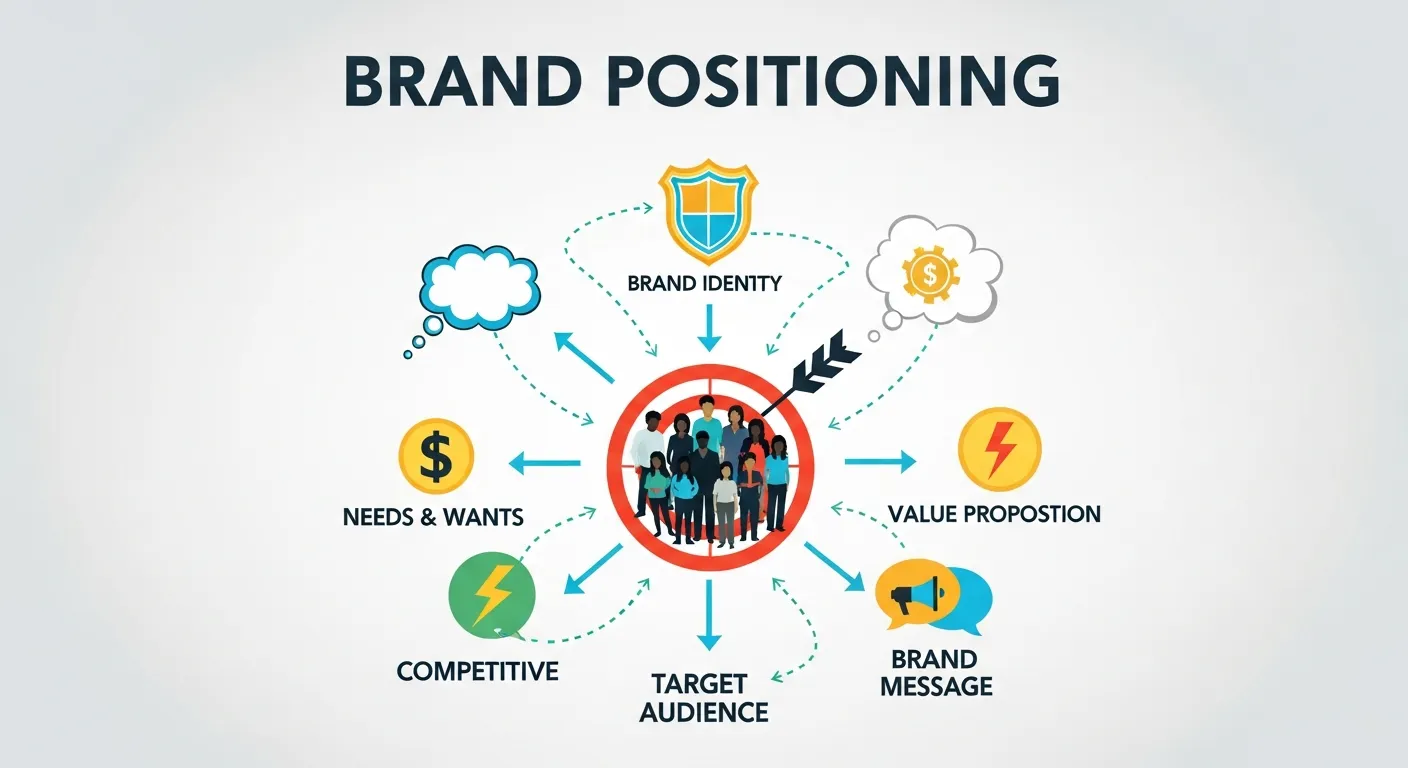
Brand positioning is fundamentally how your audience perceives your brand relative to your competitors. It is not just about what you say in your marketing campaigns; it is about what sticks in the minds of your consumers. It defines the specific niche you occupy in the market landscape.
Ask yourself this critical question: If someone had to describe your brand in one single sentence, what would they say?
If that answer isn’t crystal clear, or if it sounds exactly like your competitors (“high quality,” “great service”), it is time to work on your positioning strategy. Effective positioning should clearly define:
- Who your product or service is specifically for (your target audience).
- What makes it uniquely valuable (your value proposition).
- Why someone should choose you instead of the next available option (your competitive advantage).
It is not always about being objectively “better” in every metric. It is more about being “right” for a specific group of people. For example, a luxury car isn’t “better” than a minivan if your primary goal is hauling a soccer team. Brand positioning ensures you are talking to the luxury buyer, not the soccer coach.
Why It’s So Important (Especially Now)
Buyers are overloaded with choices. Scroll through your phone, and you will see a dozen ads in minutes. Everyone is promising quality, service, and low prices—but none of that means anything if it doesn’t connect emotionally or logically with a specific need.
That is where brand positioning helps.
When your message is clear, your audience doesn’t have to work hard to understand you. They get it immediately. They either feel it fits them—or it doesn’t. And that polarity is a good thing. Trying to appeal to everyone usually results in appealing to no one.
Strong positioning makes it easier for people to choose you. And not just once—but again and again. It creates brand loyalty and brand equity, which are crucial for long-term business growth.
It Starts with Knowing Who You’re Talking To
Before you come up with fancy words or expensive campaigns, you need to understand your audience. That means really listening. What are they struggling with? What do they care about? What are they really trying to achieve?
This goes beyond basic demographics like age or income level. You want to get into their daily lives. What problems are they facing? What are they tired of hearing from your competitors? What are they hoping to find?
Customer perception is reality. Positioning that connects is always rooted in empathy. It shows you understand something others might overlook.
Conducting Audience Research
To get this data, utilize tools like Google Analytics or SEMrush to see what your potential customers are searching for. Look at social media discussions on platforms like Reddit or LinkedIn to see unfiltered opinions about products in your category.
What Makes You Different? (Your USP)
This is the part where a lot of businesses struggle. Saying you’re “the best” isn’t a position—it’s a cliché.
Instead, think about your Unique Selling Proposition (USP):
- What do you offer that others don’t? (Feature differentiation)
- What’s your story? (Narrative differentiation)
- How do you do things differently? (Process differentiation)
What do your happy customers say about you in reviews? It could be your method, your tone, your pricing model, or even your attitude. Maybe you’re more casual and accessible. Or faster. Or just easier to work with. Whatever it is, it should be something people actually care about—not just what you think is cool.
Building a Simple Positioning Statement
You don’t need to plaster it everywhere. But having a clear internal positioning statement helps guide your branding. It acts as a compass for all your content marketing and digital marketing efforts.
Try this formula:
“WE HELP [WHO] WITH [WHAT], USING [HOW], SO THEY CAN [BENEFIT].”
Example: “We help small business owners with accounting, using AI-driven automation, so they can save 10 hours a week and focus on growth.”
Keep it conversational. You’re not writing a slogan for a billboard. You’re just clarifying your space in the market. This internal clarity is what keeps your messaging focused. Without it, every campaign feels disconnected.
Keeping the Message Clear (and Human)
Once your brand positioning is defined, everything that follows—ads, web copy, emails—should feel like it comes from the same voice. This creates brand alignment.
Don’t try to sound like everyone else. You’ve likely seen those brands that say, “We’re passionate about innovation.” What does that even mean? It’s corporate jargon that fails to connect.
Instead, talk to people like you’re writing them a real message. Be clear about what you do. Be honest about what they can expect. And make sure your tone fits your brand personality.
The clearer and more human your message is, the more people trust it. Trust is the foundation of brand advocacy.
Walk the Talk Across the Board (Consistency)
Here’s something that often gets overlooked: consistency.
Your positioning doesn’t just live on your About page. It should be felt in your emails, seen in your ads, and heard in your customer support interactions. Even your invoice emails or packaging should reflect your brand’s personality and promises.
When you say one thing but show another, people notice. This creates a disconnect known as brand dissonance.
- If your brand says “easy to use,” then your website better not feel like a puzzle.
- If you say you’re premium, your materials should look and feel high-end.
- If you claim to be eco-friendly (green marketing), your packaging shouldn’t be excessive plastic.
Little things matter. They either support your position—or contradict it.
Evolve Without Losing Your Core
Things change. Trends shift. Customer needs don’t stay the same forever. That’s fine. Your brand can (and should) adapt. This is often called rebranding or brand refreshing.
But your core position—why you exist and who you’re for—should stay pretty solid. If you keep flipping your positioning based on what’s trending, you’ll confuse your audience. And they’ll go find someone more consistent.
You can refresh your look, tweak your services, or try new channels like TikTok marketing or influencer strategy. But always check if it still aligns with your core position.
Some Brands That Get It Right
You can learn a lot by watching others who have mastered brand positioning.
|
Brand |
Positioning |
How They Do It |
|---|---|---|
|
Spotify |
“Music for everyone.” |
It isn’t just an app; it’s a personalized soundtrack. Their playlists, “Wrapped” campaigns, and social media sharing features all reinforce this. |
|
Dove |
“Real beauty.” |
Dove positioned itself against the unattainable standards of the beauty industry. Their “Campaign for Real Beauty” focuses on self-esteem and honest conversations, creating an emotional branding connection. |
|
Tesla |
“Accelerating the world’s transition to sustainable energy.” |
They aren’t just selling cars; they are selling a future. This attracts a specific type of early adopter and eco-conscious consumer. |
The Role of Content in Positioning
Your content marketing is the vehicle that delivers your positioning to the market. Whether it is blog posts, videos, or podcasts, every piece of content should reinforce your specific angle.
If you position yourself as the “expert authority,” your content needs to be deep, research-backed, and serious (like a white paper). If you position yourself as the “friendly helper,” your content should be accessible, simple, and encouraging (like a how-to guide).
Utilizing SEO optimization ensures that the people searching for your specific solution find you. If you position yourself around “affordable graphic design,” you want to rank for keywords related to budget-friendly design solutions, not “luxury branding agency.”
Monitoring Your Position
Positioning isn’t a “set it and forget it” task. You need to monitor how the market reacts.
- Social Proof: Are people repeating your positioning back to you in reviews?
- Competitor Analysis: Have competitors moved into your space? Do you need to pivot to stay unique?
- Brand Awareness Metrics: Are more people searching for your brand name directly?
Tools like Ahrefs and Google Search Console can help you track branded search volume, which is a key indicator of strong positioning.
Conclusion
If you want to know how to create strong brand positioning in your market, the answer is this: be clear, be real, and be consistent. You don’t need to shout louder than everyone else. You just need to say the right thing to the right people—and keep showing up that way. Positioning isn’t about being everything to everyone. It’s about being the right brand to the right people. When you do that, you build trust. And trust is what turns interest into loyalty.
Frequently Asked Questions (FAQs)
1. What is the difference between branding and brand positioning?
Branding is the broad set of actions you take to create an image (logos, colors, voice). Brand positioning is the specific strategy used to set your brand apart from competitors in the mind of the customer. Branding is the execution; positioning is the strategy behind it.
2. Can a small business have strong brand positioning?
Absolutely. In fact, small businesses often find it easier to position themselves because they can target niche markets that big corporations ignore. Being a “specialist” is a powerful position that small businesses can leverage effectively.
3. How often should I update my brand positioning?
You shouldn’t change your core positioning often, as consistency builds trust. However, you should review it every 1-2 years or when there are major shifts in the market, new competitors enter, or your product offering changes significantly.
4. What are the 4 types of brand positioning strategies?
Common strategies include:
- Price-based: Positioning as the cheapest (e.g., Walmart) or luxury (e.g., Rolex).
- Quality-based: Focusing on superior materials or craftsmanship.
- Convenience-based: Being the easiest or fastest option (e.g., Amazon).
- Problem/Solution-based: Positioning as the specific fix for a specific pain point.
5. How do I know if my positioning is working?
You will know it is working when:
- Your marketing messages resonate and convert better.
- Customers clearly understand what you do without you having to explain it repeatedly.
- You attract the right kind of customers who appreciate your specific value.
- You can charge a premium because you aren’t seen as a commodity.
6. Is brand positioning relevant for B2B companies?
Yes, extremely. B2B buyers are risk-averse. Strong positioning builds authority and trust, which reduces the perceived risk of hiring you. Whether you are in SaaS or manufacturing, being positioned as the “safe, expert choice” or the “innovative disruptor” matters.
7. How does SEO relate to brand positioning?
SEO optimization helps you get found by the people looking for your specific position. By targeting keywords that align with your USP (e.g., “eco-friendly running shoes” vs. just “running shoes”), you attract highly qualified traffic that is already looking for what you offer.
8. Can I position my brand based on customer service?
Yes, but it is difficult. Everyone claims to have “great service.” To make this a true position, you have to operationalize it in a way that is radically different, like Zappos did with their 365-day return policy and 24/7 support. It has to be a tangible differentiator, not just a promise.
9. What is a positioning statement vs. a tagline?
A positioning statement is an internal document that guides your strategy (e.g., “We provide X for Y so they can Z”). A tagline is an external marketing slogan derived from that statement (e.g., Nike’s “Just Do It”).
10. What happens if my brand positioning is weak?
Weak positioning leads to your brand being seen as a commodity. You will likely be forced to compete on price, which kills profit margins. It also makes your marketing inefficient because your message won’t cut through the noise, leading to higher customer acquisition costs.