As screens disappear and smart speakers take over, your brand’s visual logo matters less than its sound. Voice Branding is the new frontier for connecting with consumers in a screenless world.
This comprehensive guide explores the explosive growth of Voice Branding, explaining why auditory identities are crucial for modern businesses. We cover strategies for creating a unique sonic logo, the psychology of sound, optimizing for voice search, and practical steps to ensure your brand is heard—literally—in the smart speaker era.
The Silent Revolution: Why Voice Branding Matters Now
The digital landscape is undergoing a seismic shift. For decades, marketing was predominantly visual. Companies spent billions on logos, color palettes, and typography to ensure instant recognition. However, the rapid adoption of smart speakers like Amazon Echo, Google Home, and Apple HomePod has introduced a new paradigm: the era of “screenless” interaction. In this environment, your visual assets are invisible. This is where Voice Branding becomes not just an option, but a necessity.
Voice Branding, often referred to as sonic branding or audio identity, is the strategic use of sound to create a distinct brand identity. It encompasses everything from the voice used in your automated customer service to the specific “ding” a user hears when they complete a transaction on your app.
According to data from sources like Wikipedia, the adoption of smart speakers has outpaced almost every other consumer technology in history. When a consumer asks Alexa to “buy detergent,” the brand that wins isn’t necessarily the one with the brightest orange packaging; it’s the one that has optimized its Voice Branding strategy to be the top recommendation.
Inclusive Brand Strategies are now leveraging auditory touchpoints for better accessibility, and The Power of Sonic Branding is turning into a mainstream part of Integrated Marketing. Brands are also considering Emotional Branding in the auditory space, tapping into the psychology of color in branding and translating it into sound palettes.
The Components of a Robust Voice Branding Strategy
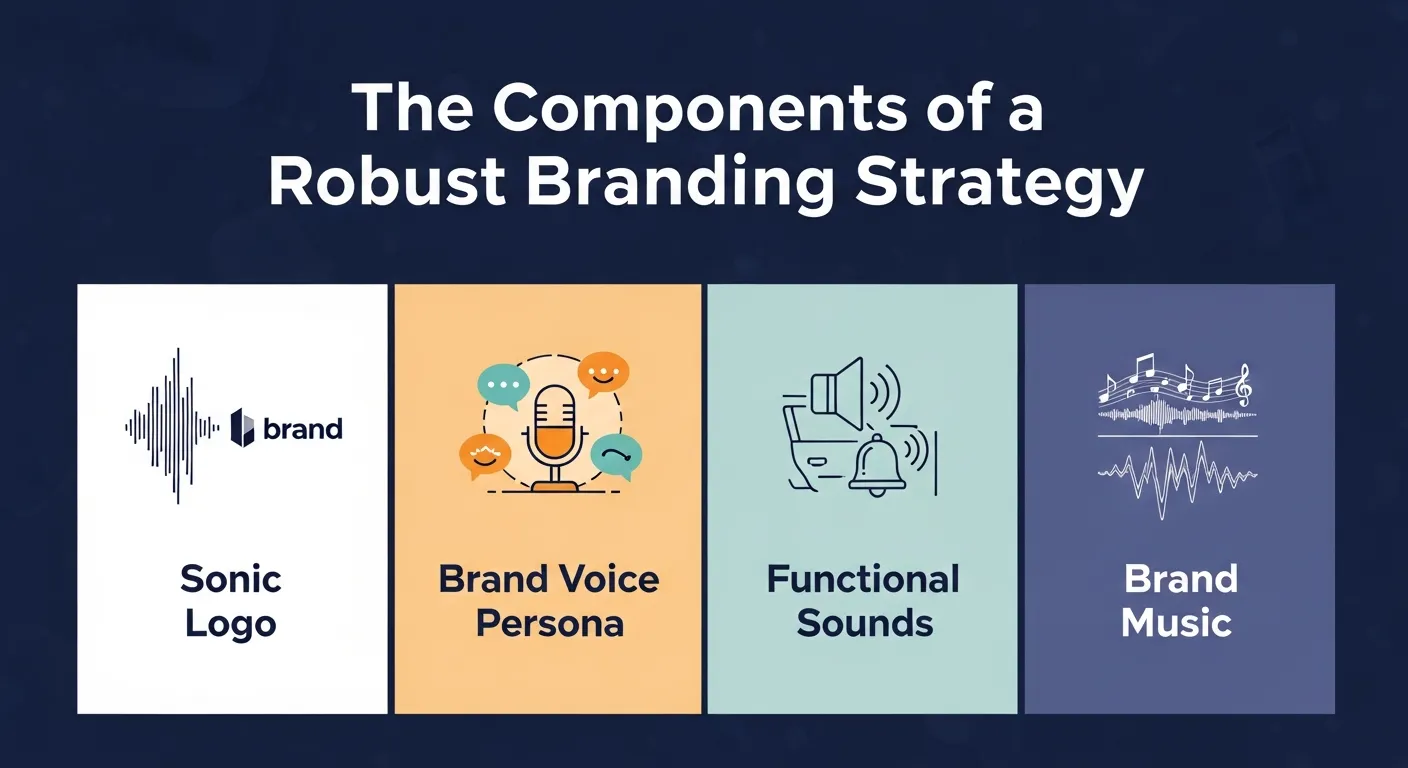
Creating a sonic identity is complex. It requires a deep understanding of your brand’s personality and how that translates into sound. Here are the core components:
- Sonic Logo (Audio Mnemonic): This is the audio equivalent of your visual logo. Think of the Intel “bong” or the Netflix “ta-dum.” It’s a short, distinctive sound that triggers immediate brand recognition.
- Brand Voice Persona: If your brand could talk, who would it sound like? Is it male or female? Is the tone authoritative, playful, nurturing, or robotic? This persona must be consistent across all touchpoints, from TV ads to Alexa skills. For Brand Personality in Marketing and Brand Voice in Marketing, ensuring consistency is essential.
- Functional Sounds: These are the user interface (UI) sounds—clicks, swipes, success chimes, and error buzzers. In Voice Branding, these sounds confirm actions and guide the user experience without visual cues.
- Brand Music/Anthem: A longer piece of music that embodies the brand’s mood. Segments of this anthem can be used for intros, outros, and background music in videos.
The Psychology of Sound in Marketing
Sound bypasses our rational brain and hits our emotional centers directly. Research shows that people react to sound faster than they react to visuals. A study cited by Harvard Business Review suggests that the right sound can increase brand recall by huge margins.
When you invest in Voice Branding, you are investing in emotional triggers. Emotional Branding creates enduring loyalty by turning casual customers into ambassadors. A warm, human voice can build trust in a financial app, while a futuristic, synthesized voice might work better for a tech startup.
The “Trust” Factor in Voice
Trust is the currency of the digital age. In a voice-first interaction, the “grain” of the voice matters.
- Pitch: Lower-pitched voices are often perceived as more authoritative.
- Pacing: Moderate pacing suggests confidence and clarity.
- Accent: Local accents can build community connection, while neutral accents often appeal to a global audience.
Neuromarketing Techniques and The Psychology Behind Successful Brand Positioning are increasingly integrated into audio brand decisions, guiding everything from tone selection to the design of Brand Voice Strategy.
Optimizing for Voice Search (VSO)
Voice Branding is inextricably linked to Voice Search Optimization (VSO). When users ask a question, they typically want one single, correct answer—not a list of ten blue links.
To capture this traffic, your content must be conversational. Users don’t type “best Italian restaurant NYC” when speaking; they say, “Hey Google, where can I get the best pasta near me?”
Strategies for VSO Success:
- Target Long-Tail Keywords: Focus on natural language phrases and questions.
- Use Schema Markup: Help search engines understand the context of your content.
- Create FAQ Pages: These closely mimic the Q&A format of voice interactions.
- Local SEO: Many voice searches are local (“near me”). Ensure your Google My Business profile is pristine.
Mastering Digital Marketing techniques and Generative Engine Optimization are crucial in the world of Conversational AI and Voice Search Optimization. For more technical insights, platforms like SEMrush and Ahrefs offer incredible tools to track voice search rankings and keyword difficulty.
Case Studies: Brands Winning at Voice Branding
Let’s look at how major players are utilizing Voice Branding to dominate their markets.
Mastercard
Mastercard recently debuted a comprehensive sonic architecture. They didn’t just create a jingle; they created a melody that can be adapted for different contexts—ads, point-of-sale chimes, and hold music. This ensures that every time a consumer interacts with Mastercard, they hear a consistent brand identity.
Visa
Visa focused heavily on the “transaction sound.” They researched sensory branding to find a sound that signifies “fast, secure, and done.” That split-second sound at the checkout terminal reinforces the brand’s promise of security every single day.
HBO
The “static” sound followed by a choir-like hum is iconic. It signals the start of premium entertainment. Before the show even starts, the viewer is primed for quality. This is Voice Branding at its finest—setting an emotional stage in seconds.
How to Build Your Voice Branding Strategy: A Step-by-Step Guide
If you are ready to craft your auditory identity, follow this roadmap—ideal for Branding and Marketing: How to Use Both to Skyrocket Your Business Growth and Brand Promotion Strategy.
Step 1: Audit Your Current Sound
Where does your brand currently make sound? Telephone hold lines? Radio ads? YouTube videos? Website videos? Apps? Document every touchpoint. Is it consistent? Often, brands find they are using stock music that clashes with their visual identity. Consider the Brand Architecture and ensure coherence across all assets.
Step 2: Define Your Brand Attributes
List 3-5 adjectives that describe your brand (e.g., Innovative, Reliable, Friendly). Now, try to translate those into sound. “Innovative” might sound like synthesizers and clean digital beeps. “Reliable” might sound like acoustic piano or a warm baritone voice. Draw on Brand Archetypes and clarify your Brand Positioning in Marketing.
Step 3: Develop Your Sonic Assets
Work with audio professionals. This isn’t a DIY project for GarageBand. You need distinct assets:
- The Sonic Logo: 3-5 seconds max.
- The Brand Voice: Scripts and casting for your AI assistant or IVR system.
- The Soundscape: Background ambience for apps or retail spaces.
Step 4: Test and Iterate
Just like you A/B test landing pages, you must test your sounds. Do they annoy users after repeated listening? Is the voice clear on low-quality speakers?
Step 5: Implement Consistently
Update your IVR, your app sounds, your podcast intros, and your video outros. Consistency is key to Voice Branding success. This aligns with the Major Objective of All Brand Marketing: achieving sustainable, recognizable, and engaging brand presence.
The Role of AI in Voice Branding
Artificial Intelligence is revolutionizing how we create and consume audio. Synthetic voices are no longer robotic and jarring; they are becoming indistinguishable from human speech.
Brands can now create custom AI voices. Instead of licensing a generic “Siri” or “Alexa” voice, you can train a neural network to speak in your brand’s unique tone. This allows for dynamic personalization. Imagine a fitness app that speaks your name and encourages you in a tone that matches your workout intensity—all generated in real-time by AI.
AI Sensory Branding and Brand Voice in the Era of Conversational AI and Chatbots are emerging solutions supporting the evolution of Voice Branding. Tools like those analyzed by Backlinko show that AI-driven content and voice optimization are top trends for the coming decade.
Challenges and Pitfalls in Voice Branding
While the opportunities are vast, the risks are real.
- Sonic Clutter: If every brand has a sound, the world becomes noisy. Your sound must be pleasant and non-intrusive.
- Cultural Insensitivity: A sound or voice that works in the US might be offensive or confusing in Japan. Global brands must consider Global Brand Localization and localize their Voice Branding approaches.
- Platform Limitations: Amazon and Google have strict guidelines for “Skills” and “Actions.” Your sonic branding must work within their ecosystems.
Being aware of Brand Crisis Management in the Social Media Era and Brand Safety in Digital Marketing will protect your efforts.
Voice Branding vs. Jingles: What’s the Difference?
Many people confuse Voice Branding with traditional advertising jingles.
|
Feature |
Jingle |
Voice Branding |
|---|---|---|
|
Length |
Long (15-30 seconds) |
Short (1-3 seconds) or continuous |
|
Purpose |
To sell a specific campaign/product |
To identify the brand ecosystem |
|
Usage |
TV/Radio Ads |
Apps, Smart Speakers, UI, Devices |
|
Flexibility |
Rigid melody/lyrics |
Adaptable, modular architecture |
|
Example |
“I’m Lovin’ It” (McDonald’s) |
The Intel “Bong” |
The Future of Voice Branding: Beyond Smart Speakers
Smart speakers are just the beginning. The Internet of Things (IoT) means that soon, your refrigerator, your car, and your thermostat will all have voice interfaces. Companies should consider Future-Proofing Your Brand Adaptation Strategies and Augmented Reality Branding for additional engagement.
Imagine walking into a hotel room. You don’t look for a light switch; you simply ask the room to “relax mode.” The lights dim, and a specific, branded soundscape plays. The hotel’s Voice Branding becomes part of the physical environment.
In the automotive industry, Voice Branding is already critical. Car manufacturers are designing specific sounds for electric vehicles (which are naturally silent) to ensure pedestrian safety and brand distinctiveness. The sound a Ford Mustang Mach-E makes is different from a Porsche Taycan. That is Voice Branding in motion. This demonstrates a sophisticated Integrated Brand Promotion and User Experience and Branding approach.
Measuring the ROI of Voice Branding
How do you know if it’s working? Measuring the return on investment for audio can be tricky, but it’s possible using tools like Google Analytics.
- Brand Recall Surveys: Play your sound without the logo. Do consumers recognize it?
- Sentiment Analysis: Monitor social media for mentions of your ads or voice apps. Do people find the voice annoying or helpful?
- Engagement Metrics: For voice apps, track session length and retention. A pleasant voice keeps users interacting longer.
Brand Equity in Marketing, Brand Equity KPIs, and Measuring The Impact Of Brand Storytelling all provide frameworks for evaluating your progress.
Practical Tips for Small Businesses
You don’t need a Mastercard-sized budget to start.
- Standardize your voicemail: ensure everyone uses the same greeting script and tone.
- Choose a consistent intro music for your social media videos.
- Be a guest on podcasts: Use the founder’s voice as a branding asset, supporting Personal Branding for CEOs.
- Optimize for “Near Me” searches: This is the low-hanging fruit of voice search and helps Increase Brand Awareness Through Digital Marketing.
Following Brand Positioning in Marketing best practices will ensure your efforts are targeted and effective.
The Ethical Dimension: Deepfakes and Voice Cloning
As Voice Branding technology advances, ethical concerns arise. Voice cloning technology can now replicate a human voice with just a few seconds of audio. This poses security risks and raises questions about consent. Brands must be transparent about when they are using synthetic voices versus human talent. Authenticity remains a core pillar of successful branding.
Sensory Congruence: Matching Sound to Sight
A critical concept in Voice Branding is “sensory congruence.” This means that what customers hear must match what they see. If your visual brand is minimalist, sleek, and modern (like Apple), your sound cannot be a chaotic, loud trumpet blast. It must be subtle, clean, and digital.
Incongruence creates cognitive dissonance. When the sound doesn’t fit the visual, consumers feel a subconscious unease and trust drops. This is why testing your Voice Branding assets alongside your visual assets is crucial.
Accessibility and Inclusion
Voice Branding plays a massive role in accessibility. For visually impaired users, your audio identity is your brand. A well-designed voice interface makes your product usable for millions of people who struggle with screens. By prioritizing clear, high-quality audio and intuitive voice navigation, you are not just branding; you are practicing inclusive design.
Conclusion
The shift toward audio-first interaction is undeniable. Voice Branding is no longer a futuristic concept—it is a present-day requirement for brands aiming to remain relevant and recognizable. By crafting a distinct auditory identity, you not only improve user experience but also deepen emotional connections with your audience. Start listening to your brand today, because your customers already are.
FAQs
1. What exactly is Voice Branding?
Voice Branding, also known as sonic branding, is the strategic use of sound—including voice, music, and sound effects—to create a unique identity for a brand. It ensures that a brand is recognizable even when it cannot be seen, such as on smart speakers or radio.
2. Why is Voice Branding important for SEO?
With the rise of voice search, optimizing for auditory queries is crucial. Voice Branding strategies often overlap with Voice Search Optimization (VSO), helping brands appear in spoken search results provided by assistants like Siri and Alexa. This is a key tactic in Digital Marketing Strategies.
3. How much does it cost to create a Sonic Logo?
The cost varies wildly. A small business might spend a few thousand dollars working with freelance composers, while major corporations spend hundreds of thousands or even millions on comprehensive Voice Branding architectures involving psychoacoustic research.
4. Can small businesses benefit from Voice Branding?
Absolutely. Consistency is free. Using a consistent tone of voice in voicemails, a standard intro music track for videos, and optimizing for local voice search are all low-cost Voice Branding tactics.
5. What is the difference between a jingle and a sonic logo?
A jingle is usually a short song with lyrics used for a specific advertising campaign. A sonic logo (like the Netflix “ta-dum”) is a short, permanent audio signature used to identify the brand across all touchpoints.
6. How do I choose the right voice for my brand?
Start by defining your brand persona. Is it helpful, authoritative, playful, or serious? Test different voice actors or synthesized voices with your target audience to see which one aligns best with your brand values.
7. Does Voice Branding affect customer trust?
Yes. Studies show that high-quality audio and a consistent, pleasant voice can significantly increase trust. Conversely, poor audio quality or an annoying voice can drive customers away. Good Brand Crisis Management in the Social Media Era plans for this risk.
8. What are the best tools for tracking Voice Search rankings?
Tools like SEMrush, Ahrefs, and Moz have developed features to track keyword rankings, including those likely to be used in voice searches (question-based and long-tail keywords).
9. How does Voice Branding work on social media?
On platforms like TikTok and Instagram Reels, audio is often “always on.” Using trending sounds combined with your custom Voice Branding elements can help increase engagement and Brand Recognition in Marketing.
10. Is Voice Branding a one-time project?
No. Like visual branding, Voice Branding requires maintenance. You need to ensure consistency as new platforms emerge and audit your sounds periodically to ensure they don’t feel dated.