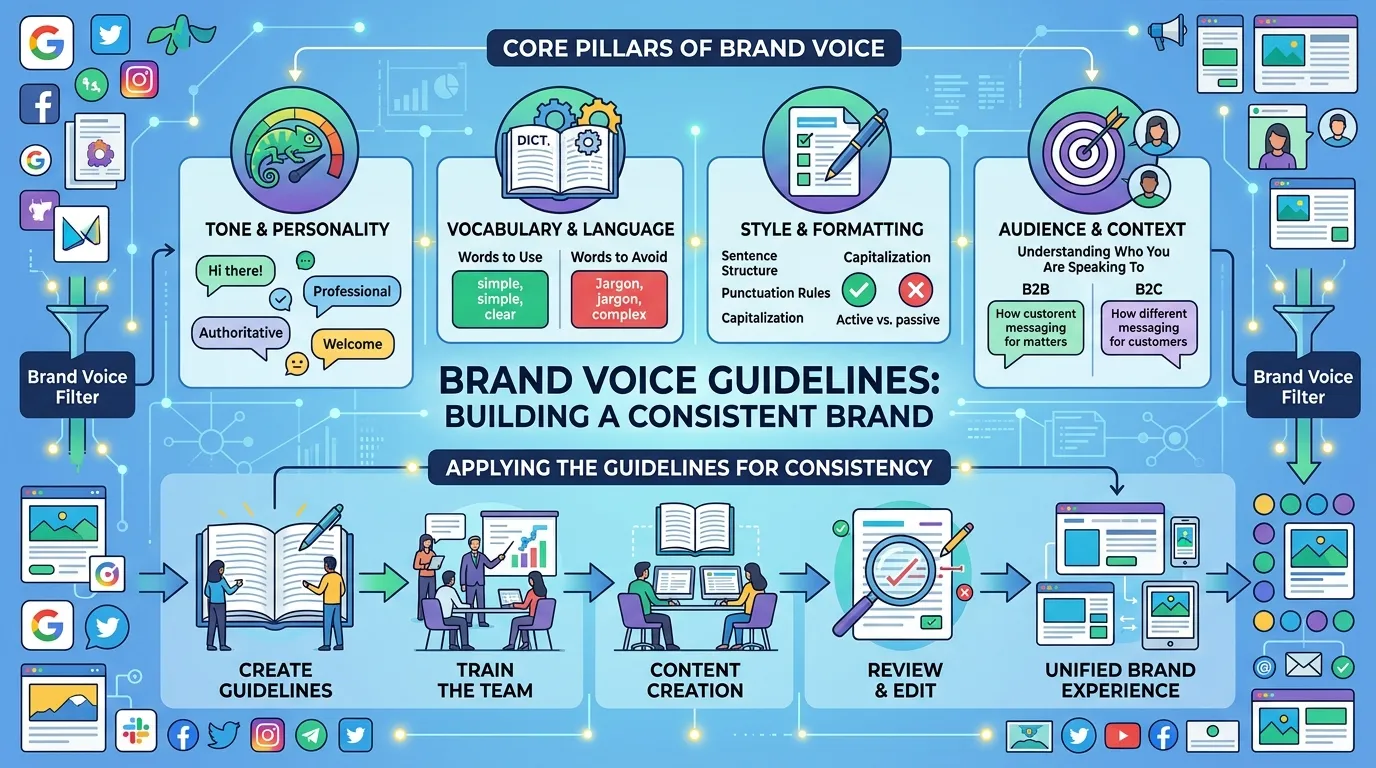
Brand Voice Guidelines help businesses communicate with a consistent personality across websites, social media, advertising, email, content, and customer interactions. A clear brand voice makes communication more recognizable and helps businesses maintain consistency even when multiple people create content. By developing a strong voice strategy, defining the right tone, and connecting messaging with brand personality, organizations can create communication that feels authentic and familiar to their audience.
What Are Brand Voice Guidelines?
Brand Voice Guidelines are a set of principles that explain how a brand should communicate with its audience. They define the personality, language, communication style, and overall character that should appear across different forms of brand communication.
A brand may communicate through blog posts, social media captions, advertisements, product descriptions, newsletters, customer service messages, videos, and sales materials. Without clear direction, each channel can begin to sound different. One team member may use a formal style, another may write casually, while another may use highly technical language.
This inconsistency can make a brand feel less recognizable.
Brand Voice Guidelines create a shared communication foundation. They help writers, marketers, designers, social media managers, customer service teams, and other employees understand how the brand should sound when communicating with customers.
A strong set of guidelines does not require every sentence to sound identical. Instead, it establishes a recognizable personality while allowing communication to adapt to different situations.
Why a Consistent Brand Voice Matters
A Consistent Brand Voice helps audiences recognize a business across different communication channels. When the same personality and communication principles appear repeatedly, customers can develop a clearer understanding of what the brand represents.
Consistency is particularly important for businesses with multiple teams or content creators. As an organization grows, more people become responsible for communicating with customers. Without shared guidelines, messaging can gradually become fragmented.
For example, a brand may describe itself as friendly and approachable on its website but use overly formal and complicated language on social media. Although each individual piece of content may be acceptable, the overall experience can feel disconnected.
A consistent voice creates continuity. Customers should be able to encounter a brand through a blog article, email, social post, or customer service interaction and still recognize the same underlying personality.
Consistency can also make content creation more efficient because writers have a clearer understanding of the communication style expected from them.
Developing a Brand Voice Strategy
A Brand Voice Strategy connects communication style with a company’s identity, audience, values, and marketing objectives. The voice should not be selected simply because a particular writing style sounds appealing.
A professional financial services company may require a communication style that emphasizes clarity, confidence, and reliability. A lifestyle brand may use more conversational and expressive language. A technology company may prioritize clarity and expertise while avoiding unnecessary technical complexity.
The audience is equally important. Communication should reflect how customers naturally understand and discuss the problems, products, or services associated with the business.
The strategy should also consider where the brand communicates. A website page, social media post, customer support message, and advertising campaign may require different levels of formality while still maintaining the same underlying voice.
A strong strategy therefore creates consistency without making communication feel repetitive or artificial.
Creating a Brand Voice Framework
A Brand Voice Framework gives teams a practical structure for understanding how the brand should communicate. It can describe several core characteristics that define the brand’s personality.
For example, a brand might describe its voice as knowledgeable, approachable, clear, and optimistic. These characteristics provide writers with a foundation for creating content that feels consistent.
A useful framework can also explain what the brand should avoid. If the brand wants to sound approachable, excessive jargon may be discouraged. If it wants to appear confident, unnecessary uncertainty or vague statements may need to be reduced.
The framework can include examples of preferred language, sentence structure, vocabulary, and communication patterns. This gives content creators a clearer reference when developing new material.
The objective is to make the framework useful in real communication rather than turning it into a collection of abstract branding terms.
Brand Voice Development and Brand Identity
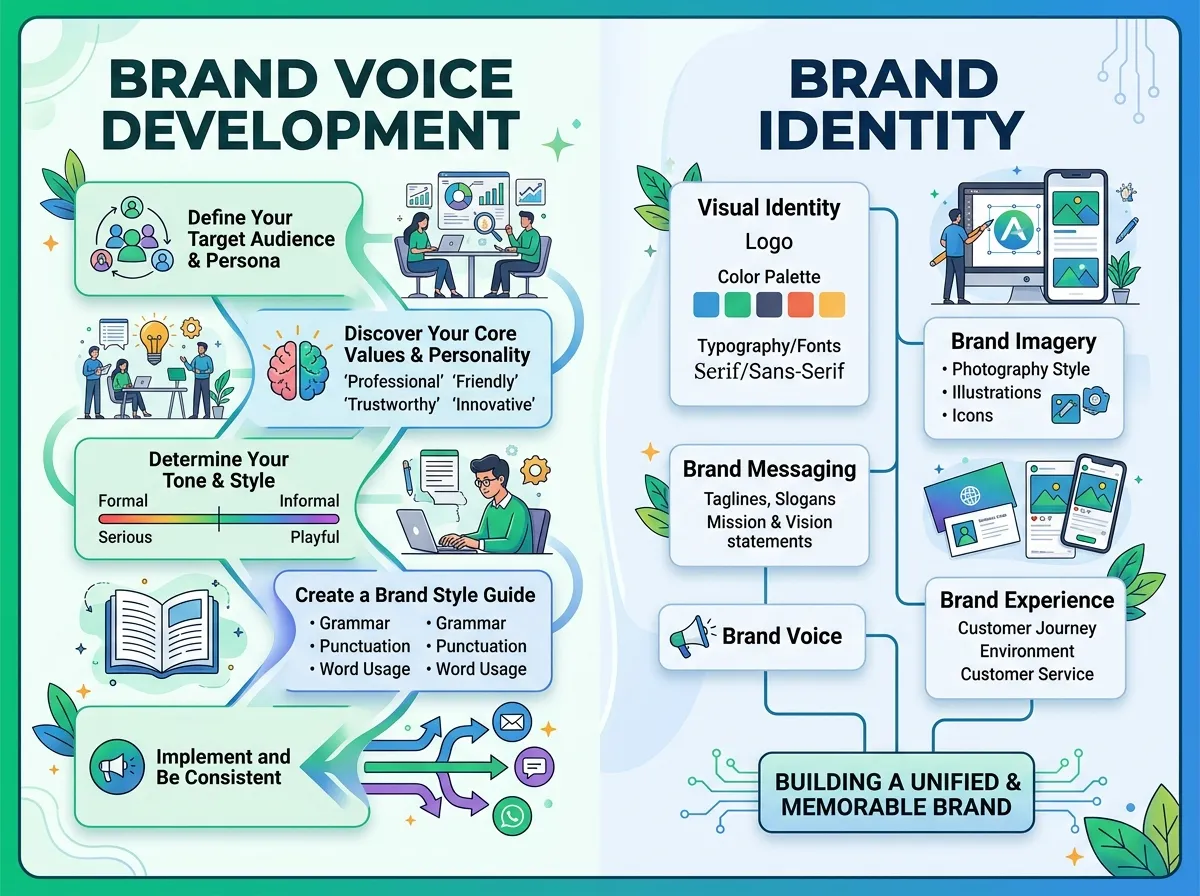
Brand Voice Development is closely connected to the broader identity of a business. The way a company communicates should support what it wants customers to understand about the brand.
A brand that positions itself around innovation may use language that communicates curiosity, progress, and forward thinking. A company focused on reliability may emphasize clarity, confidence, and practical value.
Voice development should also consider existing customer perceptions. If customers already associate a brand with a particular communication style, completely changing that style can create confusion.
This does not mean a brand can never evolve its voice. As businesses grow, enter new markets, or change their positioning, their communication may need to develop as well.
The important consideration is maintaining a recognizable connection between the brand’s identity and the way it communicates.
Brand Tone Guidelines and Communication Context
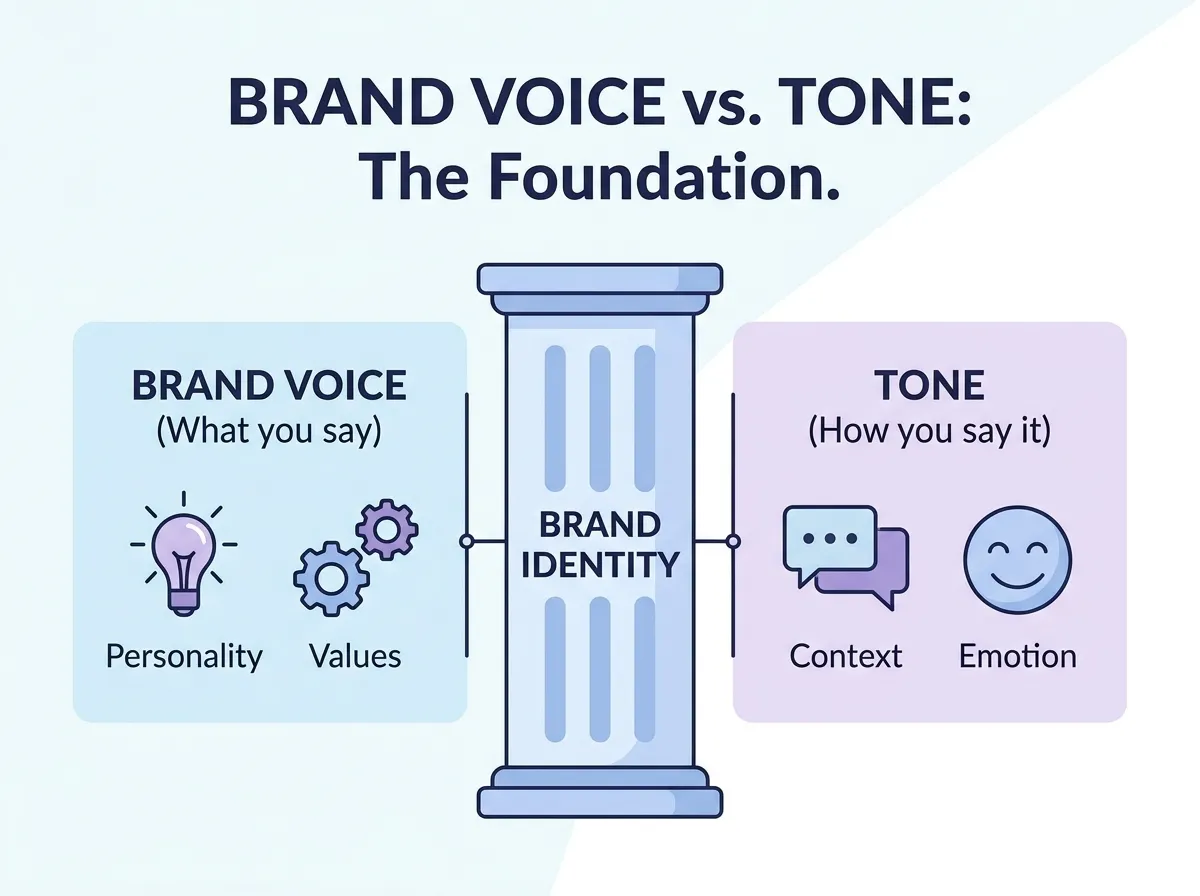
Brand Tone Guidelines explain how the brand’s voice can adapt to different situations. Voice and tone are related but not identical.
Brand voice represents the consistent personality of the brand, while tone can change depending on the context.
A company may have a friendly and approachable voice but use a more serious tone when discussing a customer complaint. The same brand may use an enthusiastic tone when announcing a new product or a supportive tone when helping a customer solve a problem.
This distinction allows businesses to remain consistent without sounding inappropriate in different situations.
Tone guidelines can therefore help teams understand how communication should change according to the audience, channel, subject, and circumstances while maintaining the underlying personality of the brand.
Brand Messaging Guidelines and Voice
Brand Messaging Guidelines provide direction around what the brand communicates, while voice guidelines focus more heavily on how it communicates.
The two should work together.
Messaging can establish key ideas, benefits, positioning statements, value propositions, and important brand themes. Voice then determines how those ideas are expressed.
For example, a business may want to communicate that its service saves customers time. Messaging guidelines establish that core benefit, while the brand voice determines whether that benefit is expressed in a professional, conversational, energetic, educational, or reassuring manner.
This relationship is particularly important when multiple teams produce marketing materials. Strong messaging combined with a consistent voice can create a more unified customer experience.
Businesses interested in strengthening this connection can also explore Brand Messaging as part of their broader brand communication strategy.
Defining Brand Communication Style
Brand Communication Style covers the practical characteristics of the language a brand uses. This can include sentence length, vocabulary, formality, punctuation, terminology, perspective, and use of conversational language.
A business might prefer short and direct sentences, while another may use more descriptive storytelling. Some brands may communicate primarily in a professional tone, while others may intentionally use humor and informal language.
The key is intentionality.
Without a defined communication style, writers often rely on their personal preferences. This can lead to significant variation across content.
Brand guidelines can establish useful preferences around these details while leaving enough flexibility for natural writing. The purpose is not to make every writer sound robotic, but to create a shared communication identity.
Brand Voice Examples and Practical Application
Brand Voice Examples can help content creators understand abstract voice characteristics more easily.
For instance, describing a brand as “friendly” may not provide enough direction. Writers may interpret friendliness differently. One writer may use casual language and humor, while another may simply use polite wording.
Examples can demonstrate what the desired style looks like in actual communication. A guideline could show how a sentence might be written in the preferred brand voice and explain the characteristics that make it appropriate.
Examples can also cover different channels. A social media post, website heading, email, product description, and customer service response may look different while maintaining the same personality.
The examples should therefore demonstrate flexibility rather than encourage writers to copy exact wording.
Brand Personality Guidelines
Brand Personality Guidelines describe the human characteristics that a brand wants its communication to express. These characteristics can make an otherwise abstract business identity easier for customers to understand.
A brand may want to appear confident, helpful, energetic, thoughtful, creative, trustworthy, or knowledgeable. These characteristics can influence word choice, sentence structure, storytelling, and tone.
Personality should also be appropriate for the target audience. A playful communication style may work effectively for some consumer brands but may be less appropriate in certain professional contexts.
The purpose of personality guidelines is not to make a company pretend to be a person. Instead, they help create a recognizable human quality in communication.
When personality is consistently reflected across content and customer interactions, audiences can develop stronger familiarity with the brand.
Brand Voice and Tone Strategy
A Brand Voice and Tone Strategy combines the consistent personality of the brand with the flexibility required by different communication situations.
This distinction becomes especially useful as a business expands across multiple channels. The same brand may communicate through advertisements, educational articles, product pages, social media, email campaigns, customer service, and influencer partnerships.
Each environment has different expectations.
A social media announcement may be more conversational than a formal business report, while a customer complaint may require a more empathetic tone. Despite these differences, the underlying brand personality should remain recognizable.
A strong voice and tone strategy provides enough flexibility for these differences while preventing the brand from becoming inconsistent.
Brand Voice Across Social Media
Social media often requires particularly careful application of brand voice because audiences interact with brands through short, frequent, and highly visible communications.
A consistent social media voice can help customers recognize posts even before they identify the company name. Language choices, humor, sentence structure, emotional tone, and communication style can all contribute to this recognition.
Different social platforms may require different content formats, but the brand should still maintain its core personality.
For brands working with creators and influencers, voice consistency can become more complex. Influencer partnerships introduce another person’s communication style into brand campaigns, making clear expectations particularly useful. A broader Influencer Marketing Strategy can help businesses think about how partnerships fit into their overall brand communication and marketing activities.
The goal is not necessarily to make creators sound exactly like the brand. Instead, businesses can establish appropriate boundaries around key messages, values, and communication expectations.
Brand Voice and Community Building
Brand voice can also contribute to community development. Customers who regularly interact with a brand may become familiar with its personality and communication style.
A recognizable voice can make social interactions feel more connected because customers know what kind of communication to expect.
This becomes especially relevant for businesses investing in customer communities. Consistent communication can help establish shared language and reinforce the values that bring members together.
Businesses interested in strengthening customer relationships through community development can explore Building Brand Communities as part of a broader brand-building strategy.
The voice used within a community should remain authentic. Customers can often recognize communication that feels overly scripted or disconnected from the actual brand experience.
Brand Voice and Storytelling
Storytelling gives brands another opportunity to express their personality. The words a company uses to describe its history, customers, products, challenges, and achievements can influence how audiences perceive the brand.
A consistent voice helps ensure that these stories feel connected rather than appearing as unrelated pieces of content.
Brand storytelling can be particularly effective when voice, messaging, and personality work together. The story provides the narrative, messaging communicates important ideas, and voice determines how the story feels when the audience experiences it.
Businesses can also examine Measuring The Impact Of Brand Storytelling to understand how storytelling fits into broader brand communication and performance measurement.
Maintaining Brand Voice Across Teams
As businesses grow, maintaining a consistent voice can become more difficult. Different departments may have different communication responsibilities, including marketing, sales, customer service, public relations, human resources, and executive communication.
Brand Voice Guidelines can give these teams a common reference point.
The guidelines should be accessible and practical enough for everyday use. New employees, freelance writers, agencies, social media managers, and other contributors should be able to understand the brand’s communication principles without requiring extensive interpretation.
Regular review can also help ensure the guidelines remain relevant. Brands evolve, audiences change, and communication channels develop over time.
A voice document should therefore be treated as a living brand resource rather than something created once and forgotten.
Measuring the Effectiveness of Brand Voice

Brand voice can be difficult to measure through a single metric because it is closely connected to perception and communication quality. However, businesses can examine several indicators to understand whether their communication is becoming more consistent and recognizable.
Content reviews can identify whether different teams are following the same principles. Customer feedback can reveal how audiences perceive the brand’s personality. Engagement patterns can provide additional context, particularly when comparing content with different communication approaches.
Businesses can also evaluate whether audiences recognize recurring themes and communication characteristics across different channels.
The goal is not to reduce brand voice to a single numerical score. Instead, measurement should provide useful evidence about consistency, audience response, and alignment with broader brand objectives.
Why Brand Voice Guidelines Should Evolve
Brand Voice Guidelines should provide consistency without preventing evolution. Brands may change their products, audiences, positioning, markets, and communication channels over time.
A voice that worked when a business was small may need adjustments as the company becomes more established. Similarly, a brand entering an international market may need to consider cultural differences while maintaining its core identity.
Updating the guidelines allows the brand to remain relevant while protecting important elements of its established personality.
The strongest approach is usually not a complete reinvention every time the market changes. Instead, businesses can preserve the core characteristics that make their communication recognizable while refining the way those characteristics are expressed.
Conclusion
Brand Voice Guidelines provide businesses with a foundation for creating recognizable, consistent, and purposeful communication. Through a clear Brand Voice Strategy, practical Brand Voice Framework, thoughtful Brand Voice Development, and appropriate Brand Tone Guidelines, businesses can create a communication style that remains consistent across different channels and teams.
A strong voice does not mean every message must sound identical. Effective brands understand the difference between voice and tone, allowing communication to adapt to different situations while maintaining a recognizable personality.
When brand voice works together with messaging, storytelling, community building, influencer partnerships, and customer communication, it can contribute to a more unified brand experience. Regularly reviewing and evolving the guidelines also helps ensure that the voice remains relevant as the business grows.
Ultimately, the purpose of brand voice is simple: to make every communication feel like it comes from the same recognizable brand.
Frequently Asked Questions
1. What are Brand Voice Guidelines?
Brand Voice Guidelines are documented principles that explain how a brand should communicate. They can define personality, vocabulary, tone, communication style, sentence structure, preferred language, and other characteristics that help maintain consistency.
2. Why is a consistent brand voice important?
A consistent brand voice helps customers recognize a business across websites, social media, email, advertising, customer service, and other channels. It also gives different content creators a shared communication foundation.
3. What is the difference between brand voice and brand tone?
Brand voice represents the consistent personality of a brand, while brand tone changes according to the communication situation. A brand may have a friendly voice but use a more serious tone when responding to a customer complaint.
4. What should a Brand Voice Framework include?
A Brand Voice Framework can include core personality characteristics, preferred communication style, vocabulary preferences, language to avoid, tone considerations, and examples showing how the voice should be applied in different situations.
5. How do you develop a brand voice?
Brand voice development involves understanding the brand’s identity, audience, values, positioning, communication channels, and existing customer perceptions. These elements can then be translated into clear personality and communication principles.
6. What are Brand Tone Guidelines?
Brand Tone Guidelines explain how the brand’s communication should adapt to different situations. They can address differences between promotional messages, educational content, customer support interactions, announcements, and other forms of communication.
7. Can brand voice improve brand recognition?
A recognizable and consistent communication style can help audiences become familiar with a brand. When similar personality characteristics appear across different channels, customers may more easily associate the communication with the same organization.
8. How can businesses maintain brand voice across multiple teams?
Businesses can maintain consistency by creating accessible guidelines, providing practical examples, reviewing content regularly, and ensuring that internal teams and external contributors understand the brand’s communication principles.
9. Should brand voice remain the same forever?
Brand voice can evolve as a business, audience, market, and communication environment changes. However, changes can be made while preserving the core personality characteristics that help make the brand recognizable.
10. How does brand voice support brand messaging?
Brand messaging establishes what a brand wants to communicate, while brand voice determines how those messages are expressed. When the two work together, communication can remain both strategically focused and stylistically consistent.