Many business leaders use the terms branding vs marketing interchangeably, yet they serve distinct purposes in the vast digital marketing ecosystem. Understanding this crucial difference is the secret to building a sustainable, profitable business—especially in a world of evolving strategies like content marketing, influencer marketing, and data analytics.
This guide delivers a comprehensive breakdown of branding vs marketing, exploring identity, strategy, and execution. Uncover actionable methods for building brand equity, see industry examples, and learn how integrating tactics—like SEO optimization, social media, email campaigns, and reputation management—bolsters both brand awareness and conversions for strong, long-lasting growth.
The Core Dilemma: Branding vs Marketing Defined
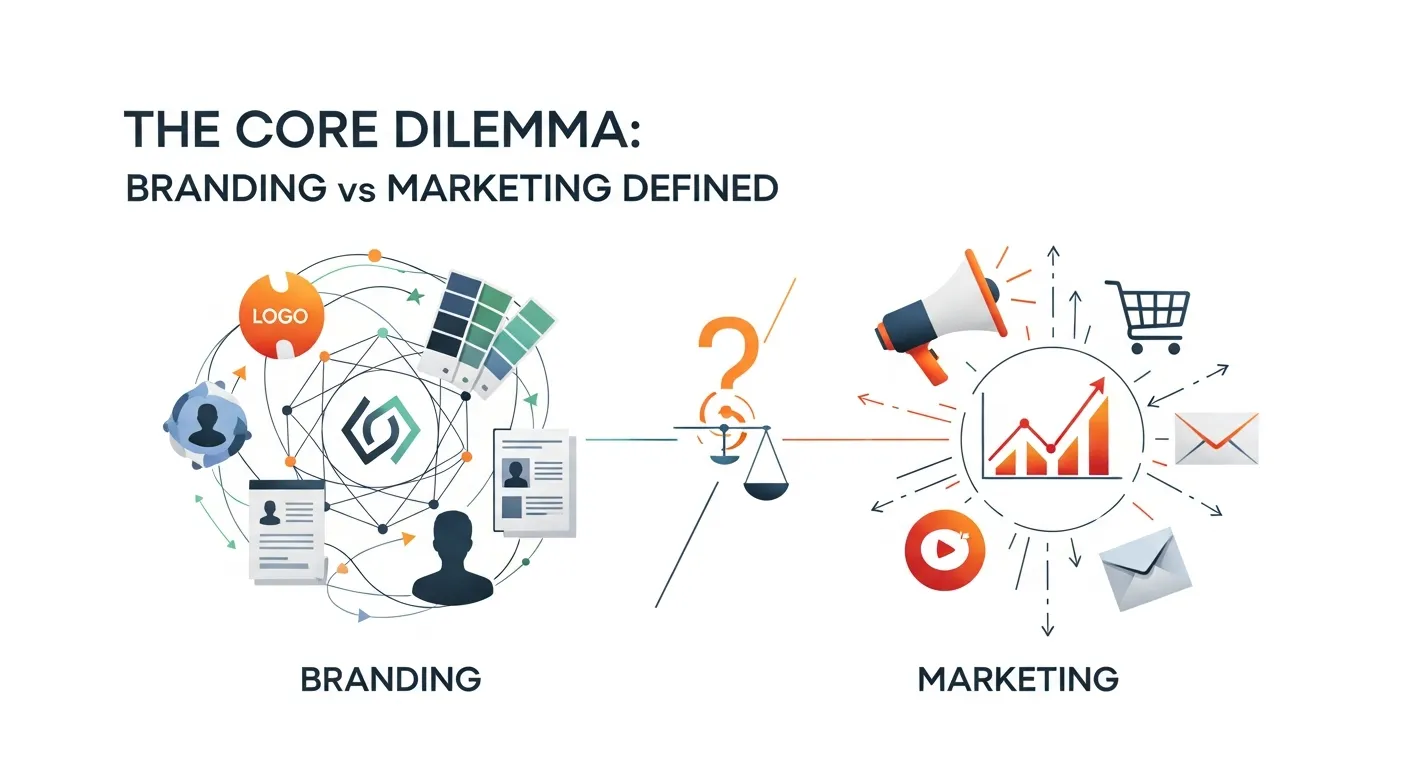
As you explore business growth strategies, you’ll inevitably encounter terms like “branding,” “marketing,” programmatic ads, and “account-based marketing.” While branding vs marketing are deeply linked—and often overlap with disciplines like content marketing or affiliate marketing—they’re truly distinct in function. Understanding this classic dilemma is critical to navigating everything from e-commerce growth to video advertising and event marketing.
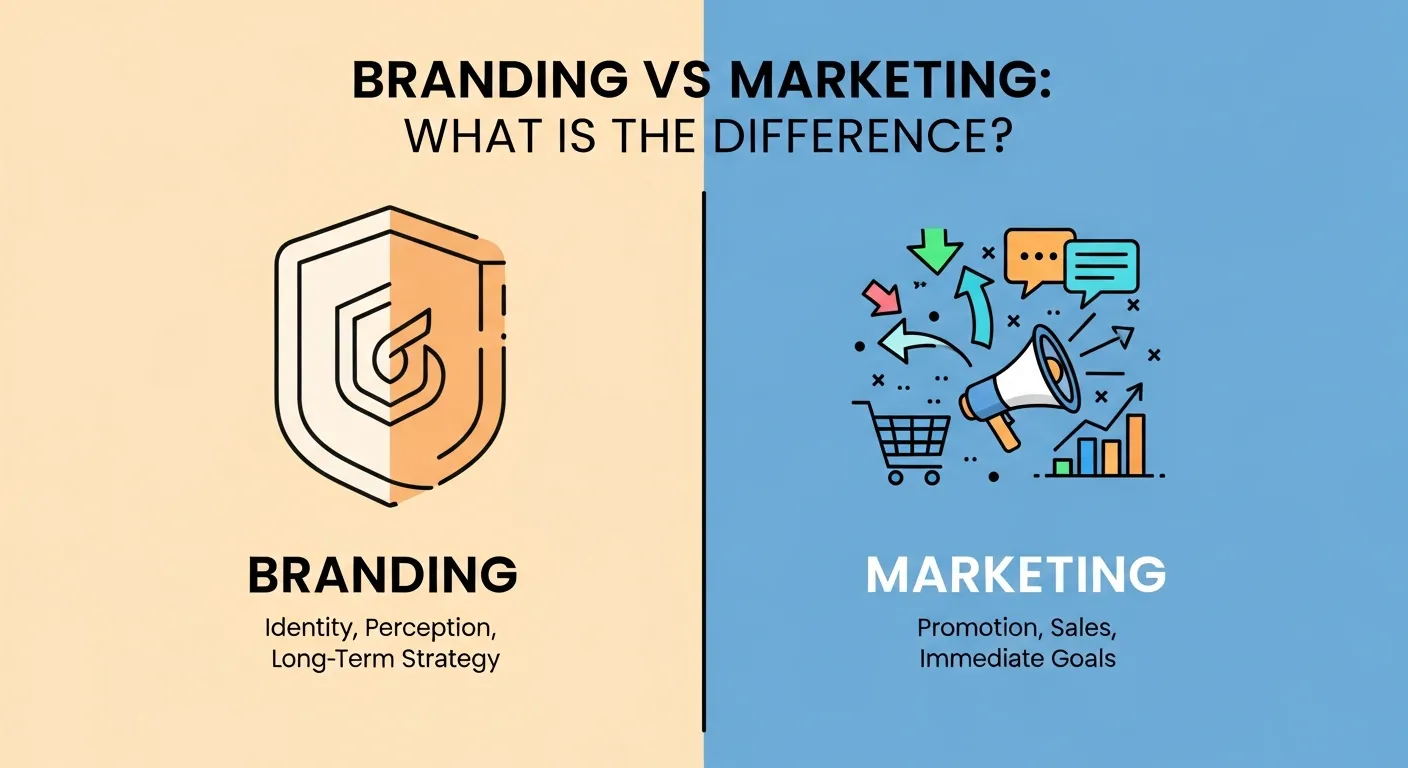
To put it simply: Branding is about who you are. Marketing is about how you promote, engage, and grow.
Think of your business as a person. Branding is that person’s character, values, beliefs, even their personal branding—while marketing is everything from their social posts (outbound marketing), to the networking events they attend (networking/lead generation), to the clothes they wear (visual identity and creative marketing services). Effective branding is the foundation that powers strong cross-channel marketing and omnichannel strategies, while marketing is the engine driving conversion optimization and lead generation.
What is Branding? The Soul of the Business
Your brand is the lifeblood and soul of your business. It shapes how you’re perceived everywhere—whether in local SEO, programmatic ads, or physical stores. Branding answers crucial questions: Who are we? What do we believe? What sets us apart in a world of endless market share battles and brand resilience strategies?
Consider the supporting keywords—from neuromarketing insights to sensory branding—that deepen your brand’s emotional resonance. Branding is about the identity you project, the experiences and customer journey mapping you deliver, and your long-term promise.
Key Elements of Branding:
- Brand Identity: Visual and sensory elements like your logo, typography, color palette, tagline, and tone of voice. Think of Nike’s swoosh or Apple’s minimalist approach; these elements extend even to metaverse branding, clothing marketing, and multisensory branding.
- Brand Values: Core principles guiding every decision—sustainability marketing, innovation, community building, green marketing, or trust establishment. LSI keywords like brand advocacy, cultural branding, and brand rituals all enrich your identity.
- Brand Promise: The experience or benefit customers expect each time. For instance, reliability (FedEx), quality (Patagonia), or comfort (Starbucks).
- Brand Personality: The human qualities your brand would embody, whether quirky and fun (meme marketing), serious and trustworthy (crisis management), or inspirational and bold (motivational archetypes).
Branding is the work behind brand equity, brand awareness, accessibility, brand resilience, and brand longevity challenges. It supports everything from NFT marketing to voice branding and the emerging field of AI branding.
What is Marketing? The Voice and Engine of the Business
If branding is the bedrock, marketing is the action. Marketing encompasses every strategy and tactic, from video marketing and webinar marketing to account-based marketing, designed to connect your offerings to ideal customers and achieve measurable business goals.
Today’s marketing landscape spans digital marketing, social media management, influencer strategy, referral marketing, SMM, mobile marketing, webinar engagement, interactive content marketing, and more.
- Advertising Campaigns: Paid promotions across Instagram, Google Ads, programmatic ad platforms, traditional channels, and even Amazon brand promotion guides—all designed for hyperlocal marketing or global reach.
- Content Marketing: Creating guides, blogs, videos, and social posts for distinct audiences—powerful for inbound marketing, e-commerce, and competitive brand analysis.
- SEO & SEM: Enhancing online visibility with search engine optimization (SEO), local and global, and using SEM and display ads to boost brand storytelling.
- Social Media and Email Campaigns: Social proof, creator marketing, media buying services, and email marketing services let you reach prospects everywhere, reinforcing your omnichannel approach.
- Analytics & Optimization: Data-driven insights using platforms like Google Analytics or Backlinko guides are essential for campaign refinement, conversion tracking, zero-click opportunities, and reputation management.
Branding vs Marketing: A Detailed Comparison
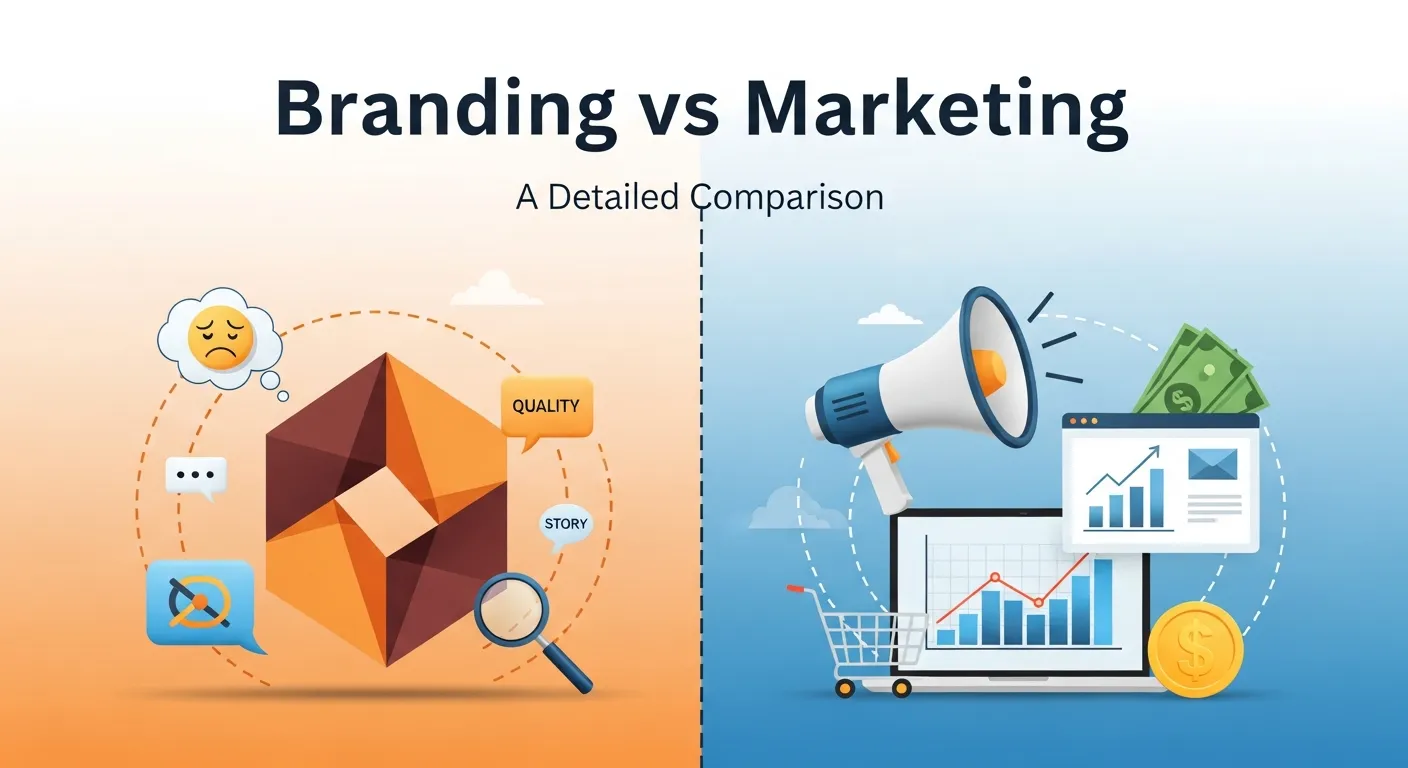
To grow market share, companies must master both branding vs marketing, as well as the countless supporting strategies that fall under these two umbrellas, from virtual influencers to chatbot marketing.
The Focus: Identity vs. Promotion
Branding is inward—mapping purpose, defining the brand archetype, building alignment across every channel, and inspiring internal brand communities. Marketing is outward—a blend of creative execution, paid and organic reach, content dissemination, and personalized experiences via hyper-personalization and gamification strategies.
The Timeline: Enduring Legacy vs. Measurable Action
Branding is about creating a legacy—an emotional connection that fosters customer-centric brand development, lead nurturing, and customer retention. Marketing is about campaigns, short-term impacts, and action, driven by micro-influencers, nano-influencers, and powerful retargeting.
Emotional Branding and Conversion
Branding creates resonance and trust—a “sticky” connection measured in NPS, brand advocacy, and organic growth. Marketing creates action: clicks, conversions, and measurable KPIs, often leveraging social proof, account-based strategies, and data-driven insights.
Table: Branding vs Marketing and More
|
Aspect |
Branding |
Marketing |
Example LSI Keyword |
|---|---|---|---|
|
Primary Focus |
Identity, values, brand story, mission |
Lead generation, promotion, optimization |
Customer experience, lead gen |
|
Output |
Equity, recognition, resilience |
Revenue, traffic, conversions |
Benefit of branding, event mktg |
|
Time Horizon |
Long-term, brand loyalty, legacy |
Short-term, campaign-driven |
Brand longevity, campaign ROI |
|
Strategy |
Brand community, storytelling, ritual |
Content marketing, ads, social engagement |
Social media, influencer strategy |
|
Measurement |
NPS, sentiment, recognition, advocacy |
CTR, CPA, conversion rate, social proof |
Data analytics, performance |
How Branding vs Marketing Work Together
Synergy between branding vs marketing turns initiatives like gamified branding, programmatic ads, and creative marketing services into business growth engines. A strong brand guides messaging, voice, and design in campaigns across every touchpoint, from TikTok marketing to email nurture tracks.
- Marketing Feeds Branding: Every successful campaign (for event marketing, referral marketing, or inbound marketing) delivers on brand promise, lifting your identity.
- Branding Lifts Marketing: Strong values and distinctive identity make influencer or affiliate campaigns resonate, fueling virality and engagement.
For sustained growth, brands should harmonize branding & marketing with:
- Consistent visuals and tone across digital channels: In line with style guides and brand purpose development.
- Customer journey mapping: Aligning touchpoints ensures omnichannel strategies and a seamless experience—think webinars, chatbot support, and sensory branding.
- Community building and advocacy: Creating brand-aligned user communities, gamification strategies, and brand archetype messaging amplifies reach organically.
Real-World Examples of Branding vs Marketing and Beyond
Apple
- Branding: Universal symbol of innovation, design simplicity, and status. Apple’s community-building extends even to developer conferences and premium retail experiences.
- Marketing: “Shot on iPhone” hashtag campaigns, media sponsorship, and AI-powered personalization across social media and outbound emails.
Coca-Cola
- Branding: Association with global happiness, nostalgia, and unity—a masterclass in sensory branding, emotional branding, and green marketing awareness initiatives.
- Marketing: Interactive campaigns, like “Share a Coke,” which leverage social proof, influencer marketing, and personalized content marketing tactics.
Patagonia
- Branding: Ethical production, environmental activism, and brand resilience under crisis. Patagonia activates a strong brand community around global marketing and sustainability marketing.
- Marketing: Viral “Don’t Buy This Jacket” campaign, integrating content and event marketing, and advocacy for reuse—showing brand alignment and authenticity.
Additional: Red Bull & Nike
- Red Bull: Champions metaverse branding, experiential event marketing (flights, F1 teams), and global cultural campaigns for energetic community building.
- Nike: Blends emotive storytelling, hyper-personalized branding moments, green marketing initiatives, and digital influencer collaborations, producing campaigns with lasting impact.
Branding or Marketing First in Competitive Markets?
While branding lays the foundation (archetype, story, and rituals), marketing brings it to life through digital and offline execution—leveraging everything from hyperlocal marketing to creator marketing and TikTok virality. The ideal roadmap involves:
- Crafting brand purpose, community, and story.
- Deploying assets—logo, message, archetype—across all content, sponsored events, and social media management platforms.
- Running iterative marketing tests: A/B ad testing, interactive content, and voice search optimization for maximum ROI.
- Scaling once you discover what resonates, adapting with feedback, and future-proofing with resilience strategies and AI-driven personalization.
Actionable Tips to Improve Your Branding (Powered by LSI Keywords)
- Map your brand archetype: Use neuromarketing insights and brand storytelling for authentic messaging.
- Prioritize accessibility: Leverage sensory branding vs voice branding for inclusivity.
- Foster community: Build brand rituals and gamified branding experiences; think Discord servers or membership clubs.
- Showcase values: Sustainable packaging, green marketing, diversity initiatives, and brand crisis management drive trust.
- Empower employees: Internal branding and training turn staff into ambassadors, accelerating cultural branding.
Actionable Tips to Improve Your Marketing (Infused with LSI Relevance)
- Diversify content strategies: Run webinars, meme marketing, influencer and virtual influencer collaborations, Instagram, and TikTok campaigns.
- Invest in data-driven optimizations: Use Google Analytics, SEMrush, Ahrefs for search term targeting, performance tracking, and competitive brand analysis.
- Experiment with emerging formats: Try NFT marketing, metaverse experiences, virtual product launches, and interactive content marketing.
- Hyper-personalize messaging: Driven by AI, chatbot marketing, micro-moment harnessing, and smart segmentation.
- Promote user-generated content: Utilize hashtag campaigns, referral marketing, and nano-influencer shoutouts.
Digital Trends Blurring Branding vs Marketing (Expanding Relevance)
Modern brand promotion is inseparable from:
- Reality branding in the metaverse and AR-enhanced campaigns,
- Multisensory branding through interactive and experiential marketing,
- Personal branding among founders and creators,
- Social media management for cross-platform consistency,
- Gamified marketing to encourage engagement and advocacy,
- Zero-click content and voice search optimization driving awareness,
- AI marketing automating campaigns while maintaining authenticity.
Adopt these trends for maximum visibility, reach, and resonance in regional or global markets.
Conclusion
In the evolving world of branding vs marketing, success lies in synergy. Branding provides meaning, mission, and community—the why behind your existence. Marketing activates, expands, and converts that meaning into measurable business outcomes. As strategies like inbound marketing, influencer strategy, gamification, and hyper-personalization reshape the landscape, you must invest in both branding vs marketing to achieve—and sustain—leadership in your market. Map your brand, launch your campaigns, harness the full spectrum of digital and traditional tools, and set your business apart for the long-term.
FAQs
1. Can you do marketing without branding?
You can run digital campaigns or PPC ads without a strong brand identity, but this leads only to short-term wins and low retention. Without branding, your business lacks emotional branding, long-term resonance, and community building, making sustained e-commerce growth much harder.
2. Which is more expensive, branding or marketing?
Branding often requires upfront investment—strategy, visual identity, and internal alignment—while marketing is ongoing (content, data analytics, social media management, influencer marketing, creative marketing services, etc.). However, weak branding means marketing (even programmatic ads) will have higher conversion costs and lower retention.
3. How do I know if I have a branding or marketing problem?
If customers see you but don’t remember or trust you, it’s likely a branding issue (fix with brand community, accessibility, neuromarketing, etc.). If trust exists, but you lack leads or sales, focus on optimizing outbound marketing, paid media, and event marketing for conversion optimization and lead generation.
4. Is SEO considered branding or marketing?
Primarily marketing—SEO drives visibility and organic traffic. But strong branding increases branded search, social proof, and SERP click-throughs. The best approach combines keyword targeting, reputation management, and thought leadership for maximal impact.
5. How does social media fit into branding vs marketing?
Social media enables both: strategic content (brand rituals, story, engagement) for branding, and actionable campaigns (contests, influencer collaborations, micro-influencer outreach) for marketing. Channels like Instagram are ideal for brand storytelling and campaign launches.
6. When does a company need to rebrand?
Major shifts (mergers, market evolution, negative PR, new products) may require brand crisis management or full rebranding. Lighter “refreshes” (logo, color update) often occur with new digital marketing strategies or to reflect current trends like green marketing.
7. What is the benefit of branding for employee recruitment?
Strong employer branding attracts top talent, boosting retention and reducing recruitment costs. Leadership in sustainability marketing, company culture, and brand advocacy makes you an employer of choice.
8. How does brand awareness differ from lead generation?
Brand awareness measures recognition, reach, and emotional branding (key metrics: impressions, recall). Lead generation—driven by content marketing, paid ads, and webinars—focuses on acquiring contacts or conversions.
9. Can small businesses compete with major brands through digital marketing?
Absolutely. With nimble tactics—like local SEO, gamification, community building, and personalized campaigns—small businesses can outperform giants in niche or regional markets, leveraging authenticity and adaptability.
10. What is brand equity and how do I grow it?
Brand equity is the value derived from positive perception, loyalty, and emotional association. Grow it by delivering on your brand promise, investing in customer experience, using referral marketing, maintaining consistency, and responding well during crisis management.