Business Revenue Planning enables companies to forecast income, set realistic financial targets, manage budgets, and identify opportunities for sustainable growth. By using reliable sales data, evaluating market conditions, optimizing pricing, and monitoring performance, businesses can improve financial decisions and prepare for future challenges. A flexible revenue plan helps align sales, marketing, operations, and finance around shared business objectives.
Business Revenue Planning helps companies estimate future income, establish realistic financial goals, and make informed decisions about long-term growth. Rather than relying on guesswork, businesses can use revenue data, market research, customer behavior, and sales performance to understand how much income they may generate and what actions can improve financial results.
A well-developed revenue plan connects business objectives with practical financial expectations. It helps organizations determine which products and services contribute the most income, identify potential risks, allocate resources efficiently, and prepare for changing market conditions. Whether a company is expanding into new markets or improving its existing operations, effective planning creates a clearer path toward sustainable profitability.
Understanding the Importance of Business Revenue Planning
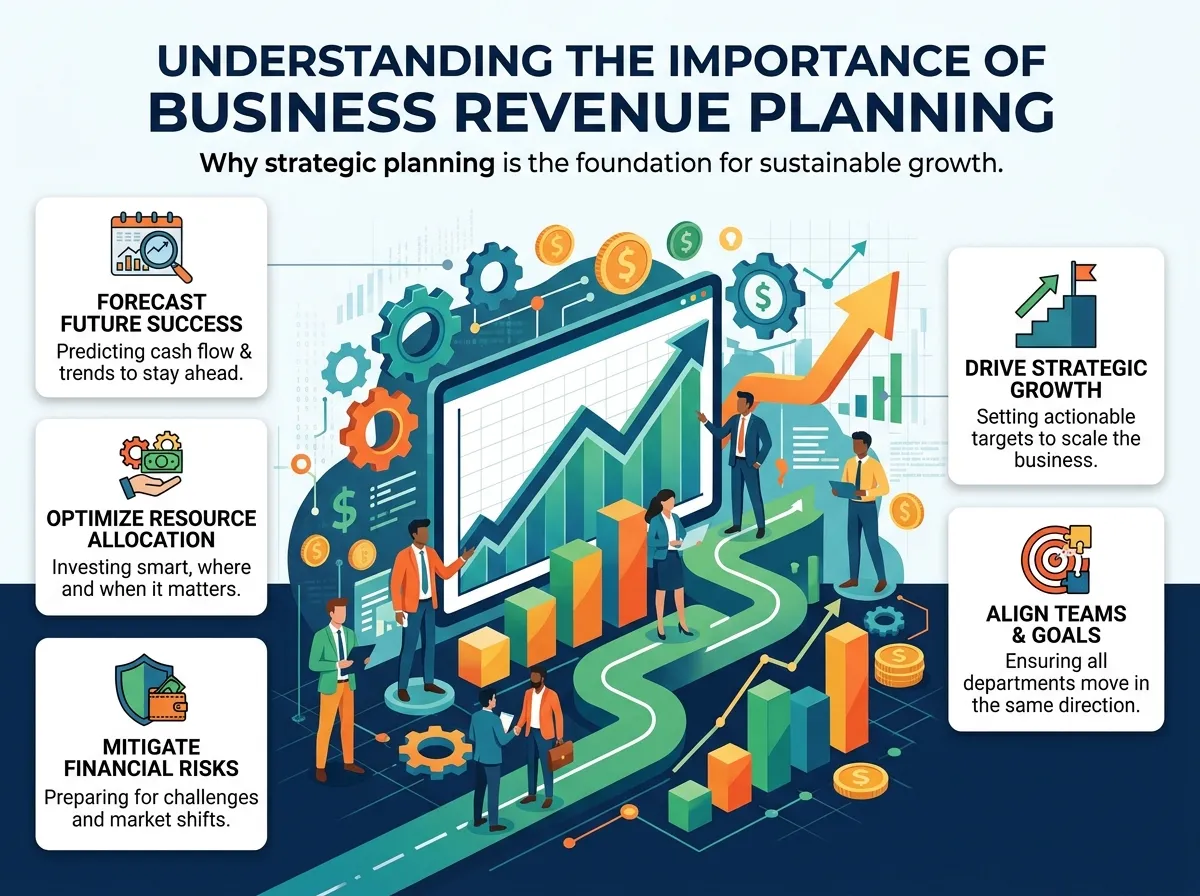
Revenue planning is the process of estimating future business income and determining how an organization will achieve its financial targets. It considers factors such as sales volume, pricing, customer demand, market competition, seasonal changes, and available resources. These factors help businesses develop realistic expectations and make decisions based on financial evidence rather than assumptions.
An effective revenue plan provides direction for different departments. Sales teams can use revenue targets to prioritize opportunities, marketing teams can align their activities with expected demand, and finance teams can prepare budgets based on projected income. When these departments work toward shared objectives, the business can manage resources more effectively and reduce uncertainty.
Revenue planning also helps businesses identify potential financial challenges before they become serious problems. For example, declining sales in a major product category may indicate changing customer preferences or stronger competition. Recognizing this trend early gives management time to review pricing, improve customer experiences, or explore alternative income sources.
Businesses that treat revenue planning as an ongoing process are often better prepared to respond to opportunities and challenges. Instead of creating a forecast once a year and leaving it unchanged, they review actual results regularly and update their expectations as new information becomes available.
Revenue Forecasting Strategies for Better Financial Decisions
Revenue forecasting strategies help businesses estimate how much income they may generate over a specific period. These estimates support budgeting, staffing, inventory management, marketing decisions, and investment planning. Although no forecast can predict the future with complete accuracy, a structured approach can improve the quality of financial decisions.
Historical sales data is a useful starting point. Businesses can review monthly and annual revenue, identify seasonal patterns, and examine periods of growth or decline. A retailer, for example, may discover that sales increase during certain holidays, while a business-to-business service provider may experience higher demand during particular budget cycles.
Market conditions should also influence forecasts. Changes in customer spending, competitor pricing, industry demand, and economic conditions can affect future sales. Combining historical performance with current market information creates a more realistic estimate than simply assuming that previous growth will continue.
Businesses can also develop multiple forecasting scenarios. A conservative forecast estimates revenue under challenging conditions, a realistic forecast reflects the most likely outcome, and an optimistic forecast considers stronger demand or successful expansion. These scenarios help management understand potential outcomes and prepare appropriate responses.
Forecasts become more useful when businesses compare them with actual performance. If revenue consistently falls below expectations, the company can investigate whether the problem comes from weaker demand, inaccurate assumptions, pricing decisions, or sales execution. Regular adjustments help keep financial plans aligned with business reality.
Business Revenue Growth Planning and Market Opportunities
Business revenue growth planning focuses on identifying practical ways to increase income without creating unnecessary financial pressure. Growth may come from attracting new customers, encouraging repeat purchases, introducing additional services, improving pricing, or entering new markets. The most suitable approach depends on the company’s capabilities, customer needs, and competitive position.
Before selecting a growth opportunity, businesses should evaluate their current revenue sources. A company may discover that a small group of products generates most of its income, while other offerings require considerable resources but produce limited returns. This information can help management decide where to invest, what to improve, and which activities deserve less attention.
Customer research is equally important. Understanding why customers purchase, what problems they need to solve, and what influences their buying decisions can reveal opportunities for additional revenue. Businesses may develop complementary services, create suitable service packages, or introduce flexible pricing options that better match customer expectations.
A strong brand can also support revenue growth by improving recognition and building trust. Companies that communicate their value clearly may find it easier to attract qualified prospects and maintain customer relationships. Businesses developing their market position can explore Smart B2B Brand Strategy to understand how brand positioning and market trust contribute to stronger business relationships.
However, growth planning should consider profitability and operational capacity alongside revenue targets. Increasing sales is not always beneficial if delivery costs rise too quickly or service quality declines. Sustainable growth requires a balance between customer demand, available resources, operating expenses, and the company’s long-term objectives.
Choosing the Right Revenue Planning Methods
Different revenue planning methods suit different business models. Some organizations rely heavily on historical sales, while others need customer-level data, market research, or detailed sales pipeline estimates. Selecting an appropriate method depends on the availability of reliable information and the nature of the company’s revenue sources.
Historical forecasting uses previous sales performance to estimate future income. This approach is particularly useful for established businesses with relatively stable demand. However, it may be less reliable when a company introduces a new product, changes its pricing structure, or enters an unfamiliar market.
Pipeline forecasting is useful for businesses that generate revenue through sales opportunities. Companies can review the value of potential deals, their current stages, expected closing dates, and historical conversion rates. This allows management to estimate which opportunities are likely to produce revenue within a particular period.
Market-based forecasting considers external factors, including industry demand, customer spending patterns, and competitor activity. It can help businesses understand whether their growth expectations match broader market conditions. New businesses may find this approach especially valuable when they have limited historical sales data.
A driver-based method estimates revenue using measurable factors such as the number of customers, average transaction value, purchase frequency, or conversion rate. For example, a subscription business may forecast revenue by estimating the number of paying customers and the average monthly subscription price.
No single method is ideal for every situation. Many businesses combine several approaches to create a more complete forecast. Reviewing the assumptions behind each method also helps management understand which estimates are reliable and which require additional research.
Developing Accurate Sales Revenue Projections

Sales revenue projections estimate the income a business expects to earn from selling its products or services during a defined period. These projections help management set priorities, prepare budgets, and evaluate whether sales activities are likely to support financial objectives.
The process begins with a clear understanding of the sales model. A business that sells individual products may calculate expected revenue using the number of units sold multiplied by the average selling price. A service company may estimate income using the number of clients, average contract value, and expected renewal rate.
Businesses should also account for sales cycle length. If customers usually take several weeks or months to make a purchase, opportunities created today may not generate revenue immediately. Ignoring this delay can result in unrealistic monthly projections and poor cash flow preparation.
Customer retention is another important consideration. Existing customers may generate recurring revenue through renewals, repeat purchases, or ongoing service agreements. Monitoring customer retention and purchase frequency helps businesses estimate how much income may come from their current customer base.
Sales teams should contribute practical information to the forecasting process. Their knowledge of customer objections, purchasing intentions, deal progress, and competitive pressure can improve the accuracy of estimates. However, projections should be supported by historical evidence and consistent assumptions rather than overly optimistic sales expectations.
Once projections are prepared, management can compare expected revenue with business targets. Any significant gap may indicate a need for additional sales opportunities, stronger customer retention, revised pricing, or a more realistic growth timeline.
Revenue Budget Planning and Resource Allocation
Revenue budget planning connects expected income with the spending required to generate and maintain it. A business may forecast strong sales, but its financial position can still weaken if operating expenses, marketing costs, staffing requirements, or production costs increase faster than revenue.
A revenue budget should reflect the company’s priorities and financial capacity. Management can estimate income from different products, services, or customer segments and then determine how much money can reasonably be allocated to each activity. This approach encourages more disciplined spending and helps prevent resources from being distributed without a clear business purpose.
Businesses should distinguish between revenue and profit when preparing budgets. Revenue represents the income generated through sales, while profit reflects what remains after relevant expenses are deducted. A company can increase revenue and still experience financial difficulties if the cost of producing, selling, or delivering its offerings becomes too high.
Cash flow also deserves careful attention. Revenue may be recorded before payment is received, particularly when customers purchase on credit or pay through installment arrangements. Businesses should consider payment terms, outstanding invoices, and expected collection dates when planning their financial commitments.
A realistic budget includes room for unexpected changes. Customer demand may fall, suppliers may increase prices, or operating costs may rise. Reviewing budget performance regularly allows management to adjust spending and protect essential business activities when revenue differs from expectations.
Business Income Forecasting for Long-Term Stability
Business income forecasting helps organizations anticipate future financial performance and prepare for both opportunities and risks. While revenue forecasts estimate sales income, a broader income forecast may also consider operating costs and other financial factors that influence the company’s overall results.
Long-term forecasting requires businesses to examine their market position, customer relationships, operational capacity, and planned investments. A company expecting to expand its service area, for example, should consider how additional staffing, marketing, technology, and delivery expenses may affect future financial outcomes.
Reliable forecasting also depends on accurate financial records. Inconsistent sales data, incomplete expense information, or outdated customer records can weaken projections. Businesses should maintain consistent reporting practices so that management can compare performance across different periods and identify meaningful trends.
Financial planning becomes more effective when it is connected to broader business development goals. Companies that want to increase their market presence may need to evaluate new partnerships, product offerings, customer segments, and distribution channels. Exploring Business Development can provide useful context for understanding how growth opportunities connect with long-term business objectives.
Forecasts should be reviewed whenever important assumptions change. A new competitor, a major customer contract, a shift in market demand, or a significant cost increase may affect expected results. Updating forecasts helps businesses make decisions using current information rather than relying on outdated projections.
Revenue Optimization Strategies That Improve Performance
Revenue optimization strategies aim to improve the income a business generates from its existing resources, customers, products, and services. Instead of focusing exclusively on attracting more customers, businesses can examine whether they are pricing effectively, serving the right audience, and making the most of current demand.
Pricing is one of the most important factors. Prices that are too low may limit profitability, while prices that are too high may reduce demand if customers do not perceive sufficient value. Businesses should evaluate customer expectations, competitor offerings, delivery costs, and product differentiation before making pricing changes.
Improving customer retention can also strengthen revenue performance. Acquiring new customers often requires marketing and sales investment, while satisfied existing customers may return for additional purchases or recommend the business to others. Reliable service, responsive communication, and consistent product quality can support repeat business.
Companies can also evaluate revenue by product, service, customer segment, or sales channel. This analysis may reveal that some offerings produce stronger returns than others. Management can use these findings to refine its product mix, improve underperforming services, or focus resources on opportunities that better support business objectives.
Brand presentation may influence how customers understand and value a company’s offerings. Clear messaging, accessible communication, and professional visual identity can help businesses explain their value to different audiences. Resources such as Personal Branding Photography That Boosts Your Presence can be relevant when business owners or service professionals want to present themselves more consistently and professionally.
Revenue optimization should remain customer-focused. Increasing prices or pushing additional purchases without considering customer needs may damage trust and reduce future sales. The strongest improvements usually come from delivering clear value while making pricing, purchasing, and service experiences more effective.
Financial Revenue Planning and Business Performance
Financial revenue planning brings forecasts, budgets, targets, and business priorities together within a consistent financial framework. It helps decision-makers understand whether expected income can support operating requirements, planned investments, and future expansion.
A useful financial plan should identify the assumptions behind revenue estimates. These may include expected customer growth, average order value, conversion rates, renewal rates, pricing changes, and market demand. Documenting these assumptions makes the plan easier to review and adjust when conditions change.
Businesses should also establish a regular reporting process. Monthly reviews may be suitable for many organizations, while businesses with seasonal demand or rapidly changing sales may need more frequent monitoring. Reports should compare actual revenue with planned figures and explain the reasons for significant differences.
Performance measurement should extend beyond total revenue. Metrics such as average transaction value, recurring revenue, customer retention, gross margin, and revenue by product category can reveal why financial results are changing. The right measures depend on the company’s business model and strategic objectives.
Financial revenue planning is most effective when the people responsible for sales, marketing, operations, and finance share information. This collaboration helps ensure that forecasts reflect operational realities and that revenue goals are supported by achievable actions.
Revenue Target Setting and Business Revenue Management

Revenue target setting gives a business measurable financial objectives. Targets help teams understand what they are working toward, evaluate progress, and identify when corrective action may be necessary. However, targets should be based on realistic forecasts, available resources, market conditions, and the company’s wider goals.
Businesses can establish annual revenue objectives and divide them into quarterly or monthly milestones. These smaller targets make progress easier to monitor and help management identify problems before they affect the full year. Targets may also differ by product, service, location, or customer segment.
It is important to distinguish between an ambitious target and an achievable one. Unrealistic expectations can encourage excessive spending, poor customer practices, or pressure to pursue unsuitable sales opportunities. A balanced target should challenge the organization while remaining supported by credible assumptions and practical plans.
Business revenue management involves continuously coordinating revenue generation, forecasting, pricing, sales performance, and financial reporting. It is not simply a process of setting a target and waiting for results. Managers need to review performance, understand changing customer behavior, and adjust priorities when the evidence supports a different approach.
Technology can support this process by organizing sales data, tracking customer activity, automating reports, and highlighting performance trends. However, software is only useful when the underlying data is accurate and employees understand how to interpret the information.
Ultimately, effective revenue management depends on consistent monitoring and informed decision-making. Businesses that connect revenue targets with customer value, operational efficiency, and financial discipline are better positioned to build stable income and achieve sustainable growth.
Conclusion
Business Revenue Planning helps organizations make informed financial decisions, establish achievable targets, and identify opportunities for sustainable growth. By combining accurate forecasting, practical budgeting, reliable sales projections, and ongoing performance reviews, businesses can develop a clearer understanding of their financial future.
The most effective approach is flexible, data-informed, and connected to the company’s wider objectives. When businesses regularly review their assumptions, understand their customers, and adjust their plans to reflect actual performance, revenue planning becomes a valuable part of long-term business management.
Frequently Asked Questions
1. What is Business Revenue Planning?
Business Revenue Planning is the process of estimating future income, establishing revenue targets, and identifying the actions needed to achieve them. It involves analyzing historical sales, customer demand, pricing, market trends, and business resources to create realistic financial expectations.
2. Why is revenue planning important for a business?
Revenue planning helps businesses make informed decisions about budgeting, staffing, marketing, pricing, and expansion. It also helps identify potential revenue shortfalls early, allowing management to adjust strategies before financial problems become more difficult to address.
3. What are the main revenue forecasting strategies?
Common revenue forecasting strategies include historical sales analysis, sales pipeline forecasting, market-based forecasting, and driver-based forecasting. Businesses often combine these methods to develop more reliable estimates and account for changes in demand, customer behavior, and market conditions.
4. How do businesses create accurate sales revenue projections?
Businesses can create sales revenue projections by reviewing historical sales, estimating future sales volume, analyzing average transaction values, and evaluating current sales opportunities. They should also consider sales cycle length, customer retention, pricing changes, and seasonal demand.
5. What is the difference between revenue planning and revenue budgeting?
Revenue planning focuses on estimating future income and determining how a business can achieve its financial goals. Revenue budgeting connects those expectations with spending decisions and resource allocation. Both processes work together to support financial control and business growth.
6. Which revenue planning methods are best for small businesses?
Small businesses can start with historical sales analysis, simple sales projections, and estimates based on customer numbers and average purchase values. Businesses with limited historical data can also use market research and competitor analysis to develop initial forecasts.
7. How can a business improve its revenue growth?
A business can improve revenue growth by attracting suitable customers, strengthening customer retention, reviewing pricing, expanding valuable offerings, and identifying promising markets. Sustainable growth also requires monitoring expenses and ensuring that increased sales do not reduce profitability.
8. What role does revenue target setting play in business planning?
Revenue target setting establishes measurable financial objectives for the business and its teams. Realistic targets help organizations monitor progress, prioritize activities, identify performance gaps, and make timely adjustments to their sales and marketing efforts.
9. How often should a business review its revenue plan?
Many businesses benefit from reviewing revenue performance monthly, with more frequent checks when sales conditions change quickly. Forecasts should also be updated after major changes, such as new contracts, pricing adjustments, shifts in customer demand, or unexpected operating costs.
10. How can technology support business revenue management?
Revenue management tools can organize sales information, track performance, automate reporting, and help identify trends. Businesses can use these insights to improve forecasting and decision-making, provided their data is accurate and their teams understand how to interpret the results.