For any small business, creating a lasting impact requires more than just a great product. It demands a powerful, integrated marketing and brand strategy that captures attention and builds loyalty.
This guide demystifies the relationship between marketing and brand strategy, offering a comprehensive roadmap for small businesses. We’ll explore their distinct roles, their powerful synergy, and provide a step-by-step process for developing and implementing them. You’ll gain actionable insights, learn from real-world examples, and discover the tools you need to drive sustainable growth and build a memorable brand that customers trust.
The Pillars of Business Growth: Deconstructing Marketing and Brand Strategy
Launching or growing a business in a competitive marketplace is a formidable challenge. Success often hinges on two fundamental pillars: your marketing approach and your brand strategy. While these terms are frequently used as if they are the same, they represent distinct yet deeply interconnected functions. When they work in harmony, they create a powerful force that not only attracts customers but also forges lasting impressions and cultivates unwavering trust. This guide will break down what a marketing and brand strategy entails, how the two elements complement each other, and the practical steps to build impactful strategies for your small business.
1. Understanding Marketing: The Engine of Customer Acquisition
Marketing is the set of activities a company undertakes to promote the buying or selling of a product or service. It is the active, tactical process of connecting with your target audience by creating and communicating value. At its core, marketing is about understanding customer needs and delivering solutions. The classic framework for this is the 4 Ps:
- Product: The item or service you offer. It must meet a genuine need or desire in the marketplace.
- Price: The cost consumers pay. Pricing strategy affects customer perception, market position, and profitability.
- Place: Where and how your product is distributed and sold. This includes everything from physical storefronts to e-commerce platforms.
- Promotion: The methods used to advertise and sell your product. This is the most visible aspect of marketing, encompassing everything from digital ads to public relations.
The Modern Marketing Toolkit: Types and Tactics
The digital age has expanded the marketing landscape, offering a diverse array of channels to reach your audience. An effective marketing and brand strategy for a small business will likely blend several of these approaches.
- Digital Marketing: This broad category utilizes online channels to connect with customers. It’s the cornerstone of modern marketing and includes:
-
- Social Media Marketing (SMM): Using platforms like Instagram, TikTok, LinkedIn, and Facebook to build community, share content, and drive engagement.
- Content Marketing: Creating valuable, relevant content (blogs, videos, podcasts) to attract and retain an audience, building trust and credibility over time. This is a key part of inbound marketing.
- Search Engine Optimization (SEO): Optimizing your website and content to rank higher in search engine results, driving organic traffic. Tools from sources like Backlinko can provide a deep understanding of SEO fundamentals.
- Email Marketing: Directly communicating with an audience that has opted in to receive messages from you. It’s a powerful tool for nurturing leads and encouraging customer retention.
- Traditional Marketing: While digital often takes the spotlight, traditional methods still hold value, especially for achieving broad reach or targeting specific local demographics. This includes print ads, television and radio commercials, and direct mail.
- Influencer Marketing: Partnering with trusted personalities, from celebrities to micro-influencers, to promote products to their dedicated followers. This strategy leverages social proof to build credibility quickly.
- Event Marketing: Engaging with potential customers through live or virtual events, such as webinars, workshops, or trade shows. This allows for direct interaction and a memorable customer experience.
The Unseen Foundation: The Role of Market Research
Every successful marketing campaign is built on a solid foundation of market research. Without understanding your audience, your efforts are just shots in the dark. Market research is the process of gathering information about your target customers’ needs, preferences, and behaviors.
- Competitive Brand Analysis: Analyze what your competitors are doing. What are their strengths and weaknesses? Where are the gaps in the market that your business can fill?
- Customer Surveys and Feedback: Directly ask your current customers about their experiences. What do they love about your product? What could be improved?
- Industry Trend Analysis: Stay informed about what’s happening in your industry. Are there new technologies or shifts in consumer behavior that present opportunities or threats?
Thorough market research ensures your marketing efforts are aligned with what your audience genuinely wants, making your campaigns more effective and your budget go further.
2. Understanding Brand Strategy: The Soul of Your Business
If marketing is the engine, brand strategy is the soul. It’s the long-term plan for how your business will present itself to the world. It’s your identity, your promise to customers, and the perception you want to create in their minds. A brand is not just a logo or a name; it’s the sum of all experiences a customer has with your company. A strong brand strategy provides the “why” behind your “what.”
Key components of a robust brand strategy include:
- Brand Purpose, Mission, and Values: This is the core of your brand. What is your reason for being beyond making a profit? What principles guide your decisions? Your brand purpose development is your north star.
- Brand Personality and Voice: This defines the emotional and human characteristics of your brand. Are you innovative and bold, or trustworthy and traditional? Playful or serious? This personality should be reflected in your brand voice across all communications.
- Brand Identity (Visual and Sensory): This is the tangible expression of your brand. It includes your logo, color palette, typography, and imagery. It can also extend to sensory branding, like a signature scent in a retail store or a specific sound associated with your brand (sonic branding).
- Brand Positioning: This is where your brand fits in the market and in the minds of your customers. It’s what makes you different from the competition.
Crafting a Unique Value Proposition (UVP)
Your Unique Value Proposition is a clear, concise statement that communicates the distinct benefit you offer and why a customer should choose you. A strong UVP answers three critical questions:
- What specific benefit do you provide?
- How do you solve your customer’s problem or improve their situation?
- What makes you different from your competitors?
For example, the UVP for the project management tool Trello is centered on visual collaboration: “Trello helps teams move work forward.” It’s simple, benefit-oriented, and clear.
The Power of Brand Consistency
Consistency is the cornerstone of trust. Every touchpoint a customer has with your business—from your website and social media posts to your packaging and customer service interactions—should feel cohesive. When your tone of voice, visual identity, and core messaging are consistent, you reinforce your brand’s identity and build credibility. This consistency is what transforms a one-time customer into a loyal advocate and builds long-term brand equity.
|
Aspect |
Marketing |
Brand Strategy |
|---|---|---|
|
Focus |
Attracting customers, driving sales (tactical). |
Building reputation, creating loyalty (holistic). |
|
Timeframe |
Short-term to medium-term (campaign-based). |
Long-term and ongoing. |
|
Goal |
Generate immediate action and lead generation. |
Build lasting relationships and brand advocacy. |
|
Metrics |
Sales figures, conversion rates, click-throughs. |
Brand awareness, customer perception, loyalty, CLV. |
The Synergy: How Marketing and Brand Strategy Work Together
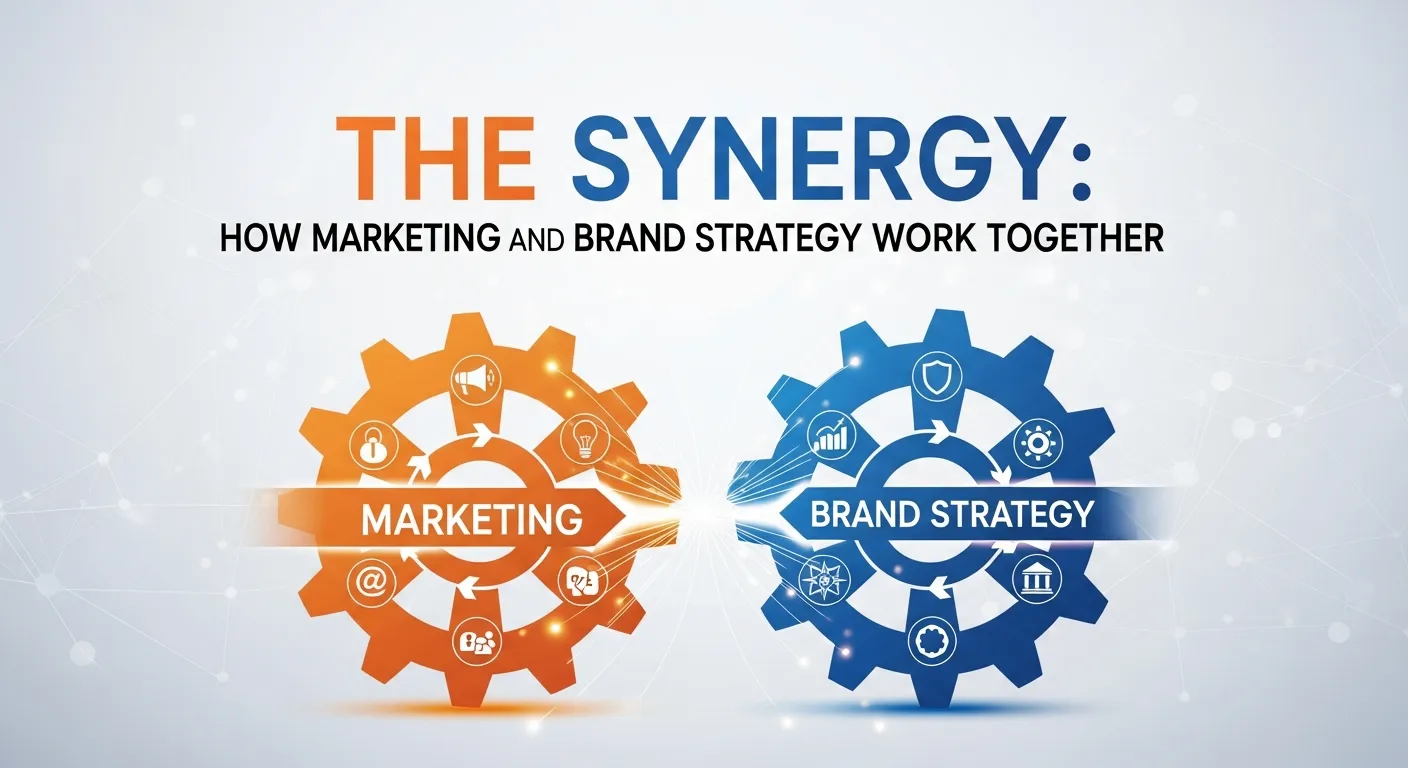
Marketing and brand strategy are not separate disciplines; they are two sides of the same coin. A powerful marketing and brand strategy is one where both elements are in perfect alignment, each amplifying the other’s effectiveness.
How Brand Strategy Fuels Marketing Efforts
Without a solid brand strategy, marketing campaigns become disjointed and lack direction. Imagine a marketing team trying to create an ad without knowing the brand’s tone of voice, core values, or target audience. The result would likely be generic, confusing, or, worse, off-putting.
Brand strategy provides the essential blueprint for all marketing activities. It answers the critical questions that guide creative execution:
- What should our campaigns look and feel like? The brand’s visual identity dictates the design.
- How should our campaigns make customers feel? The brand personality informs the emotional tone.
- What key messages should we convey? The brand’s mission and UVP provide the core narrative.
Aligning Marketing Campaigns with Brand Values for Deeper Connection
The most memorable and successful marketing campaigns are those that perfectly reflect the brand’s core values. When a campaign resonates on an emotional level, it’s because it connects with something the audience believes in.
- Patagonia is a prime example. Their marketing doesn’t just showcase jackets; it showcases environmental activism. Campaigns like “Don’t Buy This Jacket” promote sustainability and conscious consumerism, perfectly aligning with their brand values and attracting a loyal tribe of like-minded customers.
- Nike’s campaigns rarely focus on the technical specs of their shoes. Instead, they embody motivation, ambition, and the “Just Do It” spirit. Their brand storytelling is about empowerment, which aligns perfectly with their brand strategy.
Building Long-Term Brand Equity Through Integrated Strategies
When marketing activities are consistently guided by a strong brand strategy, you begin to build brand equity. This is the intangible value your brand holds in the minds of consumers. It’s why people are willing to pay a premium for an Apple product or a Starbucks coffee.
Each well-aligned marketing campaign acts as a deposit into your brand equity bank account. Over time, these consistent messages and experiences build an emotional connection with your audience. These connected customers become loyal advocates who not only keep coming back but also spread the word about your business—the most powerful form of marketing there is.
A Practical 5-Step Guide to Developing Your Marketing and Brand Strategy
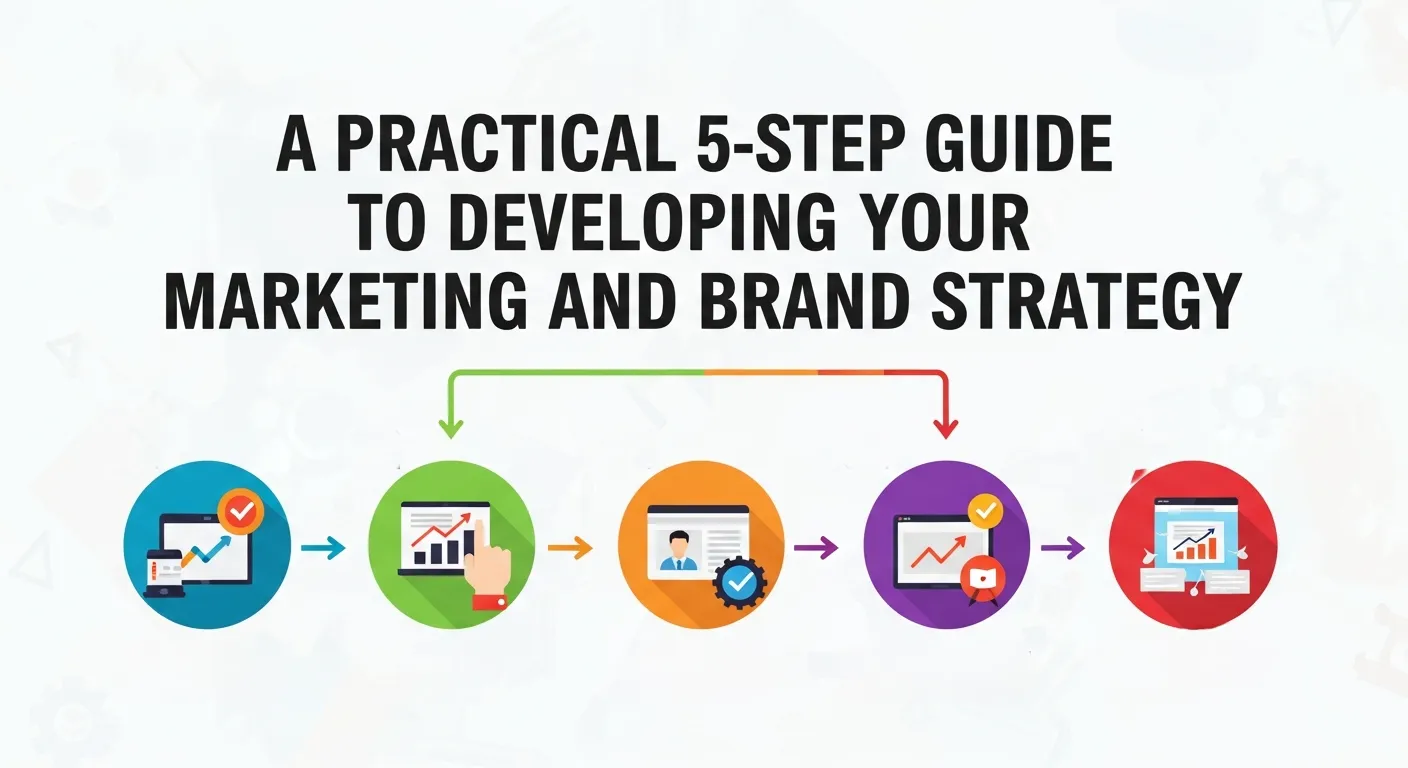
Now, let’s translate theory into action. Here is a step-by-step process for a small business to develop an integrated marketing and brand strategy.
Step 1: Conduct a Foundational SWOT Analysis
Before you can plan for the future, you need to understand your present situation. A SWOT analysis is a framework for identifying your business’s Strengths, Weaknesses, Opportunities, and Threats.
- Strengths: What do you do well? What unique assets do you have? (e.g., exceptional customer service, a proprietary product).
- Weaknesses: Where could you improve? What are you lacking? (e.g., a small marketing budget, a lack of brand recognition).
- Opportunities: What external factors can you take advantage of? (e.g., a growing market, a competitor’s misstep).
- Threats: What external factors could harm your business? (e.g., new competitors, changing regulations).
This analysis provides the strategic context needed to make informed decisions.
Step 2: Identify and Understand Your Target Audience
You cannot be everything to everyone. The more specific you are about your ideal customer, the more effective your strategy will be.
- Create Detailed Buyer Personas: Go beyond basic demographics. Give your ideal customer a name, a job, hobbies, and goals. What are their pain points? What motivates them?
- Gather Data: Use tools like Google Analytics to understand who is visiting your website. Use social media analytics to see who is engaging with your content. Conduct surveys to get direct feedback.
These personas will be your guide for crafting messaging and choosing channels that truly resonate.
Step 3: Set SMART Goals for Your Strategy
Your goals give your strategy direction and make it measurable. Use the SMART framework: Specific, Measurable, Achievable, Relevant, and Time-bound.
- Weak Goal: “I want to grow my business.”
- SMART Goal: “I will increase website sales by 15% in the next quarter (3 months) by launching a targeted Google Ads campaign and running a 20% off promotion for email subscribers.”
Setting SMART goals for both marketing (e.g., lead generation) and branding (e.g., brand awareness) ensures you are working toward tangible outcomes.
Step 4: Choose the Right Marketing Channels and Tactics
Based on your audience and goals, select the channels where you will focus your efforts. A small business with a limited budget should not try to be everywhere at once.
- Where does your audience spend their time? If you’re targeting professionals, LinkedIn might be your priority. If you have a highly visual product for a younger demographic, Instagram and TikTok are likely better choices.
- What channels align with your strengths? If you are a great writer, content marketing through a blog could be effective. If you are charismatic on camera, focus on video marketing.
Step 5: Measure, Analyze, and Optimize
A strategy is not static; it’s a living document. You must continuously track your performance to understand what’s working and what isn’t.
- Define Your Key Performance Indicators (KPIs): These are the metrics tied to your SMART goals (e.g., website traffic, conversion rate, email open rate, social media engagement).
- Use Analytics Tools: Tools like Google Analytics, Google Search Console, and the built-in analytics on social media platforms are essential for tracking your KPIs.
- Be Willing to Pivot: If a campaign is not performing well, don’t be afraid to analyze why and make changes. Optimization is the key to long-term success.
Conclusion
Marketing and brand strategy are the inseparable duo that drives business growth. Marketing provides the tactics to reach customers, while brand strategy provides the soul and direction that builds lasting connections. For small businesses, integrating these two elements is not just a best practice—it’s a necessity for survival and success. By building a cohesive strategy rooted in audience understanding and authentic values, you can create a brand that doesn’t just sell products but earns a permanent place in the hearts and minds of your customers.
FAQs
1. What’s the first step for a small business with no strategy?
Start with your “why.” Before anything else, clearly define your brand’s purpose, mission, and values. This will serve as the foundation for both your brand identity and all future marketing decisions. A SWOT analysis is a great next step.
2. How much should a small business budget for marketing?
There’s no single answer, but a common rule of thumb is to allocate 5-10% of your revenue to marketing. For new businesses focused on growth, this might be higher. The key is to start with a budget you can afford and focus on high-ROI activities.
3. What is the difference between a brand strategy and a brand identity?
Brand strategy is the high-level plan of how you want to be perceived. Brand identity is the collection of tangible elements that express that strategy—your logo, colors, fonts, and tone of voice. Identity is the execution of the strategy.
4. Can I do my own marketing and branding, or should I hire a professional?
Many small business owners successfully manage their own marketing and branding, especially with the user-friendly tools available today. However, if you lack the time or expertise, hiring a freelancer, consultant, or small agency can be a worthwhile investment to accelerate growth.
5. How often should I revisit my marketing and brand strategy?
You should be monitoring your marketing performance continuously (monthly or quarterly). It’s a good practice to formally review and update your overall strategy annually or whenever there is a significant change in your business or the market.
6. What are the most cost-effective marketing strategies for a small business?
Content marketing (blogging, SEO), email marketing, and active engagement on the right social media platforms are often the most cost-effective. They require an investment of time more than money and can deliver excellent long-term ROI by building an owned audience.
7. How do I measure brand awareness?
Measuring brand awareness can be done by tracking direct traffic to your website (people typing your URL directly), monitoring social media mentions and share of voice, and tracking branded search volume (how many people are searching for your brand name in Google).
8. What is a “brand archetype” and should I have one?
Brand archetypes are symbolic character types (e.g., The Hero, The Sage, The Rebel) that help define a brand’s personality in a relatable way. Using an archetype can help ensure your brand’s voice and actions are consistent and can be a very useful tool for small businesses.
9. How does customer service fit into my brand strategy?
Customer service is a critical component of your brand strategy. Every interaction a customer has with your support team is a brand touchpoint. Excellent, on-brand customer service reinforces your brand’s promise and is a powerful tool for building loyalty and advocacy.
10. My marketing isn’t working. What should I do?
Go back to the fundamentals. First, are you sure you deeply understand your target audience and their pain points? Second, is your messaging clear and does it communicate a unique value proposition? Third, are you tracking the right metrics? Often, a failing campaign is a symptom of a disconnect in one of these core areas.