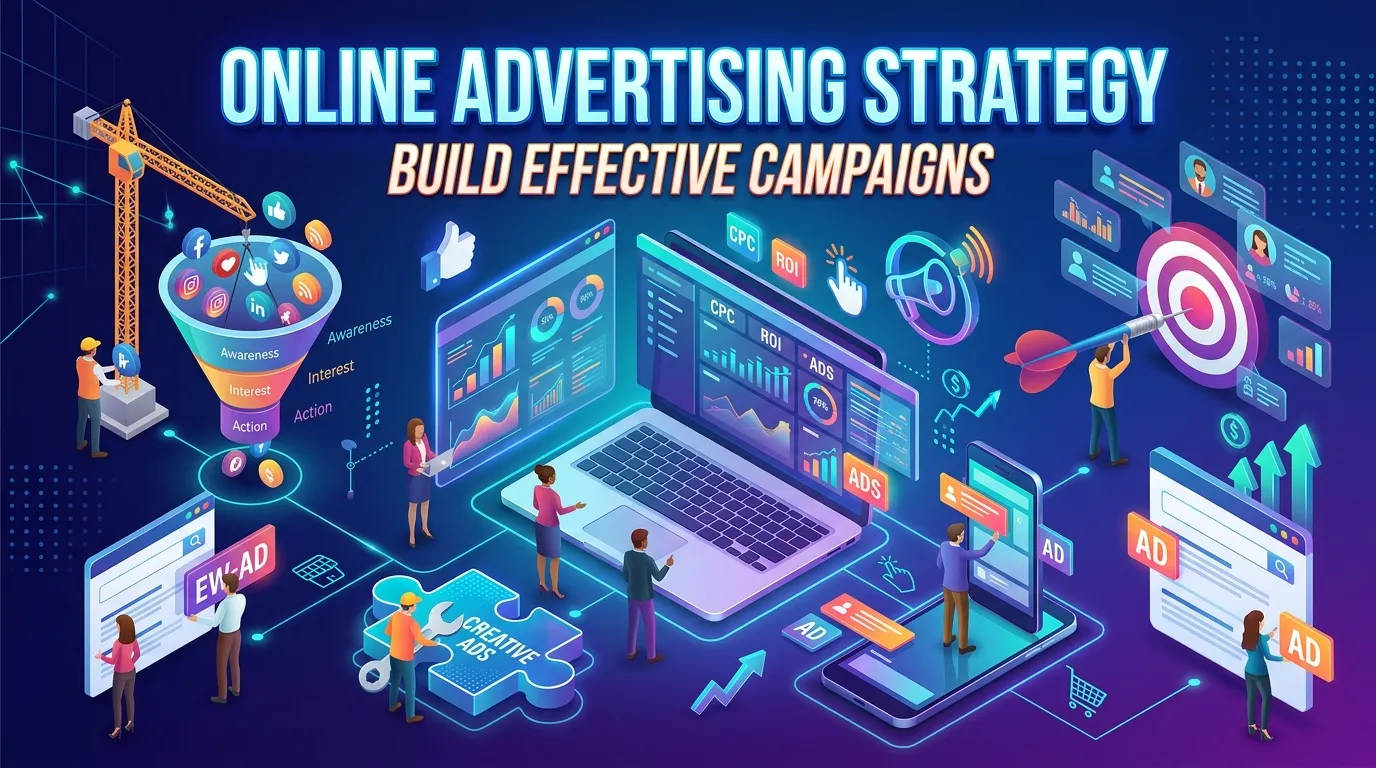
An effective online advertising strategy helps businesses reach the right audiences, promote their products or services, generate qualified traffic, and improve conversions. By combining audience targeting, compelling creative content, paid campaigns, performance tracking, and continuous optimization, businesses can make their advertising budgets more effective.
Online advertising has become an important part of modern marketing because businesses can reach potential customers across search engines, social media platforms, websites, video channels, and other digital environments. However, simply placing advertisements online does not guarantee strong results. Businesses need a clear strategy that connects advertising goals with audience needs, creative messaging, targeting, and measurable outcomes.
A well-planned online advertising strategy helps businesses determine where advertisements should appear, who should see them, what message should be communicated, and how campaign performance should be evaluated. Instead of spending money on advertisements without a clear direction, marketers can use data and audience insights to make more informed decisions.
Effective advertising is also closely connected with branding. A campaign may generate clicks, but if the message does not communicate the brand clearly, it may not create lasting value. Businesses can strengthen this connection by understanding What is Marketing and Brand Strategy? and using consistent positioning across paid and organic marketing channels.
What Is an Online Advertising Strategy?
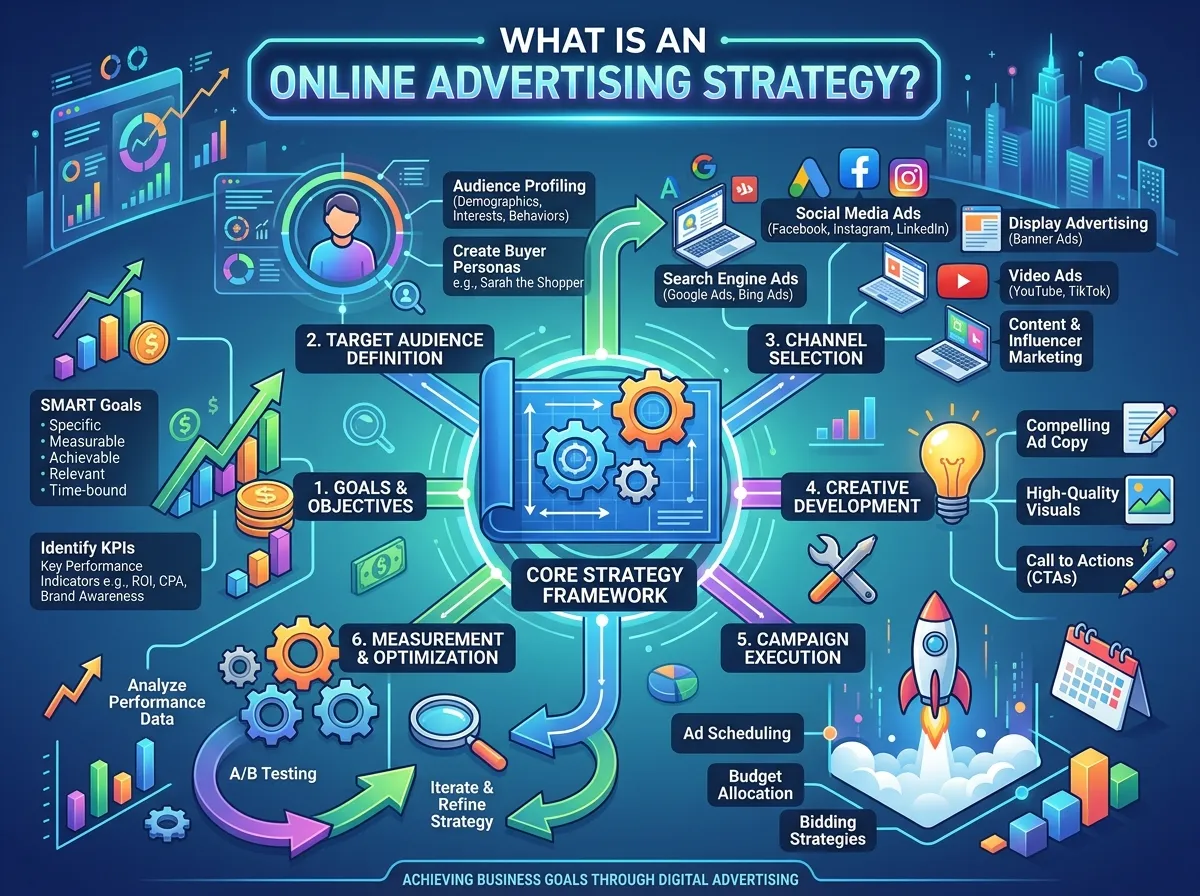
An online advertising strategy is a structured approach to using paid digital channels to reach specific marketing and business objectives. It can include search advertising, display advertising, social media advertising, video ads, remarketing, sponsored content, and other forms of digital promotion.
The purpose of an online advertising strategy is not simply to generate impressions. A successful strategy connects advertising activity with measurable goals such as website traffic, lead generation, product sales, app downloads, registrations, or brand awareness.
Businesses need to understand their target audience before choosing advertising channels. Customer demographics, interests, behaviors, purchasing intent, location, and previous interactions can influence where and how advertisements should be delivered.
Why Businesses Need a Strong Digital Advertising Strategy
A strong digital advertising strategy gives businesses greater control over how their advertising budget is used. Instead of relying on broad exposure, businesses can focus their spending on audiences that are more likely to show interest in their products or services.
Digital advertising also provides valuable performance information. Marketers can monitor impressions, clicks, conversions, engagement, cost, and other indicators to understand how campaigns are performing.
This level of visibility makes it possible to adjust campaigns while they are running. If a particular advertisement receives many impressions but few clicks, marketers can test different creative elements or messaging. If one audience segment generates better conversions, budget allocation can be adjusted accordingly.
Understanding the Target Audience
Audience understanding is one of the most important parts of an effective advertising strategy. Businesses need to know who they want to reach and what motivates those people to take action.
Customer research can reveal important information about purchasing behavior, problems, interests, preferences, and expectations. These insights can then influence advertising messages and creative decisions.
Online advertising targeting allows marketers to make campaigns more specific. Depending on the platform, businesses may be able to target users based on factors such as location, demographics, interests, browsing behavior, search intent, previous interactions, or customer lists.
More precise targeting can help reduce wasted advertising spend because advertisements are shown to audiences that are more closely connected to the campaign objective.
Choosing the Right Advertising Channels
Different online channels serve different purposes, so businesses should select platforms based on their audience and goals. Search advertising can be useful when people are actively looking for products or services, while social media advertising can help businesses reach audiences based on interests, behaviors, and demographics.
Display advertising can support brand visibility and remarketing, while video advertising can communicate products and ideas through visual storytelling. The right combination depends on the customer journey and the type of business.
A successful paid online advertising strategy should not automatically focus on every available channel. Spreading a limited budget across too many platforms can make campaigns difficult to manage and optimize. Selecting channels that match audience behavior can produce a more focused advertising experience.
Creating an Effective Online Advertising Campaign
An online advertising campaign should have a clear purpose. Before creating advertisements, marketers need to determine what they want the audience to do after seeing the message.
A campaign focused on awareness may emphasize reach and visibility, while a lead generation campaign may encourage users to complete a form or request more information. An ecommerce campaign may focus on product purchases, while a remarketing campaign may encourage previous visitors to return.
The message should clearly communicate the value being offered. Advertisements have limited space and attention, so complicated messaging can make it difficult for users to understand the offer.
Strong campaigns generally combine relevant messaging with compelling creative elements and a clear call to action. The landing page should also support the promise made in the advertisement so that users receive a consistent experience after clicking.
Developing Effective Online Advertising Techniques

Successful online advertising techniques focus on relevance, clarity, creativity, and audience behavior. One effective approach is to highlight a specific customer benefit rather than simply describing a product or service.
Another useful technique is to address a problem or need that the target audience already recognizes. When an advertisement communicates a solution clearly, users have a stronger reason to pay attention.
Visual storytelling can also improve advertising performance, particularly on social media and video platforms. Images, graphics, demonstrations, and short videos can communicate ideas quickly and make advertisements more memorable.
Testing different messages is equally important. A headline that performs well with one audience may not produce the same results with another. Continuous experimentation allows businesses to discover which combinations of messaging and creative content work best.
Personal Branding and Advertising
Advertising can also be used to strengthen individual and professional brands. Entrepreneurs, consultants, creators, and professionals can use paid campaigns to increase awareness of their expertise and direct audiences toward valuable resources.
Businesses interested in this area can explore What Is Personal Branding to understand how personal identity, expertise, and communication can contribute to a stronger brand presence.
When advertising supports personal branding, the message should remain authentic and consistent. A paid campaign should reinforce the same identity and values that audiences encounter through websites, social profiles, content, and other marketing channels.
Using Digital Advertising Tactics Effectively
Strong digital advertising tactics should be connected to the overall customer journey. A person seeing a brand for the first time may need educational content, while someone who has already visited a product page may respond better to a specific offer.
Remarketing is one example of a tactic that can reconnect with people who have already interacted with a business. These audiences may already understand the brand, meaning the advertising message can focus more directly on the next action.
Businesses can also experiment with different creative formats, audience segments, bidding approaches, offers, and landing pages. The goal is not to change everything at once but to identify which factors contribute to stronger results.
Online Advertising for Businesses of Different Sizes
Online advertising for businesses can be valuable for both small companies and larger organizations. Small businesses can use targeted campaigns to reach specific geographic markets or niche audiences without requiring the resources of a large national advertising campaign.
Local businesses, for example, can target people within specific areas and promote services, offers, events, or locations. Larger businesses can use more complex campaigns across multiple markets and audience segments.
The most important factor is not necessarily the size of the advertising budget. A smaller campaign with accurate targeting, relevant messaging, and strong optimization can outperform a larger campaign that lacks clear audience direction.
Businesses can also strengthen advertising results by connecting paid campaigns with content marketing. For example, useful local content can support both paid promotion and organic visibility. Resources such as Mastering Metaverse Branding can also provide inspiration for brands exploring emerging digital experiences and new ways to communicate with audiences.
Landing Pages and Advertising Performance
The advertisement is only one part of the customer experience. After clicking an ad, users are usually directed to a landing page or website page. If that page is slow, confusing, irrelevant, or difficult to navigate, advertising performance can suffer.
A strong landing page should closely match the advertisement. The headline, offer, visuals, and call to action should provide a consistent experience from the advertisement through to conversion.
For lead generation campaigns, forms should be simple and relevant. For product campaigns, important product information, pricing, benefits, reviews, and purchase options should be easy to find.
Improving the connection between advertisements and landing pages can increase conversion opportunities without necessarily increasing advertising spend.
Online Advertising Targeting and Personalization
Personalization can make advertisements more relevant to specific audience groups. Rather than showing identical messages to everyone, businesses can adapt advertisements according to customer interests, location, previous interactions, or stage in the buying journey.
Online advertising targeting can also support different messages for different audiences. A new prospect may receive an introductory advertisement, while an existing customer may see a complementary product or special offer.
Retargeting can be especially useful when users have previously visited a website but did not complete the desired action. A carefully designed campaign can remind them of the brand and provide a relevant reason to return.
However, targeting should always be used thoughtfully. Excessive repetition can cause advertising fatigue and negatively affect the customer experience.
Online Ad Campaign Optimization
Online ad campaign optimization is an ongoing process rather than a one-time task. Campaigns should be reviewed regularly to identify strong-performing and weak-performing elements.
Marketers can compare audience segments, advertisements, keywords, placements, creative formats, landing pages, and conversion results. This information can help determine where budget should be increased or reduced.
Optimization can also involve adjusting bids, improving ad copy, replacing underperforming creative, refining targeting, and improving landing pages. The objective is to make each part of the campaign contribute more effectively to the desired result.
A campaign that performs well initially may still require optimization as audience behavior changes. Continuous analysis helps businesses respond to those changes.
Measuring Online Advertising Performance
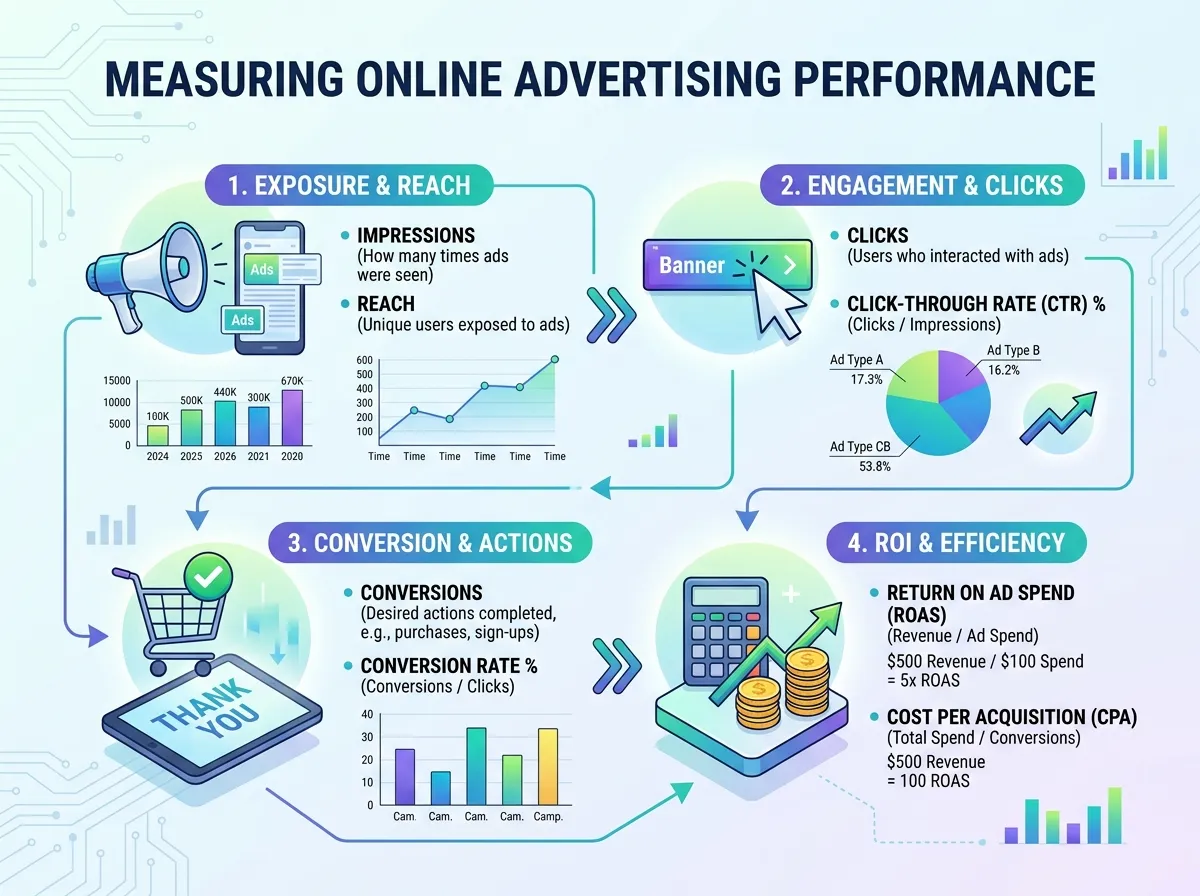
Online advertising performance metrics help businesses understand whether their campaigns are producing meaningful results. Common measurements include impressions, reach, clicks, click-through rate, conversion rate, cost per click, cost per acquisition, and return on advertising spend.
However, the most useful metrics depend on the campaign objective. A brand awareness campaign may focus more heavily on reach and impressions, while a lead generation campaign may prioritize qualified leads and cost per lead.
Businesses should avoid judging campaigns based on a single metric. A high click-through rate can look positive, but if those clicks do not generate leads or sales, the campaign may not be delivering strong business value.
Connecting advertising data with broader business results creates a more accurate understanding of campaign performance.
Building a Consistent Brand Experience
An online advertising strategy should support the overall brand rather than operate independently. The language, visual identity, messaging, and positioning used in advertisements should align with the company’s website and other marketing channels.
Consistency can help audiences recognize a business and understand what it represents. This becomes particularly important when campaigns target people who are unfamiliar with the brand.
Businesses expanding into new markets can also benefit from maintaining consistency while adapting messaging to local audiences. The Global Brand Launch Checklist offers additional perspective on considerations involved in building a brand presence across markets.
Improving Advertising Results Through Continuous Testing
Testing is one of the most reliable ways to improve advertising performance. Businesses can compare different headlines, images, videos, offers, CTAs, audience segments, and landing pages to determine what produces stronger results.
A/B testing can provide useful insights by comparing two variations while keeping other elements relatively consistent. Over time, these insights can help businesses make more informed advertising decisions.
Testing should be connected to a specific objective. Instead of changing multiple campaign elements without knowing what caused an improvement, marketers can focus on individual variables and measure their impact.
This approach creates a stronger foundation for long-term optimization and reduces reliance on assumptions.
Conclusion
A successful online advertising strategy combines audience understanding, effective targeting, relevant messaging, strong creative content, appropriate advertising channels, and continuous performance analysis. Businesses can use online advertising strategies to reach potential customers, increase brand awareness, generate leads, and support sales growth.
The strongest campaigns are not necessarily those with the largest budgets. They are campaigns that understand their audience, communicate a clear value, deliver a consistent customer experience, and use performance data to make better decisions.
By combining effective online advertising techniques, thoughtful digital advertising tactics, accurate targeting, and ongoing online ad campaign optimization, businesses can make their advertising investment more productive and build campaigns that contribute to long-term marketing success.
Frequently Asked Questions
1. What is an online advertising strategy?
An online advertising strategy is a planned approach to using paid digital advertising channels to achieve specific business goals. It can include search ads, social media advertising, display ads, video campaigns, remarketing, and other paid promotional activities.
2. Why is an online advertising strategy important for businesses?
An effective online advertising strategy helps businesses reach relevant audiences, control advertising budgets, generate traffic, increase leads, and support sales. It also allows marketers to measure campaign results and make data-driven improvements.
3. What are the most effective online advertising strategies?
Effective online advertising strategies include audience targeting, search advertising, social media advertising, remarketing, content-based advertising, personalized campaigns, creative testing, and landing page optimization. The right combination depends on the business and campaign objectives.
4. What is a digital advertising strategy?
A digital advertising strategy is a broader plan for using paid digital channels to reach customers and achieve marketing objectives. It considers audience behavior, platforms, creative content, targeting, budget allocation, campaign goals, and performance measurement.
5. How does online advertising targeting work?
Online advertising targeting allows businesses to show advertisements to specific audiences based on factors such as demographics, location, interests, behaviors, search intent, website activity, and previous interactions. Effective targeting can make campaigns more relevant and reduce wasted spending.
6. What is an online advertising campaign?
An online advertising campaign is a coordinated set of paid advertisements created to achieve a specific objective. A campaign may focus on brand awareness, website traffic, lead generation, product sales, registrations, or another measurable outcome.
7. How can businesses optimize online advertising campaigns?
Online ad campaign optimization can involve testing advertisements, refining audiences, improving landing pages, adjusting budgets, analyzing conversions, and replacing underperforming creative. Regular optimization helps businesses improve campaign efficiency over time.
8. What are important online advertising performance metrics?
Important online advertising performance metrics include impressions, reach, clicks, click-through rate, conversion rate, cost per click, cost per acquisition, and return on advertising spend. The most relevant metrics depend on the campaign’s specific objective.
9. What is a paid online advertising strategy?
A paid online advertising strategy is a plan for using advertising budgets across digital platforms to reach specific audiences and generate desired actions. It can include search ads, social media ads, display advertising, video ads, and remarketing.
10. How can businesses improve their online advertising results?
Businesses can improve results by understanding their target audience, creating relevant advertisements, improving targeting, testing different creative approaches, optimizing landing pages, monitoring performance metrics, and continuously refining campaigns based on reliable data.