A mobile marketing strategy helps businesses connect with customers through smartphones and other mobile devices using channels such as SMS, mobile apps, social media, mobile search, email, and mobile advertising. A strong strategy focuses on reaching customers at the right moment with relevant and useful messages. By combining personalization, engaging content, mobile-friendly experiences, and performance optimization, businesses can improve customer engagement, increase conversions, and build stronger relationships.
What Is a Mobile Marketing Strategy?
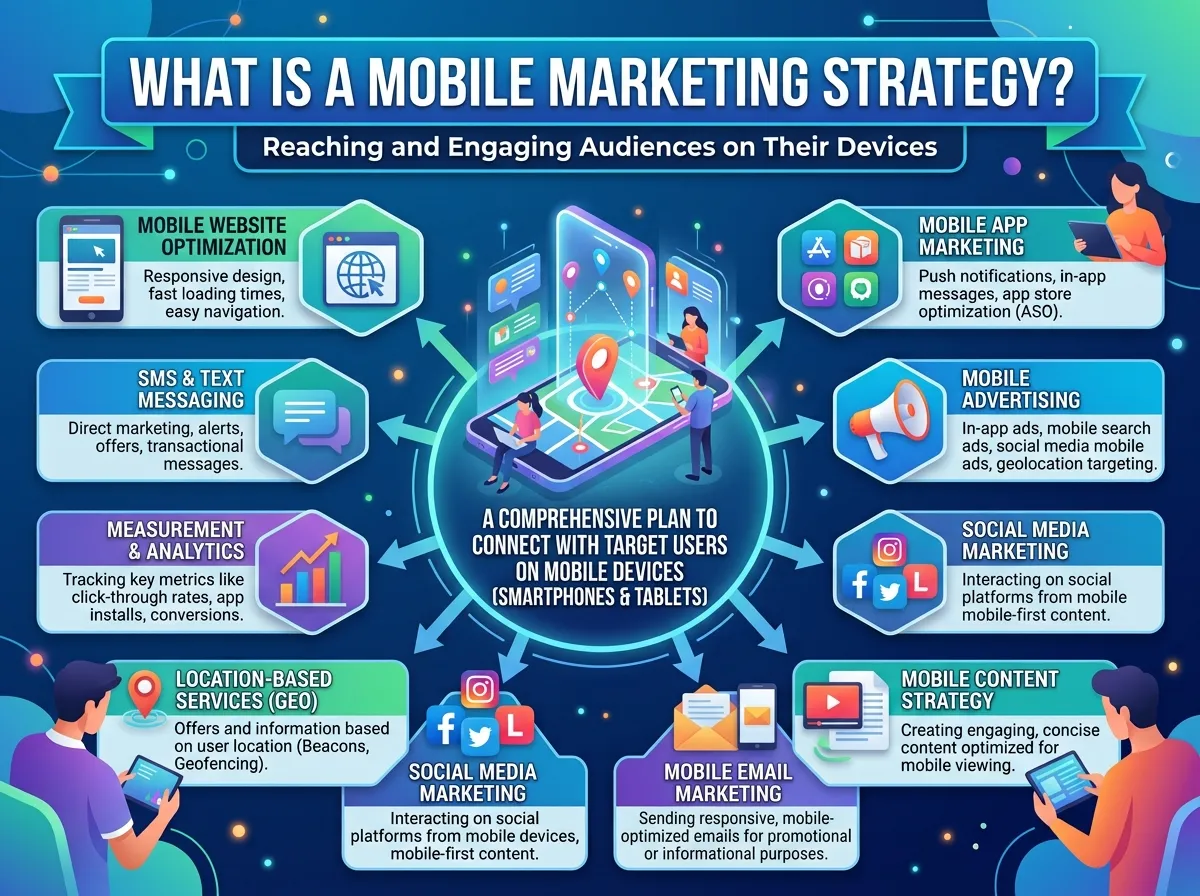
A mobile marketing strategy is a structured approach to reaching and engaging customers through mobile devices. Because smartphones are closely connected to everyday activities, mobile marketing gives businesses opportunities to communicate with audiences while they search, shop, browse social media, use apps, read emails, and interact with digital content.
Unlike traditional marketing channels, mobile marketing can create highly immediate interactions. A customer can receive an SMS promotion, discover a product through a mobile search, interact with an advertisement, or complete a purchase within a short period.
The effectiveness of mobile marketing depends on relevance. Customers do not respond positively to every message simply because it appears on their phone. Businesses need to understand customer interests, behavior, location, timing, and preferences to create experiences that feel useful rather than intrusive.
A well-developed strategy connects mobile activities with broader marketing objectives. It can support brand awareness, lead generation, sales, customer retention, product launches, event promotion, and long-term customer engagement.
Why Mobile Marketing Matters for Businesses
Mobile devices have changed how customers discover and interact with brands. People use smartphones to compare products, search for information, communicate with companies, watch videos, read reviews, and make purchases. This makes mobile an important part of the customer journey.
For businesses, mobile marketing provides an opportunity to communicate with audiences across several touchpoints. SMS can deliver immediate updates, mobile applications can support ongoing engagement, social platforms can encourage interaction, and mobile advertising can introduce products to new audiences.
Mobile marketing for businesses is particularly useful because it can support both direct communication and broader digital campaigns. A company can use mobile channels to reinforce a campaign that is already running through search, email, social media, or other platforms.
A strong mobile presence can also influence customer expectations. If a website loads slowly or a landing page is difficult to navigate on a smartphone, customers may leave before completing an action. Mobile marketing therefore involves more than promotion. It also includes the quality of the experience customers receive after clicking a message or advertisement.
Understanding Mobile Customer Engagement
Mobile customer engagement focuses on creating meaningful interactions between customers and a brand through mobile devices. Engagement can happen through an app notification, SMS message, mobile website, social media interaction, personalized offer, or other mobile experience.
Relevance plays a major role in successful engagement. Customers are more likely to respond when messages match their needs or interests. For example, a retailer might send a product recommendation based on previous browsing behavior, while an event organizer could send reminders that help attendees stay informed.
Personalization can make mobile communication feel more useful. Instead of sending the same message to every subscriber, businesses can segment audiences according to interests, purchase history, engagement behavior, or customer lifecycle stage.
Timing also matters. A relevant message delivered at the wrong moment can easily be ignored. Mobile customer engagement becomes stronger when businesses consider when customers are most likely to interact with particular types of content.
Developing Effective Mobile Marketing Strategies
Successful mobile marketing strategies usually connect several channels instead of relying on one communication method. A business may combine mobile search, SMS, social media, applications, email, and paid advertising to create a consistent customer journey.
The strategy should begin with a clear understanding of the target audience. Businesses need to know which mobile channels customers use, what type of information they want, and what actions they are most likely to take.
Content should then be adapted to the mobile environment. Shorter messages, clear calls to action, easy navigation, responsive design, and fast-loading pages can improve the overall experience.
Businesses should also maintain consistency across channels. Customers who discover a brand through a mobile advertisement should encounter similar messaging when they visit the website or receive a follow-up communication.
Mobile marketing is most effective when every interaction feels like part of the same brand experience rather than a collection of unrelated campaigns.
Creating a Strong Mobile Marketing Campaign
A mobile marketing campaign should have a clear purpose. A campaign designed to generate sales will have different messaging from one focused on brand awareness or customer retention.
Mobile campaigns can include SMS promotions, app notifications, social media advertisements, mobile search campaigns, location-based promotions, and mobile-friendly landing pages. The choice of channel should depend on the audience and campaign objective.
Creative content also matters. Mobile users often move quickly between apps and websites, so messages need to communicate their value clearly. Strong headlines, concise copy, engaging visuals, and straightforward calls to action can help capture attention.
A campaign should also create a logical path toward conversion. If an advertisement encourages customers to claim an offer, the landing page should make that process simple. Unnecessary steps can reduce conversions even when the initial advertisement performs well.
Mobile Advertising Strategy and Brand Visibility
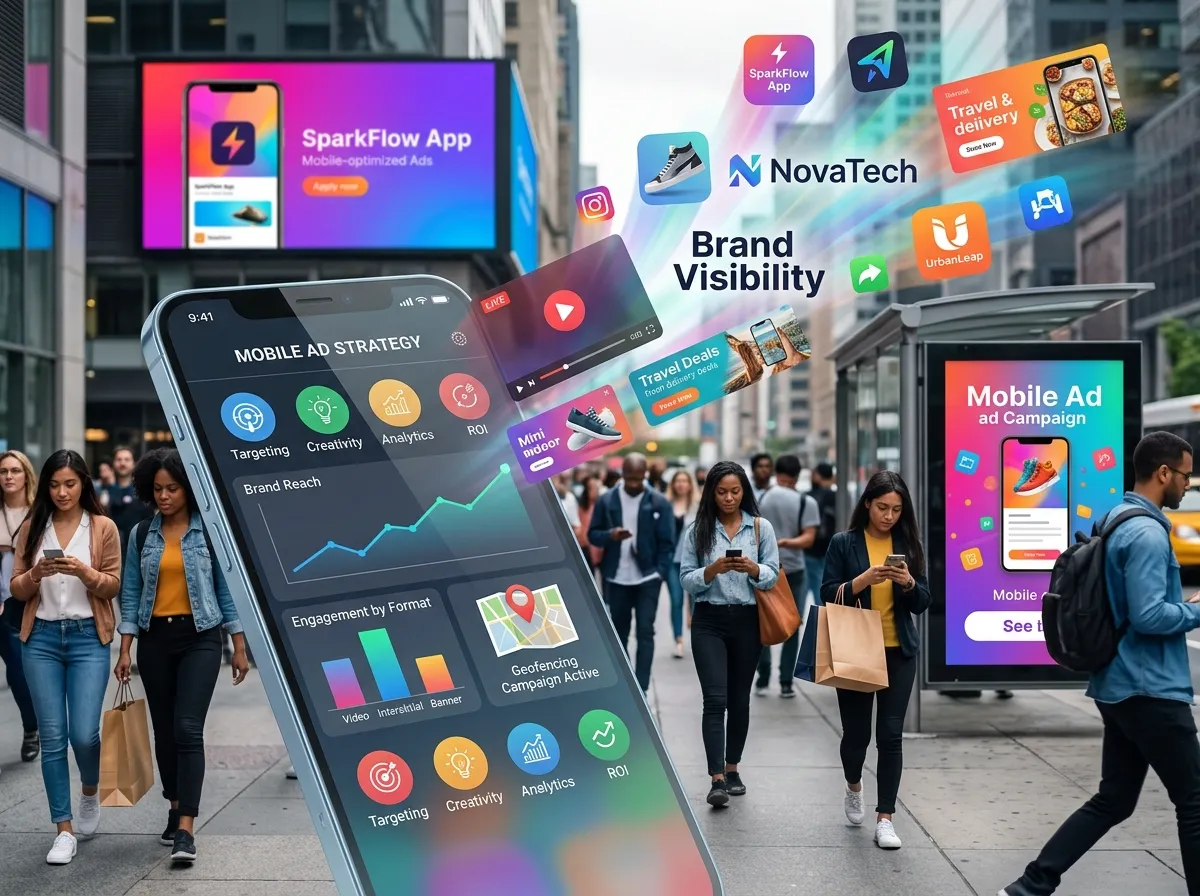
A mobile advertising strategy can help businesses reach potential customers while they use smartphones and tablets. Mobile advertisements can appear across search engines, social platforms, websites, applications, and other digital environments.
Targeting is an important part of mobile advertising. Businesses can use audience characteristics, interests, behaviors, search intent, and other available signals to improve relevance.
Creative optimization is equally important. Mobile advertisements need to work well on smaller screens and communicate their message quickly. Visual hierarchy, readable text, and strong calls to action can improve the effectiveness of mobile ads.
Advertising should also connect with the brand’s broader identity. Resources such as 10 Digital Marketing Strategies can help businesses understand how mobile activity can fit within broader digital marketing and brand awareness efforts.
Mobile Marketing Techniques That Improve Engagement
Different mobile marketing techniques can support different stages of the customer journey. SMS marketing can be useful for immediate communication, while mobile applications can support long-term engagement. Mobile search can capture customers who are actively looking for information, and social media can encourage ongoing interaction.
Location-based marketing can also be valuable for businesses with physical locations. Relevant offers or information can be presented to customers when they are near a store, venue, restaurant, or other location.
QR codes can connect offline and online experiences. A customer can scan a code on packaging, printed material, signage, or event materials and immediately access digital content.
Mobile video is another useful technique because short-form visual content can capture attention effectively. The most successful approach depends on the audience, product, and objective rather than simply following the newest mobile trend.
Building a Practical Mobile Marketing Plan
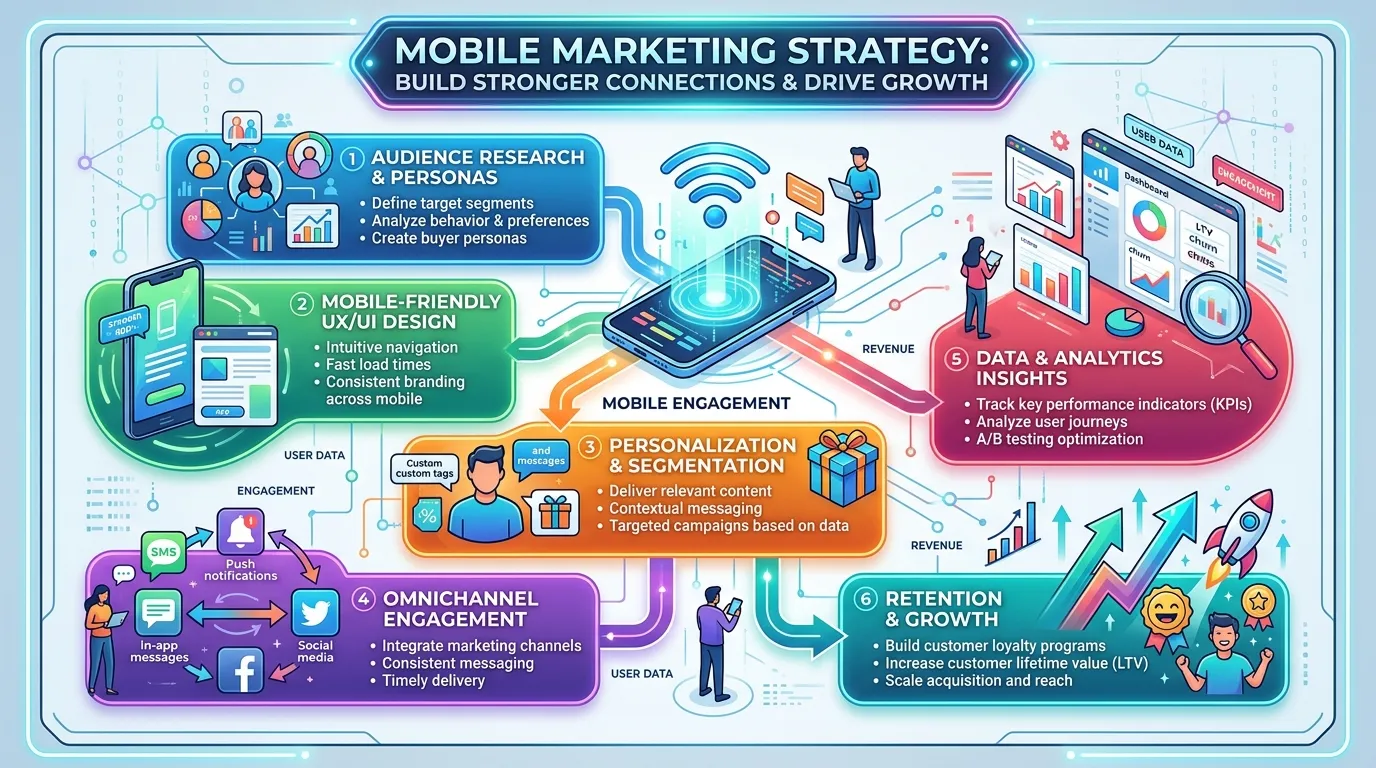
A mobile marketing plan provides direction for how a business will use mobile channels to achieve marketing goals. It should connect audience research, messaging, content, channel selection, customer experience, and measurement.
The plan should also account for different customer stages. Someone discovering a brand for the first time may need educational content, while an existing customer may respond better to personalized offers or loyalty communication.
Brand consistency should remain central to the plan. Mobile experiences should reflect the same identity customers encounter through websites, social media, email, packaging, and other channels.
Understanding broader branding concepts can also improve mobile planning. For example, What is Family Branding in Marketing explains how brands can create relationships among multiple products or offerings. This type of consistency can be valuable when customers interact with several products through mobile channels.
Mobile Marketing for Businesses Across the Customer Journey
Mobile marketing can support almost every stage of the customer journey. During the awareness stage, mobile advertisements and social content can introduce customers to a brand. During consideration, mobile-friendly websites, product information, reviews, and personalized content can help customers evaluate their options.
During conversion, mobile experiences should make purchasing or registration easy. Complicated forms, slow pages, unclear pricing, and difficult navigation can create unnecessary friction.
After conversion, mobile channels can support customer retention. Businesses can send useful updates, loyalty offers, product recommendations, service notifications, or educational content.
This continuous communication allows mobile marketing to become more than a short-term promotional channel. It can become part of a long-term relationship between the customer and the brand.
Mobile Marketing Tactics for Customer Retention
Retention-focused mobile marketing tactics can help businesses stay connected with existing customers. Personalized recommendations, loyalty rewards, reminders, exclusive offers, and helpful notifications can encourage customers to return.
The quality of communication matters more than frequency. Sending too many messages can create fatigue and encourage customers to unsubscribe or disable notifications.
Businesses should therefore focus on providing genuine value. A message should have a clear reason for reaching the customer. Whether it provides a useful update, relevant offer, helpful reminder, or personalized recommendation, the communication should respect the customer’s time.
Customer retention also depends on trust. Businesses should communicate transparently and give customers reasonable control over the messages they receive.
Mobile Marketing Optimization and Performance
Mobile marketing optimization involves continuously improving campaigns and experiences based on performance data. Businesses can evaluate metrics such as click-through rates, conversion rates, engagement, customer acquisition costs, retention, and revenue.
Website performance is also important. Mobile pages should load quickly, display correctly, and provide simple navigation. A technically strong campaign can still perform poorly if the destination experience is frustrating.
Testing can help businesses identify which messages, designs, offers, and calls to action perform best. Different audience segments may respond differently, so optimization should consider customer behavior rather than relying only on overall campaign averages.
The goal is not simply to increase clicks. Effective optimization focuses on improving meaningful outcomes such as qualified leads, purchases, registrations, engagement, and customer lifetime value.
Mobile Marketing Best Practices for Modern Brands
Mobile marketing best practices center on relevance, simplicity, personalization, speed, and consistency. Businesses should design experiences for mobile users instead of treating mobile as a smaller version of desktop marketing.
Messages should be concise and easy to understand. Landing pages should make the intended action obvious. Forms should require only necessary information, and mobile content should remain easy to read without excessive scrolling or zooming.
Privacy should also be treated as an important part of the customer experience. Businesses should communicate responsibly and respect customer preferences regarding notifications, messages, and data.
Brand consistency is another important consideration. Mobile communication should reflect the brand’s personality and positioning. The principles discussed in What Is the Big 5 Model of Brand Management? can provide useful context for thinking about how brand management influences customer experiences across different touchpoints.
Connecting Mobile Marketing With Digital Brand Strategy

Mobile marketing works best when it is connected to a broader digital brand strategy. Customers may discover a business through a mobile advertisement, visit its website, interact with social media, receive an email, and eventually become a customer.
These interactions should feel connected. Consistent messaging, visual identity, tone, and customer experience can strengthen brand recognition.
A strong digital strategy also helps businesses decide how mobile marketing should support larger business goals. The concepts covered in What is Digital Brand Strategy? can help illustrate why mobile communication should be connected to the wider digital identity of a brand.
When mobile and digital brand activities work together, customers can experience a more unified journey regardless of the device or channel they use.
The Future of Mobile Marketing
Mobile marketing will continue evolving as consumer behavior, technology, personalization, artificial intelligence, and digital experiences develop. Businesses will have more opportunities to deliver relevant content based on customer preferences and real-time interactions.
Personalization is likely to remain important, but customers will also expect greater control over how brands communicate with them. Businesses that focus on value, transparency, and meaningful experiences will be better positioned to build lasting relationships.
Mobile marketing will also become increasingly connected with other digital channels. Rather than operating as an isolated activity, mobile will continue to function as an important part of integrated marketing strategies.
Conclusion
A strong mobile marketing strategy helps businesses reach customers where they already spend significant time and attention. From mobile advertising and SMS communication to apps, social media, search, and mobile-friendly websites, businesses have many opportunities to create meaningful interactions.
The most effective strategies focus on relevance rather than volume. By understanding customers, creating useful content, optimizing mobile experiences, maintaining brand consistency, and measuring performance, businesses can turn mobile communication into a valuable part of their marketing strategy.
Mobile marketing is not simply about promoting products on smartphones. It is about creating convenient, relevant, and consistent experiences that help customers discover brands, make decisions, complete purchases, and remain connected over time.
Frequently Asked Questions
1. What is a mobile marketing strategy?
A mobile marketing strategy is a plan for reaching and engaging customers through mobile devices. It can include SMS, mobile apps, mobile advertising, social media, mobile search, email, and mobile-friendly websites.
2. Why is mobile marketing important for businesses?
Mobile marketing allows businesses to communicate with customers through devices they use regularly. It can support awareness, engagement, lead generation, sales, customer service, and retention.
3. What are the most effective mobile marketing strategies?
Effective strategies include personalized SMS marketing, mobile advertising, mobile search optimization, app engagement, social media marketing, location-based campaigns, mobile-friendly content, and personalized customer communication.
4. What is a mobile marketing campaign?
A mobile marketing campaign is a focused promotional activity designed specifically for mobile audiences. It may use SMS, mobile advertisements, apps, social media, mobile websites, or several channels together to achieve a specific marketing objective.
5. How does mobile advertising help businesses?
Mobile advertising can help businesses reach targeted audiences across search engines, applications, social platforms, and websites. With relevant targeting and strong creative content, mobile advertising can generate awareness, traffic, leads, and sales.
6. How can businesses improve mobile customer engagement?
Businesses can improve mobile customer engagement by providing relevant content, personalizing messages, choosing appropriate communication times, optimizing mobile experiences, and offering customers useful information rather than excessive promotional messages.
7. What should a mobile marketing plan include?
A mobile marketing plan should consider the target audience, business objectives, mobile channels, content, messaging, customer journey, budget, campaign timing, optimization, and performance measurement.
8. What are important mobile marketing techniques?
Important techniques include SMS marketing, mobile advertising, mobile search, app notifications, location-based marketing, QR codes, mobile video, social media marketing, and personalized mobile communication.
9. How can mobile marketing be optimized?
Mobile marketing can be optimized by analyzing engagement and conversion data, improving mobile page speed, testing messages and creative elements, simplifying customer journeys, improving targeting, and continuously adjusting campaigns based on performance.
10. What are the most important mobile marketing best practices?
Important best practices include keeping messages relevant and concise, creating mobile-friendly experiences, respecting customer privacy, using personalization carefully, maintaining brand consistency, optimizing performance, and measuring meaningful business results.