A strong video marketing strategy helps businesses attract attention, communicate their value, build trust, and encourage customers to take action. By combining quality video content with clear goals, audience research, SEO, social media distribution, personalization, and performance tracking, businesses can create videos that support both brand awareness and business growth.
Video has become one of the most effective formats for communicating with modern audiences. People use videos to learn about products, discover brands, compare solutions, follow creators, understand complex topics, and make purchasing decisions. For businesses, this creates an opportunity to communicate information in a format that is engaging, memorable, and easy to consume.
However, simply creating videos does not guarantee results. Businesses need a clear plan for deciding what to create, who the content is for, where it should be published, and how success will be measured.
This is where a video marketing strategy becomes important.
A strategic approach connects video creation with broader marketing goals. Instead of producing random promotional videos, businesses can create content that supports different stages of the customer journey, from awareness and education to consideration, conversion, and retention.
Whether a business creates short-form social videos, educational tutorials, product demonstrations, customer testimonials, webinars, or long-form videos, a well-planned strategy can make video content more consistent and effective.
What Is a Video Marketing Strategy?
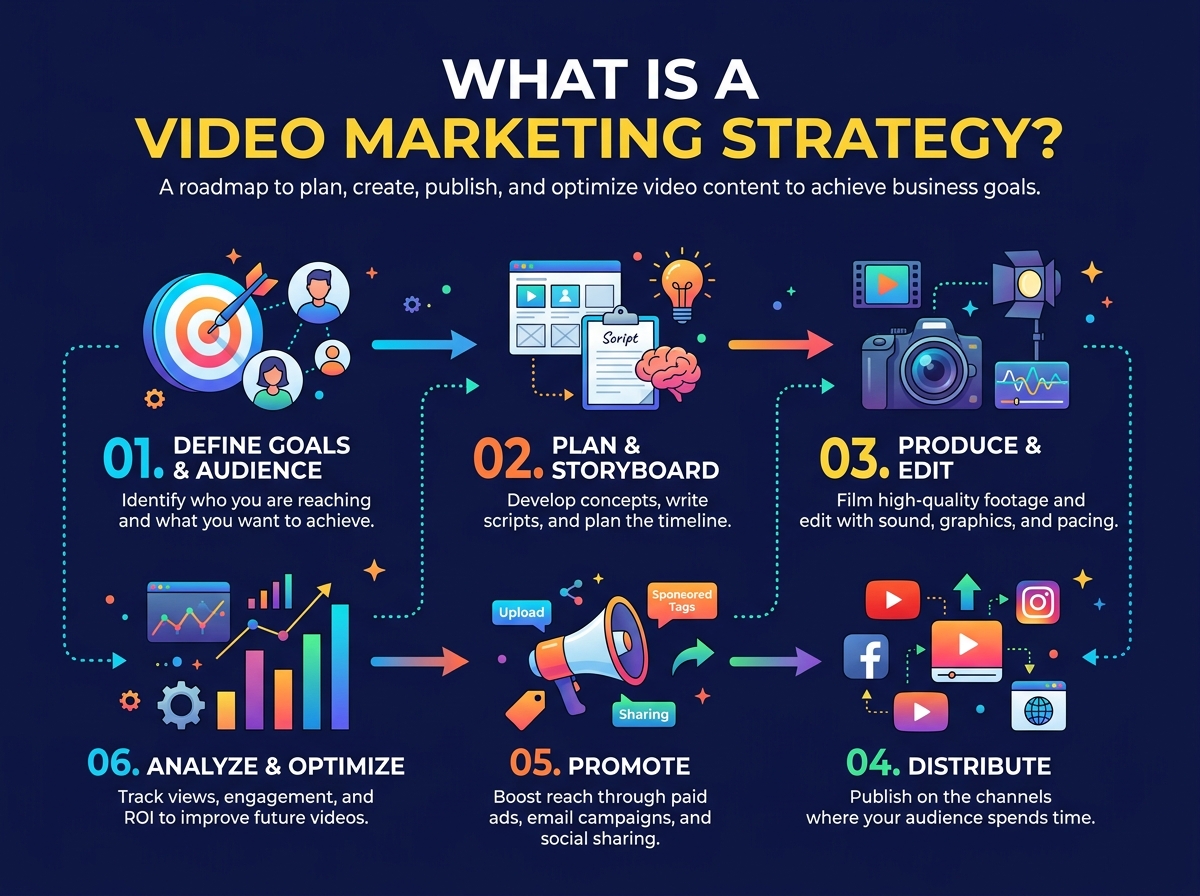
A video marketing strategy is a structured plan for using video content to achieve specific marketing and business objectives.
It defines the target audience, content topics, video formats, distribution channels, publishing schedule, production process, and performance metrics.
A strong strategy starts with a clear purpose. A company may use video to increase brand awareness, generate leads, educate customers, promote products, improve engagement, or support sales.
The strategy should also consider where the audience spends time. A business targeting professionals may prioritize LinkedIn and YouTube, while a consumer brand may focus more heavily on Instagram, TikTok, or other short-form platforms.
The most effective strategies connect content with audience needs rather than focusing only on the brand’s desire to promote its products.
1. Define Clear Video Marketing Goals
Before creating videos, businesses should determine what they want to achieve.
A video campaign designed to increase brand awareness will have different content and measurement criteria from a campaign designed to generate leads or drive product sales.
Common objectives include:
- Increasing brand awareness
- Educating potential customers
- Generating leads
- Increasing website traffic
- Supporting product launches
- Improving customer engagement
- Increasing conversions
- Building customer trust
- Supporting customer retention
Clear goals make it easier to determine which type of content should be created and which metrics should be tracked.
For example, a company trying to generate leads might create educational videos that lead viewers to a landing page. A brand focused on awareness might prioritize short, shareable videos that introduce its story or expertise.
2. Research Your Target Audience
Audience research is one of the most important parts of any video content strategy.
Businesses need to understand what their target customers care about, what problems they experience, what questions they ask, and what type of information they find useful.
Customer surveys, website analytics, social media conversations, search queries, reviews, and sales team feedback can reveal useful topics.
For example, a software company may discover that potential customers frequently ask how to automate a particular business process. The company could create an educational video demonstrating how the process works.
Understanding the audience also helps determine video length, tone, format, and platform.
A professional audience may respond well to detailed educational content, while audiences on short-form platforms may prefer concise videos that communicate one idea quickly.
3. Create a Detailed Video Marketing Plan
A video marketing plan turns strategy into an organized publishing process.
It should outline the types of videos a business will create, the topics it will cover, the target audience for each piece of content, the publishing channels, and the expected outcome.
A content calendar can help businesses maintain consistency. Instead of deciding what to publish every week at the last minute, the marketing team can plan content around product launches, seasonal campaigns, industry events, customer questions, and important business objectives.
The plan should also account for different stages of the customer journey.
Awareness videos can introduce problems or industry topics. Consideration videos can explain solutions and compare options. Conversion-focused videos can demonstrate products, answer objections, or provide customer testimonials.
This creates a more complete content ecosystem.
4. Develop Different Types of Video Content
A successful video content marketing strategy should not rely on one type of video.
Different formats serve different purposes.
Educational videos can explain concepts and establish expertise. Product demonstrations can show how a solution works. Customer testimonials can build credibility. Behind-the-scenes videos can make a brand feel more human. Tutorials can help customers solve problems, while interviews and expert discussions can provide deeper insights.
Short-form videos are useful for capturing attention and encouraging discovery, while longer videos can provide detailed education.
Businesses can also repurpose content. A long webinar can become several short clips, a tutorial can become social media snippets, and an interview can provide material for multiple platforms.
This makes content production more efficient.
5. Use Strong Video Marketing Tactics
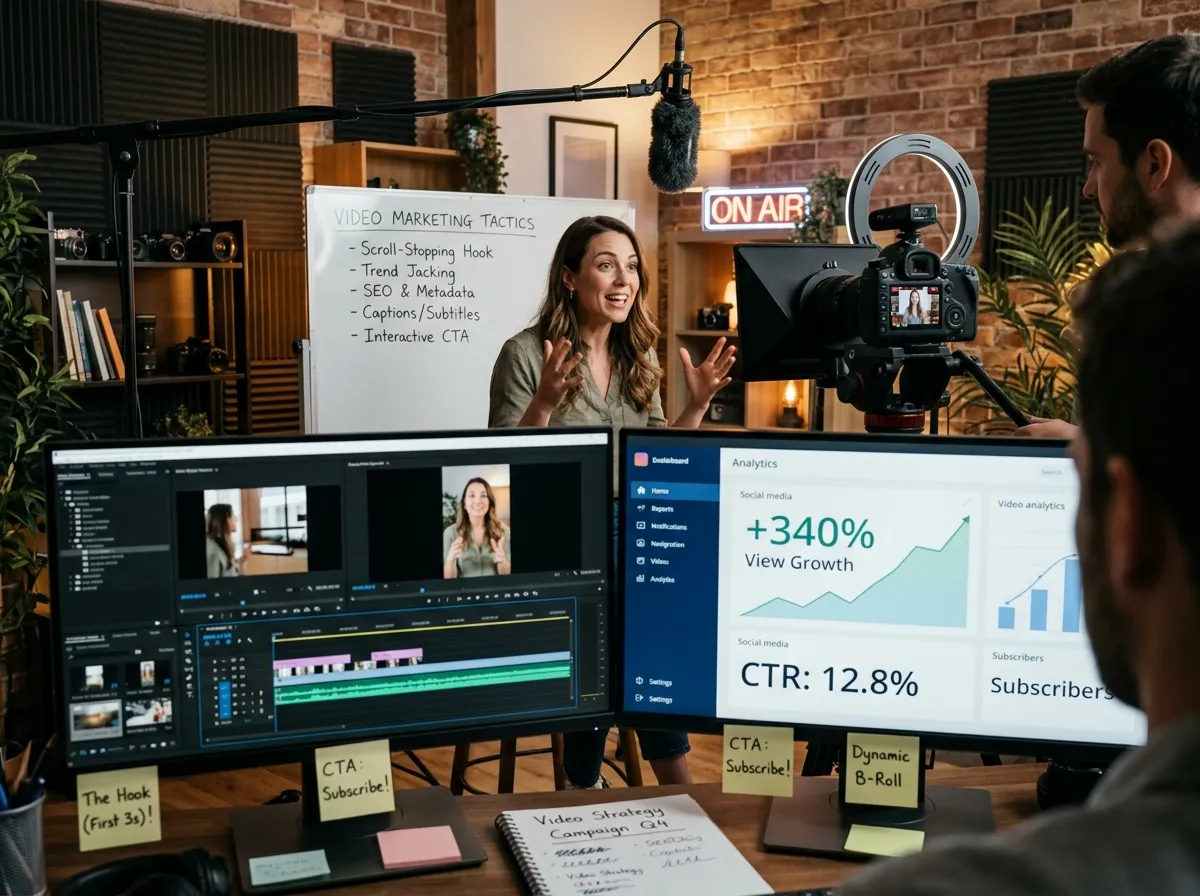
Effective video marketing tactics help businesses turn content into meaningful engagement and action.
One important tactic is to capture attention quickly. The opening seconds should clearly communicate why viewers should continue watching.
Storytelling can also make videos more memorable. Instead of simply listing product features, businesses can explain the problem, show its impact, introduce the solution, and demonstrate the outcome.
Calls to action should match the purpose of the video. A brand-awareness video may encourage viewers to follow the company, while a product video may encourage them to request a demo or visit a landing page.
Businesses should also experiment with different formats, hooks, lengths, thumbnails, titles, and publishing times to identify what performs best.
6. Build a Consistent Video Marketing Campaign
A video marketing campaign is more effective when individual videos work together toward a common goal.
For example, a product launch campaign could begin with teaser videos, followed by educational content, product demonstrations, customer testimonials, and conversion-focused videos.
Each piece can address a different stage of the audience’s decision-making process.
Campaigns should have a defined beginning, objective, audience, and measurement framework. This makes it easier to evaluate performance and determine whether the campaign contributed to business goals.
Consistency also helps reinforce the same message across multiple channels.
7. Use Video Marketing for Businesses Across the Customer Journey
Video marketing for businesses is not limited to promotional advertising.
Videos can support almost every stage of the customer lifecycle.
At the awareness stage, businesses can create educational or entertaining videos that introduce a problem or topic.
During consideration, comparison videos, tutorials, product demonstrations, and expert explanations can help prospects evaluate solutions.
At the conversion stage, testimonials, case studies, product walkthroughs, and FAQ videos can reduce uncertainty.
After purchase, instructional videos can help customers understand how to use a product and get more value from it.
This makes video a versatile tool for marketing, sales, customer service, and customer retention.
8. Create an Efficient Video Content Creation Strategy
A video content creation strategy helps businesses produce high-quality content without making production unnecessarily complicated.
The process can begin with research and topic selection, followed by scripting, filming, editing, publishing, and promotion.
Not every video requires expensive equipment or a large production team. Depending on the objective, a smartphone, good lighting, clear audio, and thoughtful scripting may be enough.
Quality still matters, but usefulness and relevance should remain priorities.
Businesses can create templates for introductions, thumbnails, captions, visual branding, and calls to action. This can make production faster while maintaining consistency.
Repurposing is another powerful technique. One strong piece of content can be adapted into multiple videos for different platforms.
9. Improve Video Marketing Engagement
Video marketing engagement measures how audiences interact with video content.
Views are useful, but they do not tell the entire story. Watch time, completion rate, likes, comments, shares, saves, clicks, and subscriptions can provide deeper insights.
Engagement often improves when content provides immediate value.
Videos should answer questions, solve problems, tell useful stories, or provide information that viewers genuinely want.
Interactive elements can also encourage engagement. Questions, polls, comments, challenges, and calls to action can invite viewers to participate rather than simply watch.
Businesses should monitor audience behavior and use the results to improve future content.
10. Develop a Strong Video SEO Strategy
A video SEO strategy helps videos become easier for search engines and users to discover.
Businesses should conduct keyword research before creating search-focused videos. Keywords can be incorporated naturally into video titles, descriptions, transcripts, headings, and related website content.
Titles should clearly communicate what the video is about. Descriptions can provide additional context and links to relevant resources.
Transcripts can also make video content more accessible and provide additional text that search engines can understand.
Businesses should also create useful supporting content around important videos. For example, a detailed tutorial can be embedded within a relevant blog post that expands on the subject.
Search optimization should never come at the expense of viewer experience. The primary objective remains creating useful content that satisfies the audience’s intent.
11. Personalize Video Content
Personalization can make video content more relevant to different audience segments.
A business may create different versions of content based on customer industry, job role, stage of the buying journey, or previous interactions.
For example, a software company could create separate videos for small businesses, enterprise organizations, and agencies because each audience may have different priorities.
Data can help businesses understand which topics and formats resonate with particular audiences. This supports a more effective content strategy.
Businesses can learn more about [data-driven personalization and tailored brand experiences]Data-Driven Personalization when developing more relevant customer-facing content.
Personalization should provide meaningful value rather than simply inserting a customer’s name into a video.
12. Use Influencer and Creator Partnerships
Influencer and creator partnerships can help businesses reach established audiences and add credibility to video campaigns.
Creators can produce product demonstrations, reviews, tutorials, testimonials, educational videos, or sponsored content that introduces a brand to their followers.
The key is choosing creators whose audience matches the business’s target market.
Performance should also be measured carefully. Views alone may not indicate whether a partnership produced meaningful business results.
Metrics such as engagement, referral traffic, leads, conversions, and revenue can provide a clearer picture of campaign effectiveness.
Businesses interested in measuring these outcomes can explore [how to measure the ROI of influencer marketing]The ROI of Influencer Marketing.
13. Optimize Video for Search and AI Discovery
Search behavior is evolving beyond traditional search engines. People increasingly use AI-powered systems and generative search experiences to discover information.
This means businesses should create clear, useful, well-structured video content that directly answers audience questions.
Strong titles, accurate descriptions, transcripts, supporting articles, FAQs, and clear topic organization can make video content easier to understand and discover across different search environments.
Businesses can also explore [Generative Engine Optimization and its role in brand visibility]Generative Engine Optimization to understand how content can be structured for emerging AI-driven discovery.
Video should therefore be treated as part of a broader content ecosystem rather than an isolated format.
14. Measure Video Marketing Performance Metrics

Tracking the right video marketing performance metrics is essential for understanding whether content is producing meaningful results.
Important metrics include views, unique viewers, watch time, average view duration, completion rate, engagement rate, click-through rate, conversions, leads, and revenue.
The right metrics depend on the campaign objective.
For example, a brand-awareness campaign may focus on reach, views, and engagement. A lead-generation campaign should place greater emphasis on clicks, form submissions, qualified leads, and conversion rates.
Businesses should also compare performance across platforms and content types.
If educational videos consistently generate more qualified traffic than promotional videos, the content strategy may need to shift toward more educational material.
15. Connect Video With Other Marketing Channels
Video works best when integrated with other marketing activities.
A business can embed videos in blog posts, include them in email campaigns, share clips on social media, use them in landing pages, and incorporate them into sales presentations.
For example, a detailed product video can support a website landing page while shorter clips promote the same message on social media.
This creates multiple opportunities for people to encounter the content.
It also increases the value of each video because one piece of content can contribute to several marketing channels.
Common Video Marketing Mistakes to Avoid
Businesses can reduce wasted effort by avoiding several common mistakes.
One mistake is creating videos without a clear objective. Without a defined purpose, it becomes difficult to determine whether the content succeeded.
Another problem is focusing entirely on product promotion. Audiences are more likely to engage with content that teaches, informs, entertains, or solves a problem. Understanding Customer Perception can also help businesses create video content that better matches audience expectations and interests.
Poor audio quality can also reduce the perceived quality of a video. Clear sound is often more important than expensive visual equipment.
Businesses should also avoid publishing videos without optimization. A strong video may receive limited visibility if its title, description, thumbnail, and supporting content are poorly optimized.
Finally, businesses should avoid judging success based only on views. A smaller video that generates qualified leads can be more valuable than a viral video that produces no meaningful business outcome.
Conclusion
A successful video marketing strategy combines clear objectives, audience research, useful content, consistent production, effective distribution, search optimization, personalization, and performance measurement.
Businesses do not need to create every possible type of video. They need to identify the formats and topics that provide the most value to their specific audience.
By developing a thoughtful video content strategy, using targeted video marketing tactics, optimizing content for search, and tracking meaningful performance metrics, businesses can turn video from a simple content format into a powerful marketing asset.
The most effective approach is continuous improvement. Analyze what viewers watch, where they stop, which topics generate engagement, and which videos contribute to leads or sales. Use those insights to refine future content and create a stronger connection between video activity and business growth.
Frequently Asked Questions
1. What is a video marketing strategy?
A video marketing strategy is a plan for using video content to achieve specific marketing objectives. It defines the target audience, content topics, video formats, distribution channels, publishing schedule, and performance metrics.
2. Why is video marketing important for businesses?
Video can help businesses explain products, educate customers, build trust, increase engagement, generate leads, and support conversions. It can also be adapted for different platforms and stages of the customer journey.
3. What should be included in a video marketing plan?
A video marketing plan should include goals, audience research, content topics, video formats, publishing channels, production processes, distribution plans, calls to action, and performance metrics.
4. What types of videos work well for businesses?
Educational videos, tutorials, product demonstrations, customer testimonials, case studies, interviews, webinars, behind-the-scenes videos, FAQs, and short-form social content can all be effective depending on the audience and objective.
5. How can businesses improve video marketing engagement?
Businesses can improve engagement by creating useful content, using strong openings, keeping viewers interested with clear storytelling, adding relevant calls to action, encouraging comments, and testing different formats and lengths.
6. What is video SEO?
Video SEO involves optimizing video content so it can be discovered more easily through search. It can include keyword research, optimized titles and descriptions, transcripts, relevant supporting content, thumbnails, and structured information.
7. How long should a marketing video be?
There is no universal ideal length. The appropriate length depends on the topic, platform, audience, and purpose. Short videos can work well for quick awareness content, while tutorials and educational videos may require more time.
8. What are the most important video marketing performance metrics?
Important metrics include views, watch time, average view duration, completion rate, engagement rate, click-through rate, leads, conversions, and revenue. The most useful metrics depend on the campaign’s specific objective.
9. Can small businesses use video marketing?
Yes. Small businesses can create effective videos without expensive production equipment. Educational videos, product demonstrations, customer stories, FAQs, and short social videos can be created with relatively simple tools.
10. How can video marketing support SEO?
Video can support SEO by providing useful content around relevant search topics. Optimized titles, descriptions, transcripts, embedded videos, supporting articles, and strong user engagement can help businesses increase discoverability and provide a richer experience for visitors.