
Digital branding helps businesses create a recognizable and trustworthy presence across websites, search engines, social media, email, and other digital channels. Through a strong digital brand strategy, online identity, positioning, communication, social media branding, and reputation management, businesses can increase awareness, build customer trust, differentiate themselves, and create long-term brand value.
Digital branding has become an essential part of how businesses establish recognition, communicate with customers, and build long-term relationships online. As consumers spend more time searching, browsing, shopping, and communicating through digital channels, a company’s online presence can strongly influence how people perceive its products, services, and overall reputation.
A business may have an excellent product, competitive pricing, and strong customer service, but these advantages can be difficult to communicate if its digital presence is inconsistent or unclear. Digital branding brings together visual identity, messaging, content, social media, websites, customer experiences, and online reputation to create a recognizable and trustworthy brand.
Unlike traditional branding, which often focuses on physical advertising, packaging, print materials, and offline experiences, digital branding exists across websites, search engines, social media platforms, email, online communities, mobile applications, and other digital environments. Every interaction can contribute to the way customers understand and remember a company.
A strong digital brand does more than make a business look professional. It creates a consistent experience that helps audiences understand what a company represents, what makes it different, and why they should trust it.
What Is Digital Branding?
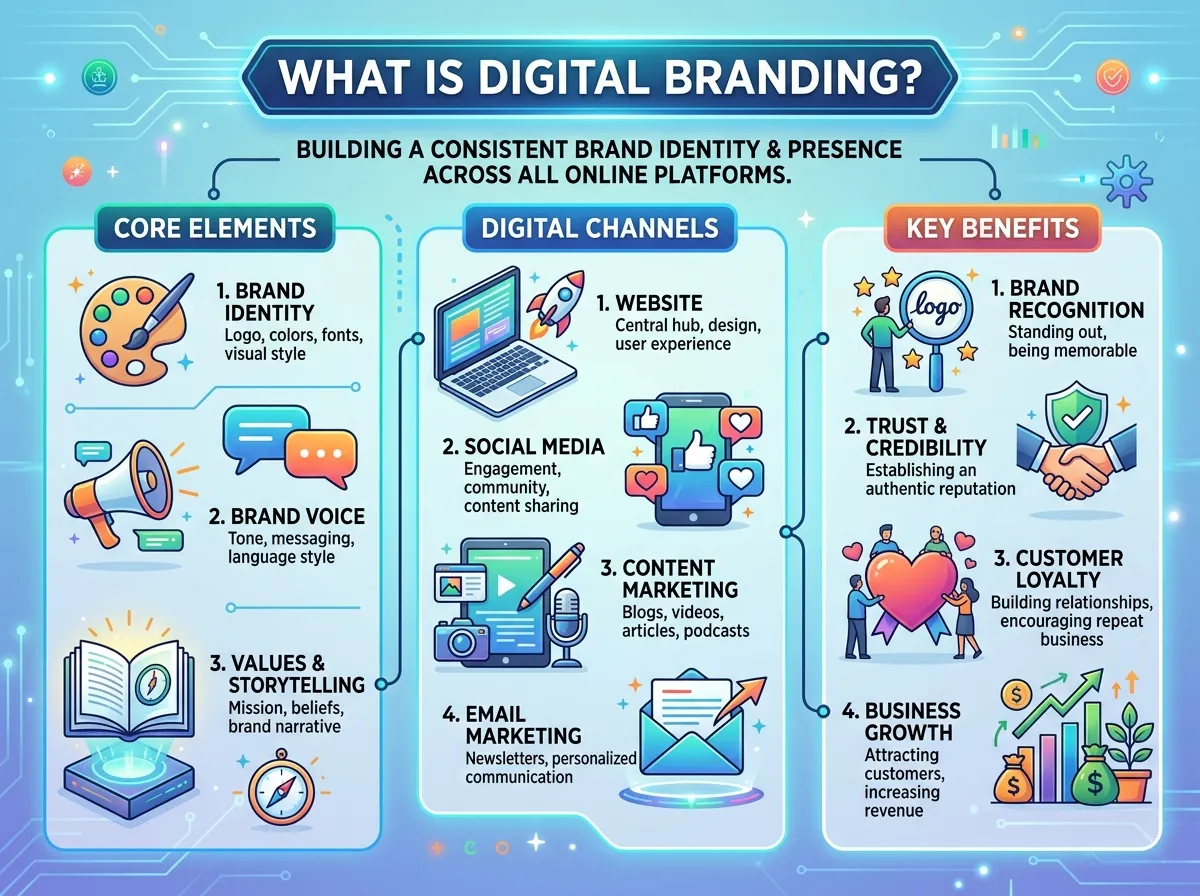
Digital branding is the process of creating, developing, and managing a brand’s identity and reputation across digital channels. It combines strategy, design, communication, content, technology, and customer experience to establish a consistent online presence.
The purpose of digital branding is not simply to make a website or social media account attractive. It is about creating a clear identity that remains recognizable wherever customers encounter the business.
For example, a customer might discover a company through Google, visit its website, watch one of its videos, see a social media post, read customer reviews, and eventually purchase a product. Each interaction contributes to the customer’s perception of the brand.
If these experiences feel consistent, the customer is more likely to recognize and remember the company. If they appear disconnected, trust and credibility can become weaker.
Digital branding therefore connects individual marketing activities into a broader brand experience.
Why Digital Branding Matters for Modern Businesses
The internet has changed the way customers discover and evaluate businesses. Before making a purchase, people can compare companies, read reviews, explore websites, watch demonstrations, and interact with brands on social media.
This means businesses have less control over when and where customers encounter their brand.
A strong digital presence helps companies create a consistent impression across these different touchpoints. It can also help smaller businesses compete with larger organizations by giving them opportunities to demonstrate expertise, build communities, and communicate directly with their target audiences.
Digital branding can also improve familiarity. When customers repeatedly encounter a recognizable visual identity and consistent messaging, the brand becomes easier to remember.
Over time, familiarity can contribute to trust and preference, particularly when the company’s actual products and customer experiences support its brand promises.
Digital Brand Strategy
A digital brand strategy establishes the overall direction of a company’s online identity. It connects business objectives with audience needs, positioning, messaging, content, design, and digital communication.
The strategy should begin with an understanding of the audience. Businesses need to know who they want to reach, what those customers care about, what problems they are trying to solve, and how they make purchasing decisions.
Competitive research is also important. Understanding how similar businesses position themselves can reveal opportunities for differentiation.
A strong digital brand strategy creates consistency without making every communication identical. A company’s website, social media content, email campaigns, and advertising can have different formats while still reflecting the same underlying identity.
The strategy should also be flexible enough to evolve as customer expectations, technologies, and markets change.
Creating an Online Brand Identity

An online brand identity represents how a business presents itself across digital channels. It includes visual elements such as logos, colors, typography, imagery, and graphic styles, but it also includes tone of voice, messaging, personality, and customer experience.
A recognizable online brand identity helps customers quickly identify a company when they encounter it in different places.
For example, a consistent color palette, typography system, photography style, and tone of voice can make social media posts recognizable even before customers read the company’s name.
However, visual consistency is only one part of identity. The words a business uses also influence how people perceive it.
A technology company might communicate using a highly technical and authoritative tone, while a consumer lifestyle brand may use a more conversational and inspirational voice.
The important consideration is that the identity should accurately represent the organization and appeal to its intended audience.
Digital Brand Management
Digital brand management involves maintaining and developing a brand across online channels. It ensures that different departments, employees, agencies, and communication platforms represent the company consistently.
This can become challenging as a business grows. Marketing teams may manage social media, content teams may operate the blog, sales teams may communicate through email, and customer service representatives may interact with customers through messaging platforms.
Without clear brand standards, these interactions can begin to feel disconnected.
Digital brand management creates a shared framework for visual identity, messaging, tone, content, and communication. It can also involve monitoring online conversations and identifying changes in customer perception.
Because digital channels operate continuously, brand management is an ongoing activity rather than a one-time project.
Online Branding Strategy and Customer Experience
An online branding strategy should consider the complete customer journey rather than focusing only on individual channels.
A customer may first discover a business through a search result and then move to its website. They may later see a social media advertisement, read reviews, subscribe to an email list, and contact customer support.
The brand experience should remain coherent throughout this journey.
Website design, content, navigation, customer service, checkout processes, emails, and social interactions can all influence brand perception.
A company that positions itself as simple and convenient should provide an easy digital experience. A premium brand should ensure that its website, communications, and customer service support the quality implied by its positioning.
When the experience matches the brand promise, customers are more likely to develop confidence in the business.
Digital Brand Awareness
Digital brand awareness refers to how familiar a target audience is with a business in online environments.
Awareness can grow through search visibility, content marketing, social media, online advertising, video, influencer partnerships, public relations, email marketing, and other digital activities.
Repeated exposure can help customers recognize a brand, but exposure alone does not necessarily create a strong brand.
The audience also needs to understand what the company represents.
A consistent digital brand awareness strategy therefore combines visibility with meaningful messaging. Customers should be able to associate the brand with particular qualities, products, services, or areas of expertise.
Over time, strong awareness can increase the likelihood that customers recognize a company when they are ready to make a purchasing decision.
Brand Identity Development in the Digital Environment
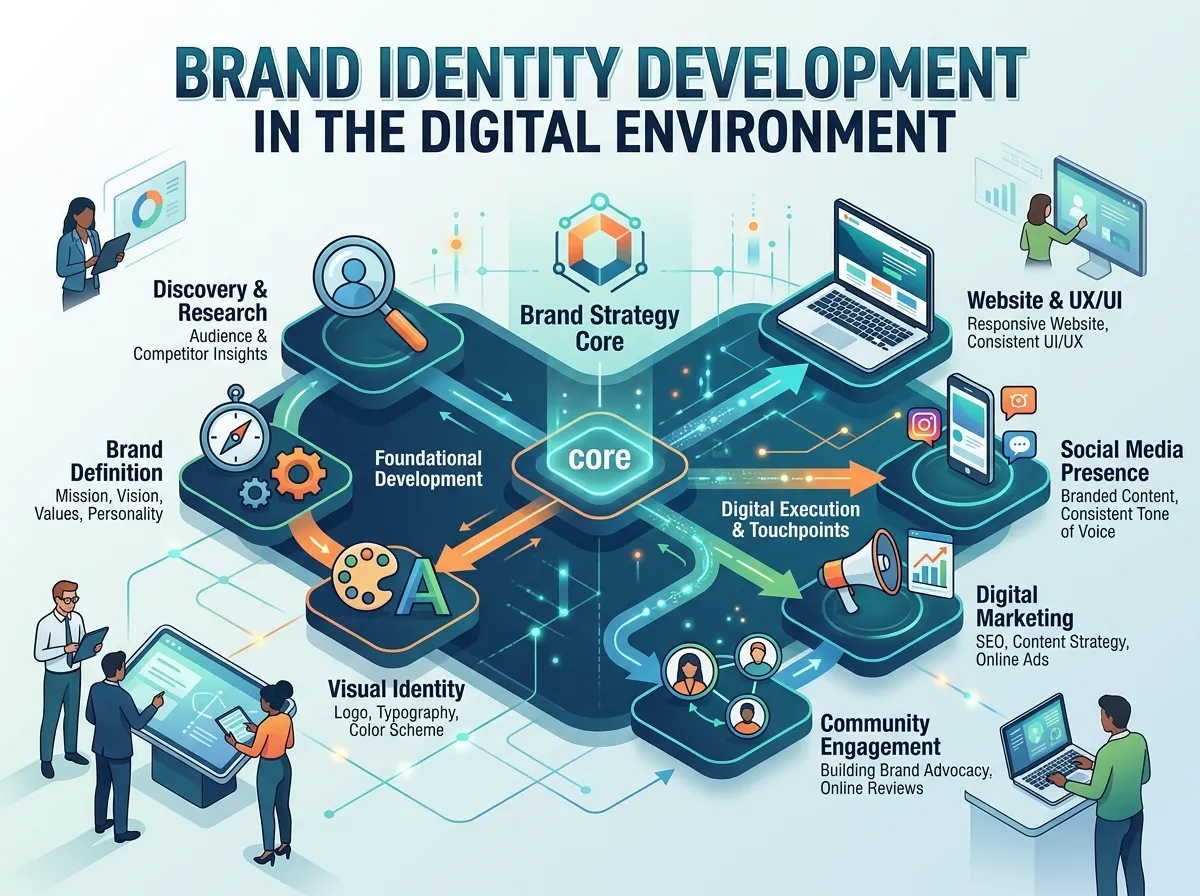
Brand identity development is an ongoing process as businesses adapt to changing markets and technologies.
A company that originally built its brand around desktop websites may need to consider mobile experiences, short-form video, social commerce, online communities, and other emerging channels.
Brand identity development does not always require a complete redesign. Sometimes small adjustments can modernize an identity while preserving the characteristics customers already recognize.
Businesses should be careful when changing established visual elements. A dramatic rebrand may create confusion if customers no longer recognize the company.
The goal should be to maintain the core identity while ensuring that it remains relevant to modern audiences and digital environments.
Digital Brand Positioning
Digital brand positioning defines how a company wants to be perceived online compared with competitors.
Positioning answers questions about the company’s target audience, value proposition, expertise, personality, and differentiation.
A clear position makes it easier for customers to understand why a business is relevant.
For example, several companies may offer similar software, but one may position itself as the easiest solution for small businesses while another focuses on advanced features for large enterprises.
Digital brand positioning influences website messaging, advertising, content topics, social media communication, design, and customer experience. Effective brand storytelling can also help businesses communicate their positioning through meaningful and memorable narratives.
When positioning is unclear, digital marketing can become fragmented because different channels communicate different ideas about the company.
Social Media Branding
Social media branding allows businesses to express their identity through platforms where customers actively communicate and consume content.
Social media provides opportunities to show personality, share expertise, respond to customers, demonstrate products, and build communities.
Consistent branding can make social media profiles more recognizable. This can involve visual elements, writing style, recurring content themes, and the way the business responds to comments.
However, social media branding should not feel overly rigid. Social platforms are conversational environments, and audiences often respond positively to authentic communication.
Brands can maintain consistency while adapting content to the culture and format of each platform.
A professional network may require a different communication style from a short-form video platform, but both can still represent the same underlying brand personality.
Digital Brand Communication
Digital brand communication covers the messages a business sends through websites, social media, email, advertising, online communities, videos, and other digital channels.
Clear communication helps customers understand products, services, values, benefits, and expectations.
Consistency is particularly important. If a company describes itself differently across its website, advertisements, and social media accounts, customers may struggle to understand its identity.
Digital communication should also be relevant to the audience. Promotional messages alone can become repetitive, while useful educational and entertaining content can create stronger engagement.
The most effective brand communication balances business objectives with customer value.
Online Reputation Management
Online reputation management is an important part of digital branding because customers can publicly share their experiences with businesses.
Reviews, social media discussions, comments, news articles, forums, and other online conversations can influence how potential customers perceive a company.
A strong reputation cannot be created through positive messaging alone. It depends heavily on actual customer experiences.
Businesses should therefore monitor relevant online conversations and respond appropriately when customers raise concerns.
Professional and transparent responses can demonstrate that the company takes customer feedback seriously.
Negative feedback should not automatically be treated as a threat. Constructive criticism can reveal problems that need to be addressed. Resolving the underlying issue can ultimately strengthen the brand.
Digital Branding and Content Marketing
Content marketing and digital branding work closely together. Content gives businesses an opportunity to demonstrate expertise and communicate their personality.
Blog articles, videos, podcasts, research reports, case studies, newsletters, and social media posts can all contribute to brand perception.
The topics a company chooses to discuss can influence what audiences associate with the brand.
A business that consistently publishes valuable insights about a particular industry can gradually become associated with expertise in that field.
Content quality is important because every published piece can affect credibility. Poorly researched or inconsistent content can weaken a brand, while useful and authoritative content can strengthen it.
Digital Branding and Search Visibility
Search engines are another important part of digital branding. When people search for a company, product, service, or topic, the information they discover can influence their perception.
Search engine optimization can help businesses increase visibility for relevant queries. High-quality content can attract users while also demonstrating expertise.
Branded search results are particularly important because they often appear when people are already familiar with a company.
A strong digital presence can ensure that customers find accurate, useful, and consistent information when they search for the brand. As businesses adopt new technologies across different industries, topics such as blockchain in event management can also become part of the broader digital content and search strategy.
A strong digital presence can ensure that customers find accurate, useful, and consistent information when they search for the brand.
Measuring Digital Branding Performance
Digital branding can be measured through a combination of quantitative and qualitative signals.
Website traffic, branded search activity, social media engagement, direct traffic, audience growth, content interaction, customer reviews, and online mentions can provide useful information.
Brand awareness surveys can provide additional insight into whether audiences recognize and remember a company.
Conversion data can also show whether increased awareness contributes to business outcomes.
However, digital branding should not be evaluated solely through short-term conversions. Brand building often produces value over a longer period.
A customer may discover a company today but make a purchase several weeks later. Measuring only immediate responses can therefore underestimate the impact of branding.
The Long-Term Value of Digital Branding
Digital branding is a long-term investment. Strong online brands are rarely created through a single campaign or redesign.
Recognition develops through repeated exposure. Trust develops through consistent experiences. Reputation develops through continued communication and customer satisfaction.
A strong digital brand can also reduce the difficulty of launching new products or entering new markets. When customers already trust a company, they may be more willing to consider new offerings.
Digital branding can also support recruitment, partnerships, investor relations, and other business activities because stakeholders often research organizations online before engaging with them. Developing brand resilience strategies can help organizations maintain trust and adapt when market conditions or customer expectations change.
The value of a strong brand therefore extends beyond marketing. An effective approach can also consider inclusive brand strategies to ensure that brand communication connects with a broader range of audiences.
Common Challenges in Digital Branding
Businesses can face several challenges when developing a digital brand. One common problem is inconsistency between channels. Different logos, colors, messages, or tones can make a company appear less established.
Another challenge is trying to appeal to everyone. A brand that attempts to communicate with every possible audience may struggle to develop a clear identity.
Businesses may also focus too heavily on visual design while neglecting customer experience. A visually impressive website cannot compensate for slow service, confusing navigation, or poor communication.
Rapid changes in digital platforms create another challenge. Businesses need to adapt to new formats and technologies without constantly changing their fundamental identity.
The strongest digital brands maintain a stable core while adapting their execution to changing environments.
Conclusion
Digital branding has become an essential part of modern business because customers increasingly discover, evaluate, and interact with companies through digital channels. A strong digital brand brings together strategy, identity, positioning, communication, content, social media, customer experience, and reputation.
A well-developed digital brand strategy creates consistency across online touchpoints while allowing businesses to communicate with different audiences in relevant ways. Online brand identity and brand identity development make the company recognizable, while digital brand positioning helps establish meaningful differentiation.
Social media branding and digital brand communication create opportunities for direct engagement, while online reputation management helps protect trust and credibility.
Ultimately, successful digital branding is not simply about creating attractive digital assets. It is about creating a recognizable and trustworthy experience that reflects what the business actually delivers.
When a company’s online identity, messaging, customer experience, and reputation work together, digital branding can become a powerful long-term asset. It can strengthen awareness, build trust, support customer relationships, and create a foundation for sustainable business growth.
Frequently Asked Questions About Digital Branding
What is digital branding?
Digital branding is the process of creating and managing a company’s identity, reputation, communication, and customer experience across digital channels such as websites, search engines, social media, email, and online communities.
Why is digital branding important?
Digital branding helps businesses become recognizable online, communicate their value, differentiate themselves from competitors, build trust, and create consistent customer experiences across digital touchpoints.
What is a digital brand strategy?
A digital brand strategy defines how a company presents itself online. It connects business goals with audience research, positioning, messaging, visual identity, content, communication, and customer experience.
What is an online brand identity?
An online brand identity is the way a business presents itself across digital platforms. It includes visual elements such as logos and colors as well as messaging, tone, personality, and digital customer experiences.
How does social media branding support digital branding?
Social media branding helps businesses communicate their identity through social platforms. Consistent visuals, messaging, content themes, and communication styles can improve recognition and strengthen relationships with audiences.
What is digital brand positioning?
Digital brand positioning describes how a business wants to be perceived online compared with competitors. It communicates the company’s target audience, unique value, expertise, and reasons customers should choose it.
What is digital brand management?
Digital brand management involves maintaining and developing a company’s brand across online channels. It helps ensure consistency in visual identity, messaging, content, communication, and customer experience.
How can businesses increase digital brand awareness?
Businesses can increase digital brand awareness through SEO, content marketing, social media, online advertising, video, public relations, partnerships, email marketing, and consistent communication across relevant channels.
Why is online reputation management important?
Online reputation management is important because reviews, social conversations, news coverage, and customer experiences can influence how potential customers perceive a company. Monitoring and responding appropriately can help protect trust.
How long does it take to build a strong digital brand?
Building a strong digital brand generally takes time. Recognition, trust, and reputation develop through consistent communication and positive customer experiences over an extended period rather than through a single campaign.




[…] consistent approach to Digital Branding can help businesses establish recognizable visual and verbal elements across online […]