Brand permissions define who can use a company’s name, logo, trademarks, and other brand assets, along with the conditions that apply. Clear authorization, licensing agreements, access controls, usage guidelines, and approval processes help prevent misuse and maintain brand consistency. By managing permissions responsibly, businesses can protect their intellectual property, strengthen partnerships, and support reliable brand communication across marketing channels.
A brand is built through its name, logo, visual identity, messaging, products, and the experiences it delivers to customers. As a business grows, these brand elements may be used by employees, marketing agencies, business partners, distributors, content creators, and other external organizations. Without clear rules about who can use these assets and how they can be used, businesses may face inconsistent branding, unauthorized promotions, legal concerns, and damage to their reputation. This is why brand permissions are an important part of effective brand management.
Brand permissions define the rights and conditions under which individuals or organizations can access, reproduce, modify, publish, or distribute a company’s brand assets. These permissions help protect intellectual property while allowing approved parties to communicate the brand accurately across different channels.
For example, a business may authorize a marketing agency to use its logo in advertising but prohibit changes to the logo’s design. A retail partner may receive permission to display approved product images, while an influencer may be authorized to use selected brand assets for a specific campaign and period. Clear permission arrangements reduce uncertainty and establish accountability.
As brands expand across digital platforms, partnerships, and international markets, managing these rights becomes increasingly important. A structured approach to brand permissions helps businesses maintain control, support collaboration, and ensure that their identity is used in ways that align with their values and commercial objectives.
Understanding Brand Permissions
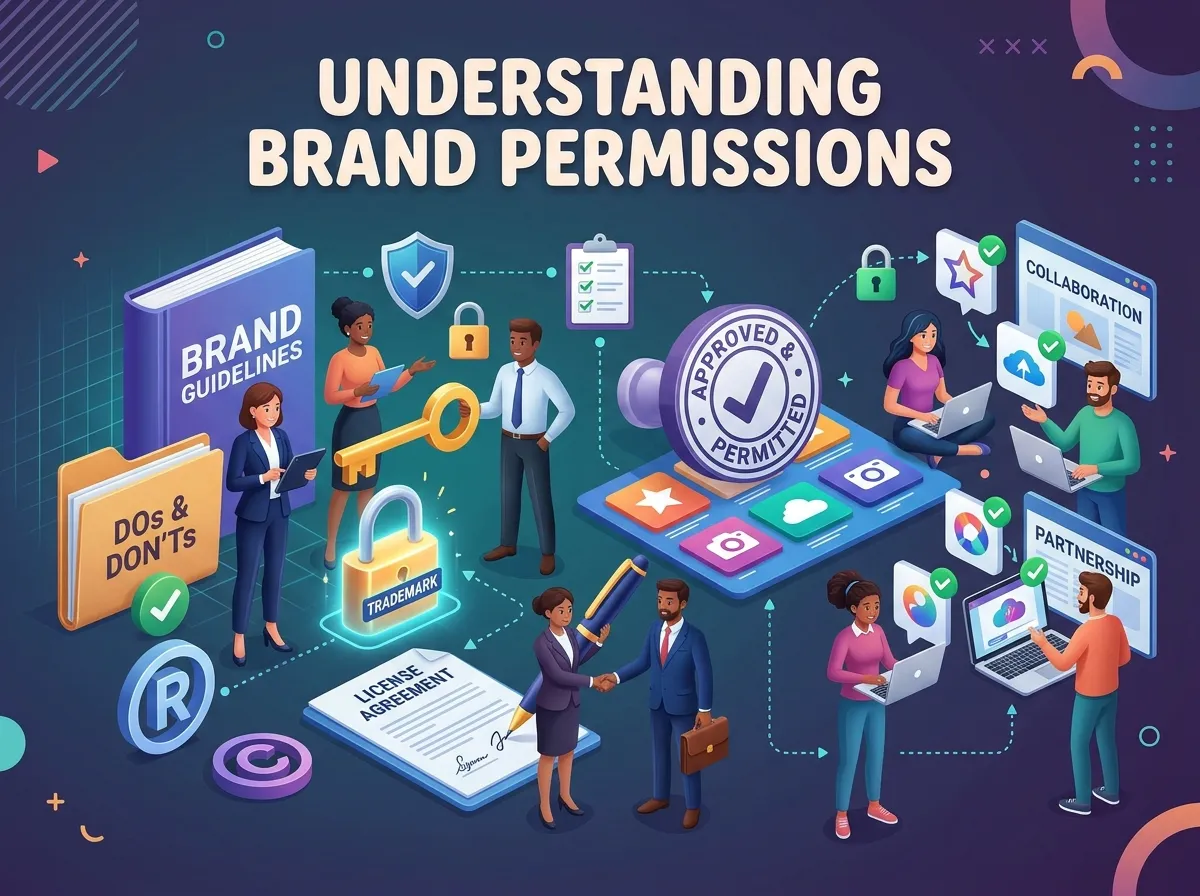
Brand permissions refer to the formal or documented authorization that determines how a brand’s identity and related assets may be used. The scope of permission can vary depending on the asset, the intended activity, the parties involved, and the agreement between them.
These permissions may cover a company name, logo, tagline, product photography, advertising materials, brand colors, videos, written content, packaging designs, or other elements associated with the business. They can also establish restrictions on where assets may appear, whether modifications are allowed, and how long the authorization remains valid.
Brand permissions are not identical to ownership. A business may own a trademark or copyright while allowing another organization to use the relevant asset under specific conditions. Similarly, receiving a copy of a logo or access to a shared folder does not automatically grant legal permission to use that material for every purpose.
A clear permission structure helps businesses distinguish between access, authorization, and ownership. Access determines who can retrieve an asset, authorization defines permitted uses, and ownership identifies the rights held by the relevant person or organization. These concepts may overlap, but they serve different functions.
Brand permissions also support consistent communication. When teams understand which assets are approved and what restrictions apply, they are less likely to publish outdated logos, alter brand elements incorrectly, or make unsupported claims about their relationship with the company.
Brand Usage Permissions and Authorized Brand Communication
Brand usage permissions establish how an organization’s identity can be represented in public or private communications. They help businesses determine which individuals, departments, partners, and service providers can use brand elements and for what purposes.
An internal marketing team may have permission to create social media graphics, email campaigns, and website content using approved brand materials. An external agency may receive narrower authorization to develop advertisements for a particular campaign. A distributor may be allowed to use product images and approved descriptions in its online store, subject to the terms of its agreement.
The scope of authorization should reflect the actual business relationship. Permission to use a logo in one advertisement should not automatically imply permission to place it on merchandise, include it in a partnership announcement, or use it to suggest an endorsement that does not exist.
Clear usage permissions also help reduce uncertainty when multiple parties work on the same campaign. Instead of relying on informal conversations, teams can refer to documented terms that explain approved assets, channels, formats, and limitations.
Businesses should review these arrangements when projects change or new channels are introduced. A partner authorized to use brand materials for a short-term campaign may need additional approval before extending that activity. Likewise, permission may need to be withdrawn when a contract ends or a relationship changes.
By defining brand usage permissions clearly, organizations can encourage appropriate collaboration while maintaining control over how their identity appears in the market.
Brand Authorization and Accountability
Brand authorization is the process of granting approval for a specific use of brand assets or identity. It may involve a manager, legal team, brand department, licensing representative, or another person responsible for protecting the organization’s interests.
A reliable authorization process identifies who can approve a request, what information must be provided, and which uses require additional review. A straightforward request to download an approved logo for an internal presentation may need little oversight, while a proposal to place the logo on a partner’s product packaging may require legal, marketing, and commercial review.
This distinction prevents businesses from treating every request as equally risky. It also helps avoid unnecessary delays by allowing routine activities to proceed through established approval channels.
Accountability is another important consideration. Organizations should record who granted authorization, which assets were covered, the approved purpose, and any applicable conditions. These records can help resolve disagreements and clarify responsibilities if a brand asset is used incorrectly.
Authorization should also include appropriate limitations. A business may approve the use of its logo while requiring the partner to preserve its original proportions, maintain sufficient visibility, and avoid placing it alongside misleading claims. Where the use involves regulated products, endorsements, or commercial representations, additional review may be necessary.
A well-managed authorization process protects the brand without making legitimate business activity unnecessarily difficult. It gives teams a clear path to approval and ensures that important decisions are made by people with the appropriate responsibilities.
Brand Licensing Rights and Trademark Usage Rights

Brand licensing rights allow a business or rights holder to authorize another party to use specified intellectual property under agreed conditions. Depending on the arrangement, a license may cover a trademark, copyrighted artwork, product design, character, or other protected asset.
Licensing agreements commonly define the permitted products or services, territory, duration, channels, payment terms, quality requirements, and restrictions. Some licenses are exclusive within a defined scope, while others allow multiple parties to use the same intellectual property under separate agreements.
Trademark usage rights require particular attention because trademarks help distinguish the goods or services of one business from those of another. A company allowing a partner to use its trademark may need to establish standards for presentation, product quality, and public communication to protect the mark’s identity and reputation.
However, a licensing agreement does not necessarily grant unrestricted rights to every brand asset. A company may have permission to use a partner’s trademark but not its photographs, music, written content, or other copyrighted materials. Each relevant right should be considered separately.
Businesses should avoid relying on assumptions about what a license includes. The agreement should clearly define the authorized use and any restrictions, and legal advice may be appropriate when significant intellectual property rights are involved.
Clear licensing terms benefit both parties. The rights holder can protect the brand, while the authorized user gains a better understanding of what it can do without exceeding the agreed scope.
Brand Asset Permissions and Access Control
Brand asset permissions determine who can view, download, edit, share, or publish official brand materials. These assets may include logos, fonts, templates, photography, videos, product images, presentations, and campaign files.
As organizations grow, brand materials are often stored across shared drives, cloud platforms, design applications, and digital asset management systems. Without suitable access controls, employees or external partners may use outdated files, make unauthorized changes, or distribute materials beyond the intended audience.
A role-based approach can help address these problems. Designers may need editing access to approved source files, while sales teams may only need downloadable presentation templates. External agencies may receive access to a specific project folder rather than the entire brand library.
Access control should follow the principle of giving users only the permissions necessary for their work. This reduces the risk of accidental changes and limits exposure of confidential or unreleased assets.
Organizations should also maintain clear version information. If several logo variations or campaign files are available, users need to know which version is current and which uses are approved. Archived assets should be clearly identified to reduce the possibility of outdated materials appearing in public communications.
Permissions should be reviewed when employees change roles, contractors finish assignments, or agency agreements end. Removing unnecessary access is an important part of protecting brand materials over time.
These practices work particularly well when supported by broader brand governance, which establishes responsibilities, standards, and accountability for how the brand is managed throughout the organization.
Brand Usage Guidelines and Consistent Presentation
Brand usage guidelines explain how approved assets should be applied in different contexts. They may cover logo placement, colors, typography, spacing, image selection, tone of voice, product descriptions, and rules for representing partnerships.
While brand permissions determine who may use assets and under what conditions, usage guidelines explain how the assets should be used correctly. Both are necessary for maintaining a consistent identity.
For example, an organization may authorize a partner to use its logo but require the logo to remain unaltered, preserve its proportions, and appear against an appropriate background. Guidelines may also prohibit combining the logo with misleading claims or presenting a limited collaboration as a permanent endorsement.
Clear documentation makes these expectations easier to follow. Approved logo files, sample layouts, downloadable templates, and explanations of common restrictions can reduce mistakes and unnecessary requests for clarification.
Guidelines should be accessible to the people who need them. If employees and partners cannot find the latest standards, they may rely on old files or recreate assets from memory. A centralized resource helps ensure that approved materials and instructions remain easy to locate.
The guidelines should also be updated as the brand evolves. A redesign, new product line, or change in positioning may require revised assets and permission terms. Communicating these changes helps prevent outdated branding from continuing to circulate.
When usage guidelines are clear and practical, they support creative work while preserving the visual and verbal consistency that makes a brand recognizable.
Brand Approval Process and Permission Management
A brand approval process establishes how requests to use or modify brand materials are submitted, reviewed, approved, and recorded. It provides a consistent way to evaluate proposed activities without requiring every decision to begin from scratch.
The process may start with a request that identifies the asset, intended purpose, audience, distribution channels, expected publication date, and any relevant commercial relationship. Reviewers can then determine whether the request fits existing permissions or requires additional authorization.
Routine requests can often follow a streamlined process. A partner using an approved logo in a standard co-branded presentation may only need confirmation that the correct template is being used. A new product collaboration, major advertising campaign, or public endorsement may require additional legal and brand review.
Brand permission management keeps the resulting decisions organized. Records can include the approved assets, permitted uses, relevant dates, restrictions, responsible parties, and any renewal or review requirements. This creates a reliable reference when questions arise later.
Businesses should also define how urgent requests are handled. A clear escalation path can prevent teams from bypassing approval simply because a deadline is approaching. At the same time, reasonable review timelines help avoid unnecessary delays in marketing and business operations.
The approval process should not become more complicated than the risks require. Excessive bureaucracy can discourage collaboration, while insufficient oversight can expose the brand to inconsistent or unauthorized use. A proportionate process balances speed with accountability.
By connecting approvals with documented permission management, businesses can make decisions more efficiently and maintain a clear record of how their brand assets are used.
Brand Permissions in Partnerships and Personal Branding
Brand permissions become especially important when organizations collaborate with influencers, agencies, sponsors, affiliates, distributors, or other business partners. Each party may have its own identity, audience, contractual obligations, and expectations about how brand materials can be used.
A partnership agreement should clarify whether each party can use the other’s name, logo, images, and campaign content. It should also define the purpose, duration, channels, approval requirements, and any restrictions on editing or reuse. Permission to publish a campaign post, for instance, may not automatically include the right to use that content in paid advertising indefinitely.
These distinctions matter in creator partnerships. An influencer may agree to publish content on a personal account, while the brand may want additional rights to reuse the content on its website or in advertisements. Those rights should be addressed explicitly rather than assumed.
The same principle applies to personal branding. Professionals, consultants, and creators may control their own names, photographs, logos, and original content, but they still need to consider the permissions required when using another company’s brand assets. Clear boundaries help both individuals and businesses represent their relationships accurately.
Collaborations with smaller creators can introduce additional permission considerations. Micro-influencer partnerships may provide relevant audience connections, but agreements should still define content usage, brand representation, disclosure expectations, and approval responsibilities.
Well-defined permissions support smoother partnerships because both parties understand what is authorized and what requires further agreement. They also reduce the risk of disputes when content is reused, campaigns are extended, or relationships come to an end.
Brand Compliance Rules and Responsible Usage
Brand compliance rules establish the standards that authorized users must follow when representing a business. These rules may address trademark use, advertising claims, copyright, confidentiality, endorsements, industry regulations, and internal brand requirements.
Compliance is not limited to preventing unauthorized logo use. A partner may have permission to use the correct logo yet still represent the brand improperly by making unsupported product claims, suggesting an unapproved endorsement, or publishing misleading information.
Businesses should therefore consider both the asset and the context in which it will appear. A campaign may need to follow advertising regulations, platform policies, contractual terms, and disclosure requirements in addition to the company’s own brand guidelines.
Documentation helps make these expectations clear. Permission agreements can identify prohibited uses, explain approval responsibilities, and specify what happens when a user violates the terms. Training and accessible guidance can further reduce accidental mistakes.
Monitoring is also important. Organizations may review public-facing materials, partner campaigns, product listings, and other uses of their identity to identify inconsistencies or potential violations. When a problem is discovered, the response should reflect its seriousness and the relevant contractual or legal obligations.
Not every error indicates deliberate misuse. Some issues may result from outdated files, unclear instructions, or simple misunderstandings. A clear correction process can resolve these problems while preserving productive business relationships.
Consistent compliance practices help businesses protect their reputation, maintain trustworthy partnerships, and ensure that brand representation remains aligned with organizational standards.
Data-Driven Personalization and Brand Permission Management

Businesses increasingly use customer information to tailor marketing messages, product recommendations, and digital experiences. Although personalization can make communications more relevant, it must be handled responsibly and kept distinct from permission to use brand assets.
Data-driven personalization focuses on using appropriate information to deliver experiences that better reflect customer needs and preferences. Brand permission management, by contrast, determines how a company’s identity and assets may be used by authorized people or organizations. The two areas intersect when personalized campaigns involve partner content, branded templates, customer-facing materials, or shared marketing platforms.
For example, a business may authorize an agency to create personalized email campaigns using approved brand templates. That authorization should clarify the agency’s access to the relevant materials and define how the brand must be represented. Separately, the handling of customer data should follow applicable privacy laws, consent requirements, and contractual obligations.
Access to a shared marketing platform should not automatically grant unrestricted rights to modify official brand assets. Likewise, permission to use a logo does not grant permission to access confidential customer information. These rights should be managed according to their different purposes.
Clear boundaries reduce the risk of accidental disclosure, unauthorized publication, and inconsistent branding. They also help businesses assign responsibility when several teams or external partners work together on the same campaign.
When brand permissions, data governance, and personalization practices are coordinated appropriately, companies can deliver relevant experiences while maintaining accountability and protecting their identity.
Conclusion
Brand permissions help businesses control how their names, logos, trademarks, creative materials, and other identity assets are accessed and used. Clear authorization, licensing terms, access controls, and approval procedures reduce uncertainty while supporting consistent communication across internal teams and external partnerships.
Effective permission management requires more than deciding who can download a logo. Businesses must define the scope of permitted use, communicate practical guidelines, maintain accurate records, and review access when roles or relationships change. They should also distinguish brand asset permissions from ownership rights, customer data access, and other legal obligations.
By combining brand usage permissions with governance, compliance, and regular oversight, organizations can protect their identity without creating unnecessary barriers to collaboration. A well-managed system helps employees and partners work confidently while ensuring that brand representation remains accurate, consistent, and aligned with business objectives.
Frequently Asked Questions
1. What are brand permissions?
Brand permissions are authorizations that define how individuals or organizations can access, reproduce, modify, or use a company’s brand assets under specified conditions.
2. Why are brand permissions important?
They help protect intellectual property, prevent unauthorized usage, maintain consistent branding, clarify responsibilities, and reduce potential legal or reputational risks.
3. What is the difference between brand permission and brand ownership?
Brand ownership refers to the rights held by the owner of an asset. Brand permission allows another party to use that asset under specific conditions without necessarily transferring ownership.
4. What are brand usage permissions?
Brand usage permissions specify how approved users may use a company’s identity, including its name, logo, images, messaging, and other marketing materials.
5. What are brand licensing rights?
Brand licensing rights allow an authorized party to use specified intellectual property under an agreement that defines the scope, duration, territory, and conditions of use.
6. How do brand asset permissions work?
They determine who can view, download, edit, share, or publish brand materials. Businesses can assign different access levels according to each user’s role and responsibilities.
7. What is a brand approval process?
A brand approval process establishes how requests to use or modify brand assets are submitted, reviewed, approved, and documented before the intended activity takes place.
8. How can businesses prevent unauthorized brand usage?
Businesses can use written agreements, clear usage guidelines, access controls, centralized asset libraries, regular monitoring, and documented procedures for reporting and correcting misuse.
9. Do influencers need permission to use a company’s logo?
Influencers generally need appropriate authorization when using a company’s logo or other protected brand assets in ways that require permission. The scope should be agreed upon in advance, especially when content will be reused in paid advertising or other channels.
10. How often should brand permissions be reviewed?
Permissions should be reviewed when contracts expire, projects change, employees or partners change roles, new channels are introduced, or brand assets are updated. Periodic reviews also help identify outdated authorizations and unnecessary access.