
Brand consolidation brings multiple brands, sub-brands, products, or business identities together under a more organized brand structure. It helps organizations reduce duplication, clarify market positioning, improve customer recognition, and use marketing resources more efficiently. A successful brand consolidation strategy requires careful planning, audience research, consistent messaging, and a clear understanding of each brand’s existing value. When managed effectively, consolidation creates a more coherent identity while supporting operational efficiency and sustainable business growth.
Why Businesses Reconsider Their Brand Structure
As businesses expand, their brand portfolios rarely remain simple. New products introduce additional names, acquisitions bring unfamiliar identities, and different departments may develop separate marketing styles. Over time, an organization that once operated under a recognizable identity can end up managing numerous brands with overlapping audiences, inconsistent messaging, and duplicated resources.
This complexity can make it harder for customers to understand what a company offers. Marketing teams may compete for attention, product lines may appear disconnected, and businesses may spend unnecessary resources maintaining several identities that communicate similar benefits. In these situations, brand consolidation offers a way to bring greater clarity to the overall brand structure.
Brand consolidation involves reviewing and combining selected brands, identities, or marketing assets into a more coherent system. Depending on the business, it may involve retiring outdated brand names, merging overlapping product identities, bringing acquired businesses under a parent brand, or standardizing how related brands communicate with customers.
However, consolidation is not simply a matter of replacing several logos with one. Each existing brand may have its own reputation, customer relationships, market recognition, and commercial value. Bringing these identities together requires an understanding of what customers already trust and what the organization wants its unified brand to represent.
The goal is to create a stronger and more manageable brand ecosystem without unnecessarily losing the value built by individual brands. When consolidation is based on clear business objectives and customer insight, it can improve recognition, strengthen positioning, and create a more consistent experience across the organization.
Understanding the Business Case for Brand Consolidation
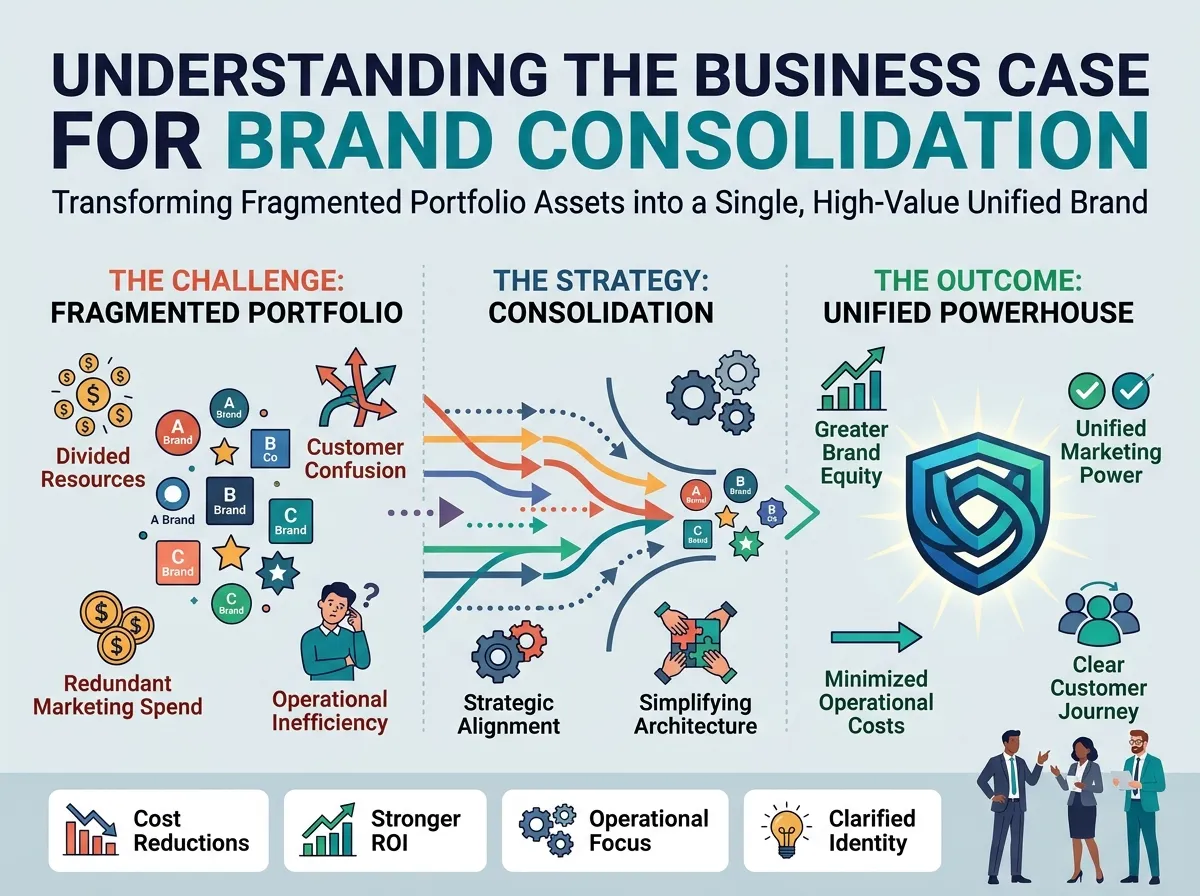
The need for consolidation often becomes visible when a business grows faster than its brand structure can accommodate. Different teams may create separate identities for similar services, while acquired companies continue operating under names that customers struggle to connect with the parent organization.
These arrangements can create hidden costs. Each brand may require its own website, visual identity, promotional materials, social media presence, and communication strategy. Maintaining several overlapping systems can increase workload without producing a corresponding increase in market value.
A fragmented brand portfolio can also weaken customer understanding. When related products use unrelated names and messaging, customers may not recognize the connection between them. This can limit cross-selling opportunities and make the overall business appear less cohesive than it actually is.
Brand consolidation provides an opportunity to reassess these structures. A business can identify which brands have distinct market value, which serve similar purposes, and which no longer support its wider objectives. The result may be a simplified portfolio, a stronger parent brand, or a clearer relationship between the corporate identity and individual product brands.
The commercial case should extend beyond reducing the number of logos. Businesses need to consider customer acquisition, brand awareness, internal efficiency, market differentiation, and the long-term costs of maintaining each identity.
For example, retiring a recognizable brand may save administrative effort but damage customer trust if the transition is poorly communicated. Conversely, combining two little-known brands with similar audiences may simplify marketing and make the combined offer easier to understand.
The most effective consolidation decisions balance operational benefits with customer expectations and the existing value of each brand.
Developing a Brand Consolidation Strategy
A successful brand consolidation strategy begins with a clear understanding of the problem the organization is trying to solve. Without a defined objective, consolidation can become a cosmetic exercise that changes names and designs without improving the business’s market position.
Some organizations consolidate to simplify a complicated portfolio. Others want to strengthen their corporate identity after an acquisition, create a consistent customer experience, reduce duplicated marketing expenses, or improve recognition across several markets.
These objectives influence the entire process. A business focused on portfolio simplification may prioritize brands with overlapping audiences and product offerings. An organization seeking stronger corporate recognition may emphasize the parent brand and establish a more visible relationship between its business units and corporate identity.
Customer research is essential during this stage. Existing customers may have strong associations with a particular brand, even if management considers it outdated. Research can reveal which names carry trust, which identities cause confusion, and whether customers understand the relationship between different products or services.
Internal perspectives also matter. Sales teams, customer support employees, marketing professionals, and business leaders often see different aspects of the brand experience. Their insights can help identify practical issues that may not be apparent from an executive-level portfolio review.
The strategy should establish what the consolidated brand is expected to achieve and how progress will be evaluated. Possible measures include brand recognition, customer retention, marketing efficiency, website engagement, cross-product adoption, and customer understanding of the combined offer.
With these objectives in place, consolidation becomes a business decision supported by evidence rather than a design preference.
Brand Portfolio Consolidation and the Value of Each Identity
A company’s brand portfolio may contain corporate brands, product brands, acquired identities, regional brands, and specialized service names. Each can serve a different purpose, so reducing the number of brands is not automatically the best outcome.
Brand portfolio consolidation requires examining how these identities relate to one another and whether their individual roles remain commercially useful.
Some brands may have similar audiences, overlapping product ranges, or nearly identical positioning. Combining them could create a clearer offer and reduce unnecessary duplication. Other brands may serve distinct customer groups or occupy carefully established market positions. Keeping these identities separate may protect valuable differentiation.
A portfolio review should consider customer recognition, market performance, strategic relevance, operational costs, and the strength of each brand’s reputation. Businesses should also examine whether customers purchase a product because of the corporate brand, a specialist product identity, or a combination of both.
The findings may lead to several outcomes. A business might retain a strong standalone brand, reposition another under the corporate identity, merge two overlapping identities, or discontinue a name that no longer supports its strategy.
This process is closely connected to brand portfolio management, which considers how brands work together to support the organization’s wider commercial objectives. A well-managed portfolio avoids unnecessary competition between related brands while preserving identities that provide meaningful market value.
The result should be a portfolio with clear roles. Customers should understand what each brand represents, how the offerings differ, and where the organization provides connected products or services.
Managing Brand Mergers Without Losing Customer Trust
Brand merger management becomes particularly important when businesses combine through acquisitions, mergers, or strategic partnerships. Each organization may bring its own reputation, customer relationships, visual identity, and communication style.
Although the corporate structure may change quickly, customer perceptions do not change automatically. Customers of an acquired business may value its established name and worry that the merger will alter the quality, service, or expertise they have come to expect.
A poorly managed transition can create uncertainty. Customers may not know which company is responsible for their account, whether existing contracts remain valid, or where they should seek support. Employees can experience similar confusion when internal communications fail to explain the new structure.
Effective brand merger management connects the business transaction with the customer experience. The organization needs to decide whether the acquired brand will remain independent, operate as an endorsed brand, gradually transition to the parent identity, or disappear into a fully unified brand.
The right choice depends on the strength of each identity and the strategic purpose of the merger. A recognized specialist brand may continue to provide value within a larger corporate portfolio. A smaller brand with limited recognition and substantial overlap may be better suited to a gradual transition.
Communication should explain what is changing and what is staying the same. Customers need clear information about product names, service arrangements, support channels, and the benefits of the combined organization.
Employees should also understand the reasoning behind the new brand structure. When internal teams can explain the change consistently, customers are more likely to receive clear and reassuring messages.
Brand mergers succeed when the combined organization respects existing relationships while establishing a convincing reason for customers to embrace the new identity.
The Brand Integration Process: From Decisions to Implementation
Brand integration turns consolidation decisions into practical changes across the organization. It connects strategy, design, communication, technology, and customer-facing operations so that the new brand structure works consistently in real situations.
The process often begins with an inventory of existing brand assets. This may include websites, domain names, logos, product packaging, sales materials, social media accounts, customer communications, internal templates, and advertising campaigns. The inventory helps teams understand the full scope of the transition.
Once the new structure has been approved, each affected asset needs a defined treatment. Some materials may require immediate updates, while others can transition over time. Customer-facing assets generally deserve careful attention because outdated information can create confusion or reduce confidence.
Digital properties may require particular coordination. Website redirects, page titles, metadata, branded email addresses, analytics configurations, and search visibility can all be affected by a change in brand identity. A rushed transition may lead to broken links, inconsistent search results, or the loss of useful information for existing customers.
The integration process should also address the experience behind the visual identity. If a company promises a unified brand but continues providing disconnected support systems, inconsistent service policies, or unrelated customer journeys, the consolidation will feel incomplete.
A well-coordinated transition aligns the brand’s appearance with the way the business actually operates. Marketing, sales, customer service, product teams, and technology specialists need to work from a shared understanding of the new identity.
The process should remain flexible enough to address unexpected issues. Customer feedback, employee observations, and performance data can reveal areas where the transition requires further clarification or adjustment.
Brand Architecture Consolidation and a Clearer Market Position

Brand architecture describes how a company’s corporate identity, product brands, service brands, and sub-brands relate to one another. Consolidating this structure helps organizations establish clearer relationships between the parent company and its individual offerings.
A company may choose a unified structure in which most products use the corporate brand. Another organization may retain distinct product brands while using the parent identity to communicate ownership and credibility. Some businesses adopt a hybrid approach, combining a strong corporate identity with selected standalone brands.
The choice depends on the organization’s audience, product diversity, reputation, and competitive position. A unified structure can simplify communication and strengthen corporate recognition. A more differentiated structure may be appropriate when products serve substantially different markets or require distinct positioning.
The key is to avoid unnecessary complexity. If customers cannot understand why two brands exist or how their offerings differ, the organization may be spending resources maintaining distinctions that provide little value.
Consolidation can also help clarify positioning. When overlapping brands are brought together, the business can communicate a more consistent value proposition and make the relationship between its products easier to understand.
Brand positioning should guide these decisions rather than follow them as an afterthought. The consolidated identity needs a clear place in the market, a meaningful promise to customers, and a credible distinction from competitors. Businesses can strengthen this work by reviewing their Brand Positioning to ensure that the new structure communicates a focused and relevant value proposition.
A strong brand architecture makes the portfolio easier to navigate internally and externally. It gives employees a clearer framework for decisions and helps customers understand the organization as a connected business rather than a collection of unrelated names.
Corporate Brand Consolidation and Internal Alignment
Corporate brand consolidation brings an organization’s business units, divisions, subsidiaries, or regional operations under a more coherent corporate identity. It can be especially useful for companies that have expanded through acquisitions or developed separate identities across different markets.
A unified corporate brand can strengthen recognition and make the organization’s overall capabilities more visible. Instead of requiring customers to understand several unrelated company names, the business can present a clearer picture of its expertise, services, and values.
However, corporate consolidation requires more than a common logo. Different divisions may have established cultures, operational processes, customer expectations, and communication habits. A new identity will not create genuine unity if the organization continues to behave inconsistently.
Internal alignment is therefore essential. Employees need to understand the purpose of the consolidated brand and how their work contributes to the experience it promises. Leadership communication, internal training, shared messaging, and clear brand ownership can support this transition.
The company should also determine which decisions are centralized and which remain with individual business units. A corporate team may control core identity standards while allowing local teams to adapt communications to their markets. This balance protects consistency without removing useful flexibility.
Corporate brand consolidation is most effective when it reflects a real organizational relationship. The shared identity should represent common standards, connected capabilities, and a coherent customer promise rather than simply placing different divisions under the same visual design.
Brand Identity Integration: Creating Consistency Without Erasing Difference
Brand identity integration brings visual and verbal elements into a coordinated system. It may involve logos, colors, typography, photography, messaging, tone of voice, product naming, and the way the company describes its value.
During consolidation, businesses must decide which elements should remain consistent and where differences are still meaningful. Applying one identity to every product can improve recognition, but excessive uniformity may make specialized offerings harder to distinguish.
The goal is to establish recognizable common elements while preserving the information customers need to choose between products and services. A unified visual system can support consistency, while descriptive product names, category labels, or distinct supporting messages help customers understand individual offerings.
Brand standards play an important role in this work. They define how the consolidated identity should be applied across websites, advertising, packaging, presentations, and other customer touchpoints. Clear Brand Standards help teams use approved assets and communicate consistently without needing to reinterpret the brand on every project.
Identity integration should also consider accessibility and usability. Visual consistency is valuable only when customers can easily read information, recognize important actions, and navigate the experience. Brand elements should support communication rather than make interfaces or materials more difficult to use.
A consistent identity is reinforced through repetition. Customers gradually become familiar with a brand when they encounter the same recognizable signals across relevant interactions. That familiarity can strengthen recognition and help the consolidated business establish a clearer presence in its market.
The Customer Experience During Brand Consolidation
Customers experience a brand through more than advertising and design. They encounter it when searching for information, using a website, purchasing a product, contacting support, receiving an invoice, or requesting assistance.
Brand consolidation can disrupt these experiences if the transition focuses only on external communication. A new logo may appear across the website while account systems remain separate, support instructions become outdated, or customers are redirected to unfamiliar services without explanation.
The consolidation should therefore be evaluated from the customer’s perspective. Customers need to understand what the new identity means for their existing relationship and whether the change brings practical benefits.
This is where User Experience and Branding becomes particularly relevant. A unified identity should make interactions easier to recognize and navigate, not simply make every touchpoint look similar.
Customer feedback can reveal whether the transition is working. Questions about product names, support arrangements, or company ownership may indicate that communication needs improvement. Changes in retention, satisfaction, website engagement, and service inquiries can provide further evidence of how customers are responding.
Brand consolidation can also strengthen relationships by making the organization feel more connected. When customers can move between related services with fewer obstacles and a clearer understanding of the company behind them, the unified brand becomes a practical benefit rather than a cosmetic change.
Brand Unification Strategy and Long-Term Growth
A brand unification strategy establishes how the organization will maintain a coherent identity after the initial consolidation is complete. Without continued oversight, separate departments may gradually introduce new naming conventions, inconsistent visual elements, or independent communication practices that recreate the original fragmentation.
Long-term unification requires clear ownership. Organizations should identify who approves brand changes, maintains shared assets, reviews new product names, and ensures that regional teams follow the agreed structure. These responsibilities need to be practical enough to support daily operations.
Brand unification should not eliminate every difference between products or audiences. The organization may still need distinct messaging for different customer segments, local markets, or specialist services. The important distinction is between purposeful variation and unnecessary inconsistency.
Customer communities can also support a unified brand. When people understand the shared values and benefits that connect a company’s offerings, they may develop a stronger relationship with the organization as a whole. This is relevant to Building Brand Communities, where consistent experiences and shared identity help customers feel connected to a brand.
Over time, a unified portfolio can make new product launches easier to manage, improve cross-promotion, and reduce the effort required to maintain unrelated marketing systems. It can also create a stronger foundation for future acquisitions and expansion.
The lasting value comes from maintaining a clear relationship between the brand structure, the company’s strategy, and the experience delivered to customers.
Measuring Whether Brand Consolidation Is Working
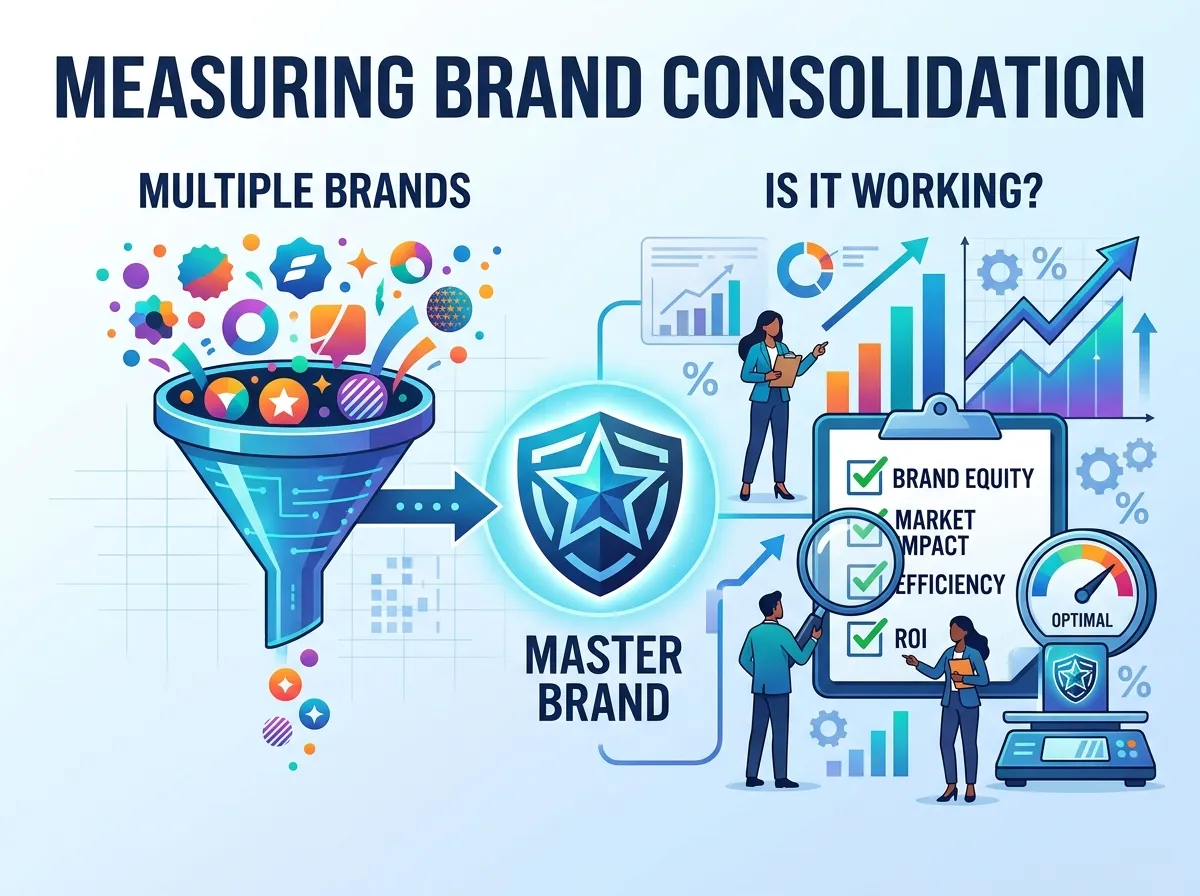
The results of consolidation should be evaluated against the objectives established at the beginning. A reduction in the number of brands may indicate that the portfolio has become simpler, but it does not prove that customers understand the new structure or that the business is performing better.
Useful measures can include brand recognition, customer retention, awareness of the parent company, cross-product adoption, marketing costs, website engagement, and the frequency of customer confusion about product or company names.
Operational measures can reveal whether consolidation has reduced duplicated work. For example, teams may track the time required to create campaign materials, the number of separate assets maintained, or the cost of supporting overlapping websites and communication systems.
Customer feedback should remain part of the evaluation. Research and support inquiries can show whether people understand the new identity, recognize the relationship between products, and feel confident that existing services remain reliable.
Results should be assessed over an appropriate period. Brand perception and customer habits may take time to adjust, especially when a previously established name is retired. Short-term uncertainty does not always indicate failure, but persistent confusion or declining customer confidence may signal that changes are needed.
Regular reviews allow organizations to refine messaging, improve transition processes, and preserve distinctions that customers still value. This makes brand consolidation an ongoing strategic responsibility rather than a one-time rebranding project.
Conclusion
Brand consolidation helps organizations bring their identities, products, and business units into a clearer and more manageable structure. By addressing overlapping brands, strengthening corporate recognition, and improving consistency, businesses can make their offerings easier to understand and their marketing activities more efficient.
Successful consolidation depends on more than visual changes. It requires careful portfolio evaluation, customer research, thoughtful brand architecture, coordinated implementation, and consistent communication. Businesses must also protect the value of established brands and recognize when maintaining a distinct identity is more beneficial than merging it.
When supported by clear objectives and long-term oversight, brand consolidation can improve customer understanding, strengthen internal alignment, and create a more coherent foundation for growth. The strongest result is not necessarily the fewest brands, but a portfolio in which every identity has a clear purpose and contributes meaningfully to the organization’s overall strategy.
Frequently Asked Questions
1. What is brand consolidation?
Brand consolidation is the process of combining or simplifying multiple brand identities, product brands, or business names into a more organized structure. Its purpose is to improve clarity, consistency, efficiency, and strategic alignment.
2. Why is brand consolidation important?
It can reduce duplicated marketing work, strengthen corporate recognition, clarify product relationships, and make it easier for customers to understand what a business offers. Its value depends on how well the new structure meets business and customer needs.
3. What is a brand consolidation strategy?
A brand consolidation strategy defines why a business needs to simplify its brand portfolio, which identities should be combined or retained, how the transition will occur, and how the results will be measured.
4. How does brand portfolio consolidation work?
It involves reviewing the organization’s brands according to factors such as customer recognition, market positioning, performance, strategic relevance, and operating costs. The business then decides which brands to retain, merge, reposition, or retire.
5. What is the difference between brand consolidation and rebranding?
Brand consolidation focuses on simplifying or reorganizing multiple brand identities and their relationships. Rebranding changes how a brand is presented or perceived and may involve a new name, visual identity, positioning, or messaging. The two processes can overlap.
6. How does brand consolidation affect customers?
It can make products and services easier to understand and strengthen recognition of the company behind them. However, unclear communication or poorly managed transitions can create confusion, so customer needs should influence consolidation decisions.
7. What is brand architecture consolidation?
Brand architecture consolidation reorganizes the relationships between a corporate brand, product brands, sub-brands, and business units. It creates a clearer structure for how these identities are presented and managed.
8. What challenges can occur during brand consolidation?
Common challenges include losing existing brand recognition, confusing customers, aligning employees, integrating digital assets, coordinating departments, and managing the costs of transition. Research and careful planning help reduce these risks.
9. How can businesses measure brand consolidation success?
Businesses can evaluate brand awareness, customer retention, customer understanding, cross-product adoption, marketing efficiency, operational costs, and feedback. Measures should match the original goals of consolidation.
10. Does brand consolidation mean eliminating all separate brands?
No. Some brands have distinct audiences, reputations, or market positions that justify keeping them separate. Effective consolidation simplifies unnecessary complexity while preserving identities that continue to provide meaningful value.